ENEnglish
 LTLietuviškai
 DEDeutsch
 FRFrançais
 RUРусский
 ESEspañol
 PLPolski
 ITItaliano
 UKУкраїнська
 CSČeština
 PTPortuguês
 JA日本語
JA日本語 LVLatviešu valoda
 ETEesti
 HUMagyar
 IDBahasa Indonesia
 TRTürkçe
 HIहिन्दी
 ELΕλληνικά
 ARالعربية
 THไทย
THไทย VITiếng Việt
 RORomână
 MSBahasa Melayu
 BNবাংলা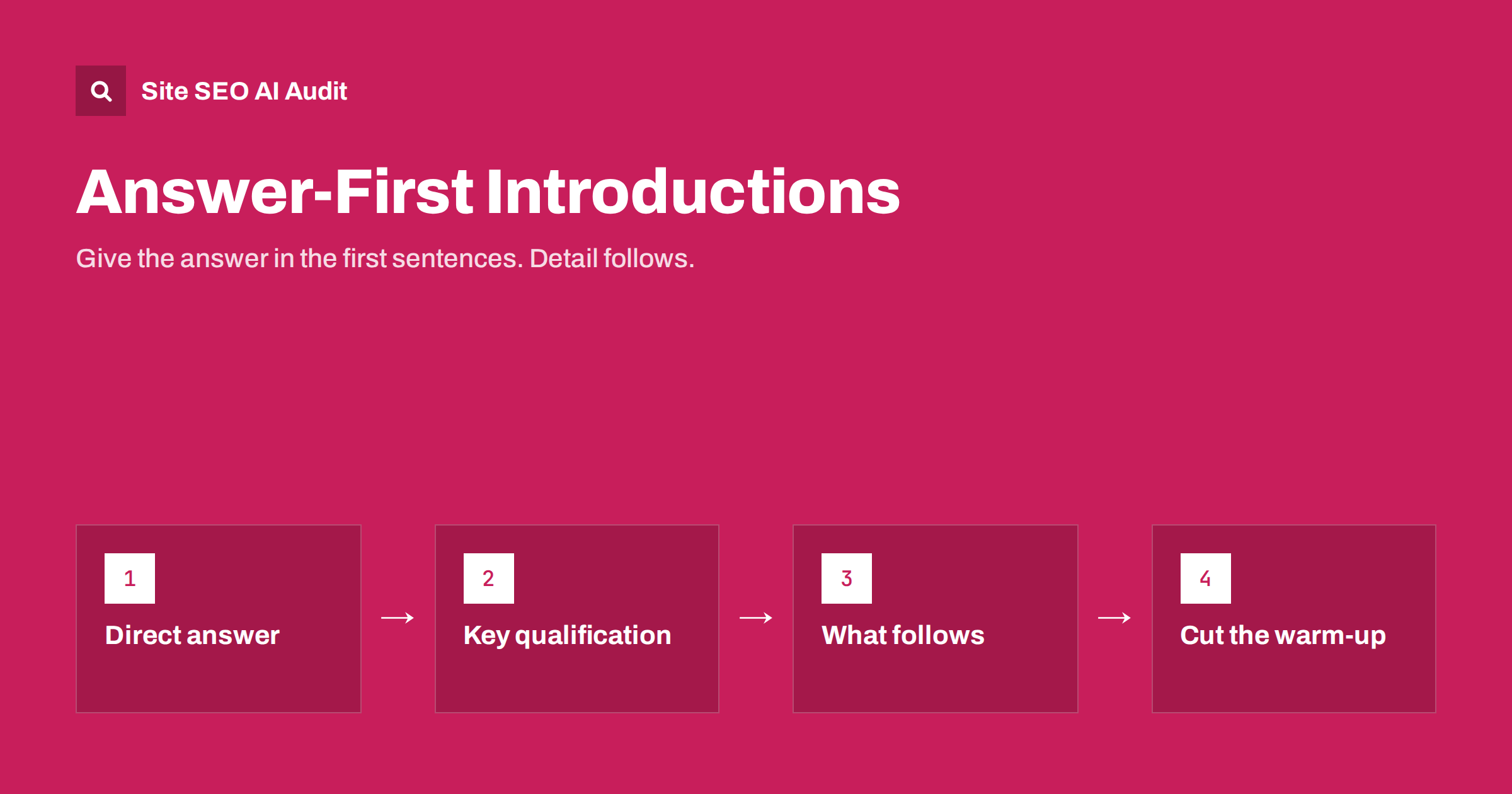
Short answer: An answer-first introduction gives the reader the direct answer to their question in the first two to four sentences, then explains what the rest of the page adds. It works because most visitors decide within seconds whether a page is worth their time, and because search features and AI answers look for clear, self-contained passages to quote. Cut the warm-up, state the answer plainly, and let the detail follow.
Why introductions matter so much
The introduction is the part of a page that almost every visitor reads. Headings are scanned, lists are skimmed, the middle of a long article is often skipped, but the first lines are where people decide whether they are in the right place. If those lines are a slow warm-up, a large share of visitors will go back to the search results and choose another page.
That matters for search in two ways. First, pages that consistently fail to satisfy the people who click them are unlikely to keep strong positions over time. Second, search features such as featured snippets and AI-generated answers look for short passages that answer a question directly. An introduction that answers first is exactly such a passage. An introduction that circles the topic for three paragraphs is not.
The good news is that fixing introductions is one of the fastest on-page improvements available. It usually means deleting words, not adding them.
The problem with traditional introductions
Many web pages still follow the essay format taught at school: set the scene, explain why the topic matters, preview the structure, and only then begin. On the web that format works against the reader. Common patterns that delay the answer:
- The history lesson: “Since the early days of the internet, website owners have wondered…”
- The obvious statement: “In today’s digital world, having a website is more important than ever.”
- The rhetorical question stack: “Have you ever wondered…? Are you struggling with…? Do you want to…?”
- The self-introduction: “At Brandname, we have been helping customers for many years, and we are often asked…”
- The table-of-contents paragraph: “In this article, we will first look at…, then explore…, and finally discuss…”
These openings usually come from good intentions: wanting to sound friendly, to establish authority, or to prepare the reader. But on the web the reader has already prepared themselves by typing a question. They want the reply.
None of these tell the reader anything they came for. Each one pushes the answer further down the page, below the first screen on a phone.
The answer-first structure
A strong introduction for most informational pages has three short parts:
- The direct answer. One to three sentences that answer the main question as plainly as possible. If the answer is a number, give the number. If it is a method, summarize the method. If it depends, say on what.
- The key qualification. One sentence on the most important exception, condition or trade-off, so the short answer is not misleading.
- What the rest of the page adds. One sentence telling the reader what they will get by continuing: steps, examples, a checklist, a comparison.
For example, for “how long should a meta description be”:
“Aim for about 120 to 160 characters. Search engines cut descriptions by display width rather than a fixed count, so put the essential information in the first 110 characters or so. Below you will find a simple formula, examples for different page types and templates for large sites.”
A reader who only needed the number has it in the first sentence. A reader who wants to do the job properly knows exactly why to keep reading.
Examples: before and after
| Question | Slow opening | Answer-first opening |
|---|---|---|
| How often should I replace running shoes? | “Running shoes are one of the most important purchases a runner makes…” | “Most running shoes last roughly 500 to 800 km, depending on your weight, running surface and the shoe’s construction.” |
| What is a canonical tag? | “SEO has many technical terms, and canonical tags are one of the most confusing…” | “A canonical tag is a line of HTML that tells search engines which URL is the main version of a page when several URLs show the same content.” |
| Do I need to register for VAT as a freelancer? | “Taxes can be a stressful topic for many freelancers…” | “It depends on your country and your turnover: most countries require VAT registration once your sales pass a set threshold within a period. Below we explain how to check yours.” |
Answer-first for different page types
The principle adapts to every kind of page, not just articles:
- Service pages: state what you do, for whom and where, and the key fact a buyer needs, such as availability or how pricing works. “We repair boilers across Leeds, usually the same day. Call-out is a fixed fee; parts are quoted before work starts.”
- Product pages: the first lines of the description should say what the product is and who it is for, before brand stories or materials.
- Category pages: one or two sentences on what the category includes and how to choose, above the products.
- Comparison pages: the verdict first, with the main reason, then the detailed comparison.
- Help and FAQ pages: the answer immediately under the question, with steps below.
When “it depends” is the honest answer
Some questions genuinely have no single answer. The temptation is to open with “it depends” and leave it there, which frustrates readers as much as a slow introduction. Instead, say what it depends on, and give the most common case:
- Weak: “The cost of a website depends on many factors.”
- Better: “The cost depends mainly on the number of pages, custom features and who builds it. A simple template-based site typically costs far less than a custom-designed one with online payments; below we break down the main cost drivers.”
Readers accept that some answers are conditional. What they do not accept is being made to read the whole page to find out what the conditions are.
How answer-first helps search features and AI answers
Featured snippets, “People also ask” answers and AI-generated summaries all rely on finding a passage that answers a question clearly and can be understood on its own. An answer-first introduction, and answer-first sections under question headings, give search engines precisely that.
A few details make these passages easier to use:
- Name the subject in the answer itself: “A canonical tag is…” rather than “It is…”.
- Avoid references to other parts of the page such as “as explained below”.
- Keep the core answer to a few sentences; add nuance in the following paragraph.
- Use the same structure under each question heading throughout the page.
None of this guarantees your page will be quoted. It removes the structural reasons for being passed over.
How to rewrite existing introductions
You can improve introductions across a site quickly, starting with the pages that get the most impressions:
- Write down, in one sentence, the question the page answers.
- Find where the page actually answers it. Often it is in the third paragraph or the second section.
- Move that answer to the top and tighten it to two or three sentences.
- Delete the warm-up sentences that come before it. Keep any genuinely useful context and move it after the answer.
- Add one sentence on what the rest of the page offers.
- Read the new opening on a phone. The answer should be visible on the first screen without scrolling past banners.
Structural issues that often come with weak openings, such as missing H1s and thin pages, can be found across a site with a crawl. Site SEO AI Audit checks those on every page, and its AI visibility area looks at whether content is structured in a way AI answers can quote. See the plans, or start with a free first audit.
Related reading
- Readability and SEO: How to Write Pages People Finish
- Featured Snippets: How to Structure Content to Win Them
- How to Write Content That AI Answers Actually Quote
The bottom line
Open every page with the answer. State it plainly in the first two or three sentences, add the most important qualification, and tell the reader what the rest of the page adds. Cut history lessons, obvious statements and rhetorical questions. Apply the same approach to service, product and category pages, and under every question heading. It is one of the quickest ways to make pages more useful to readers, search features and AI answers alike.
FAQ
How long should an introduction be?
Usually two to four sentences for the core answer, plus one sentence on what follows. Longer context can come after the answer, not before it.
Won’t people leave if I give the answer straight away?
Some will, satisfied, which is fine: they got what they needed and are more likely to trust your site next time. Readers who need more will continue because the rest of the page promises the detail they want.
Does answer-first work for sales pages?
Yes. The “answer” on a service or product page is what you offer, for whom and the key fact a buyer needs. Stating that clearly helps the right visitors recognize they are in the right place.
Should the introduction include the main keyword?
Usually it will, naturally, because answering the question means naming the subject. There is no need to force the exact phrase in if it reads awkwardly.
Is answer-first the same as the inverted pyramid?
Very close. The inverted pyramid is the journalistic principle of putting the most important information first and details after. Answer-first applies it to web pages that respond to a search question.