ENEnglish
 LTLietuviškai
 DEDeutsch
 FRFrançais
 RUРусский
 ESEspañol
 PLPolski
 ITItaliano
 UKУкраїнська
 CSČeština
 PTPortuguês
 JA日本語
JA日本語 LVLatviešu valoda
 ETEesti
 HUMagyar
 IDBahasa Indonesia
 TRTürkçe
 HIहिन्दी
 ELΕλληνικά
 ARالعربية
 THไทย
THไทย VITiếng Việt
 RORomână
 MSBahasa Melayu
 BNবাংলা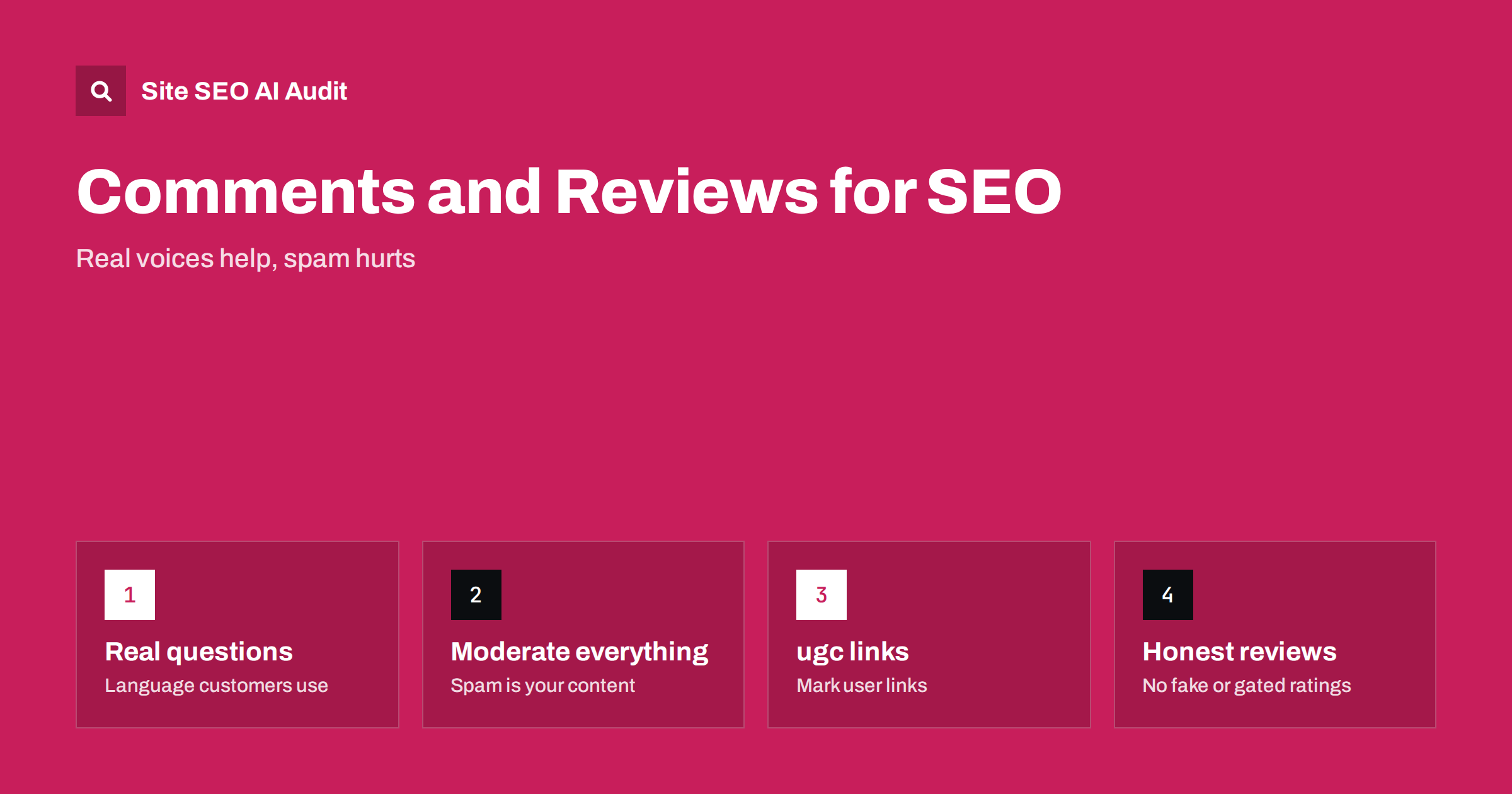
Short answer: Comments and user reviews can help SEO because they add genuine questions, experiences and wording that searchers use, keep pages useful and build trust with visitors. Search engines treat them as part of your page, so their quality is your responsibility: unmoderated spam, off-topic threads and fake reviews can weaken the page and, in serious cases, lead to a manual action for user-generated spam. Moderate everything, mark user links with rel="ugc" or nofollow, make sure the content loads in HTML, and only use review markup for real reviews shown on the page.
Many sites switched comments off years ago because of spam, and many shops hide reviews behind widgets that search engines cannot see. Others keep thousands of old comments full of “great post!” and links to dubious sites. Neither extreme is ideal. User content is valuable when it is real, relevant and moderated, and a liability when it is not.
How search engines treat user content
When comments or reviews are part of the HTML of a page, search engines generally consider them part of that page’s content. They are indexed with it, can match search queries and contribute to what the page is understood to be about. Google has said that it treats comments as part of the page and that site owners are responsible for what appears there.
That has two consequences. Good user content can make a page more complete and more relevant. Bad user content, such as spam, abuse or off-topic noise, lowers the quality of the page, and links in it reflect on your site unless they are marked properly. Google’s spam policies include user-generated spam as a reason for manual action.
Where comments and reviews help
- Real questions and answers. Readers ask what others are wondering too, often in the exact words people type into search. Answering them in the thread adds useful detail that the article may lack.
- Long-tail coverage. Product reviews mention sizes, uses, problems and comparisons that a product description does not, which helps the page match specific searches. Our guide to long-tail keywords explains why these phrases matter.
- Freshness and activity. New, relevant comments show that the topic is current and that real people engage with it.
- Trust and conversions. Reviews are one of the main reasons people choose a product or service, independent of rankings.
- Feedback for content updates. Repeated questions in comments show where an article needs to be clearer or longer; see how to refresh old content.
Where they hurt
- Spam. Automated comments with links to unrelated sites, pharmaceutical or gambling keywords, or text in random languages make a page look abandoned and can trigger a manual action.
- Thin, low-value threads. Hundreds of “thanks” and “nice article” comments add length, not value, and can bury the main content.
- Paginated comment pages. Systems that split comments into separate URLs can create many near-duplicate pages with the same article text.
- Slow pages. Heavy third-party comment or review widgets add scripts that slow loading and interaction.
- Fake or incentivised reviews. Reviews written by the business, or only collected from happy customers, mislead users and break the policies of review platforms and, in many countries, consumer law.
A useful test is to read a page’s user content as a first-time visitor would. Does it answer questions, add experience or point out limits that the main text missed? Or is it noise that has to be scrolled past to reach the footer? If most of the thread is noise, the page would be better with fewer comments, or none. For reviews, look at the spread: a product with only five-star reviews and identical wording raises more doubts than one with a realistic mix and specific details. Visitors notice this, and so do the systems that summarise reputation.
The answer can also differ by page type. A practical tutorial with readers asking follow-up questions benefits from comments far more than a news announcement or a product launch post. Many sites therefore keep comments open on guides and how-to articles and close them elsewhere, which keeps moderation manageable without losing the threads that add value.
Moderation rules that work
Moderation is the difference between user content as an asset and as a risk. A practical setup:
- Hold first comments for approval. Approve a new commenter once, then let later comments through automatically, if your system supports it.
- Use spam filtering at the form, such as a spam filter plugin or a challenge that does not annoy humans.
- Remove or limit links in comments. Many sites allow no links at all from new users.
- Close comments on old posts you no longer moderate. Spam tends to target old, forgotten pages.
- Delete low-value comments that add nothing, especially in bulk on older posts. Keeping fewer, better comments is fine.
- Publish a short comment policy so users know what is allowed.
If your site was hit by comment spam in the past, our guide to finding and removing spam pages covers the clean-up.
Links in user content
Links that users add should not pass your site’s ranking signals by default. Google recommends marking them with rel="ugc", and rel="nofollow" is also accepted. Most blogging platforms do this automatically for comment links and author website links; check your theme’s output to be sure. Trusted, long-term contributors can be an exception if you have reviewed their links. Our guide to nofollow, sponsored and UGC links explains the attributes.
Also check user profile pages on forums and communities. Spammers create profiles only for the link in the bio. Noindex profile pages that have no real activity, or require some participation before a profile becomes public.
Make sure search engines can see the content
Many review and comment systems load their content with JavaScript from a third-party service, sometimes inside an iframe. Users see it; search engines may not, or may attribute it to the provider’s domain rather than your page. Check:
- view the page source and search for a phrase from a review or comment; if it is not there, it depends on scripts;
- use the URL Inspection tool and look at the rendered HTML;
- if the content is in an iframe from another domain, it is generally not treated as part of your page.
If reviews are important for a page, prefer a solution that outputs them in the HTML, or at least a summary and the most recent reviews. Our guide to JavaScript SEO basics explains how rendering works. For long comment threads, loading older comments on demand is fine, as long as the most useful ones are in the initial HTML and comment pagination does not create duplicate URLs.
Review markup without trouble
Review and aggregate rating structured data can make product and service results show stars. The rules are strict, and mistakes are common:
| Rule | What it means in practice |
|---|---|
| Reviews must be visible | Marked-up reviews and ratings must appear on the same page |
| Real users only | No reviews written by the business or copied from elsewhere |
| No self-serving reviews of your own business | LocalBusiness and Organization pages cannot show stars from reviews you host about yourself |
| Correct item | The rating refers to the specific product or service on the page |
| Accurate numbers | The rating value and count match what users see |
Breaking these rules can lead to rich results being removed or a manual action for structured data. Our guide to fixing structured data errors covers validation.
Comments, reviews and AI answers
AI search systems also read user content. A question asked and answered clearly in a comment thread can be picked up as a source, and summaries of reviews are often what AI answers say about a product or business. The same principles apply: real, moderated content that is visible in the HTML helps; spam and fake reviews damage trust. Our article on reviews and reputation in AI recommendations goes further into how reputation shapes AI answers.
Check how user content affects your pages
Comment pagination, thin archive pages and slow third-party widgets are site-wide patterns rather than single-page issues. Site SEO AI Audit crawls every page and checks duplicate and thin content, nofollow and empty links, structured data and page weight, ranking each issue by how many pages it affects. The first audit of up to 200 pages is free; paid plans show every affected page and let you re-check after a clean-up.
Related reading
- Thin content: how to find and fix low-value pages
- Product page SEO
- FAQ sections that work for readers and AI answers
The bottom line
User content is part of your page, so treat it like your own content. Keep comments and reviews that add real questions and experience, moderate everything, remove spam and empty threads, mark user links as ugc or nofollow, and make sure the valuable parts are in the HTML. Use review markup only for genuine reviews visible on the page.
الأسئلة الشائعة
Do blog comments help SEO?
They can, when they add relevant questions, answers and experiences that make the page more useful. Search engines treat comments as part of the page, so spam and low-value comments can also lower its quality. Moderation decides which effect wins.
Should I turn off comments on my blog?
If you cannot moderate them, closing comments, at least on older posts, is reasonable. If readers ask genuine questions and you can answer them, comments are worth keeping on posts where discussion adds value.
Should links in comments be nofollow?
Yes. Mark links added by users with rel=”ugc” or rel=”nofollow” so they do not pass your site’s ranking signals. Most blogging platforms do this by default, but check your theme’s output.
Can search engines read reviews loaded by a widget?
Sometimes. Reviews loaded with JavaScript may be rendered, but content inside an iframe from another domain is generally not treated as part of your page. Check the page source and the rendered HTML to see what is available.
Can I add review stars for reviews of my own business?
Not on your own site for LocalBusiness or Organization markup. Google does not show review stars for self-serving reviews a business hosts about itself. Review markup works for products and other items reviewed by real users on the page.