ENEnglish
 LTLietuviškai
 DEDeutsch
 FRFrançais
 RUРусский
 ESEspañol
 PLPolski
 ITItaliano
 UKУкраїнська
 CSČeština
 PTPortuguês
 JA日本語
JA日本語 LVLatviešu valoda
 ETEesti
 HUMagyar
 IDBahasa Indonesia
 TRTürkçe
 HIहिन्दी
 ELΕλληνικά
 ARالعربية
 THไทย
THไทย VITiếng Việt
 RORomână
 MSBahasa Melayu
 BNবাংলা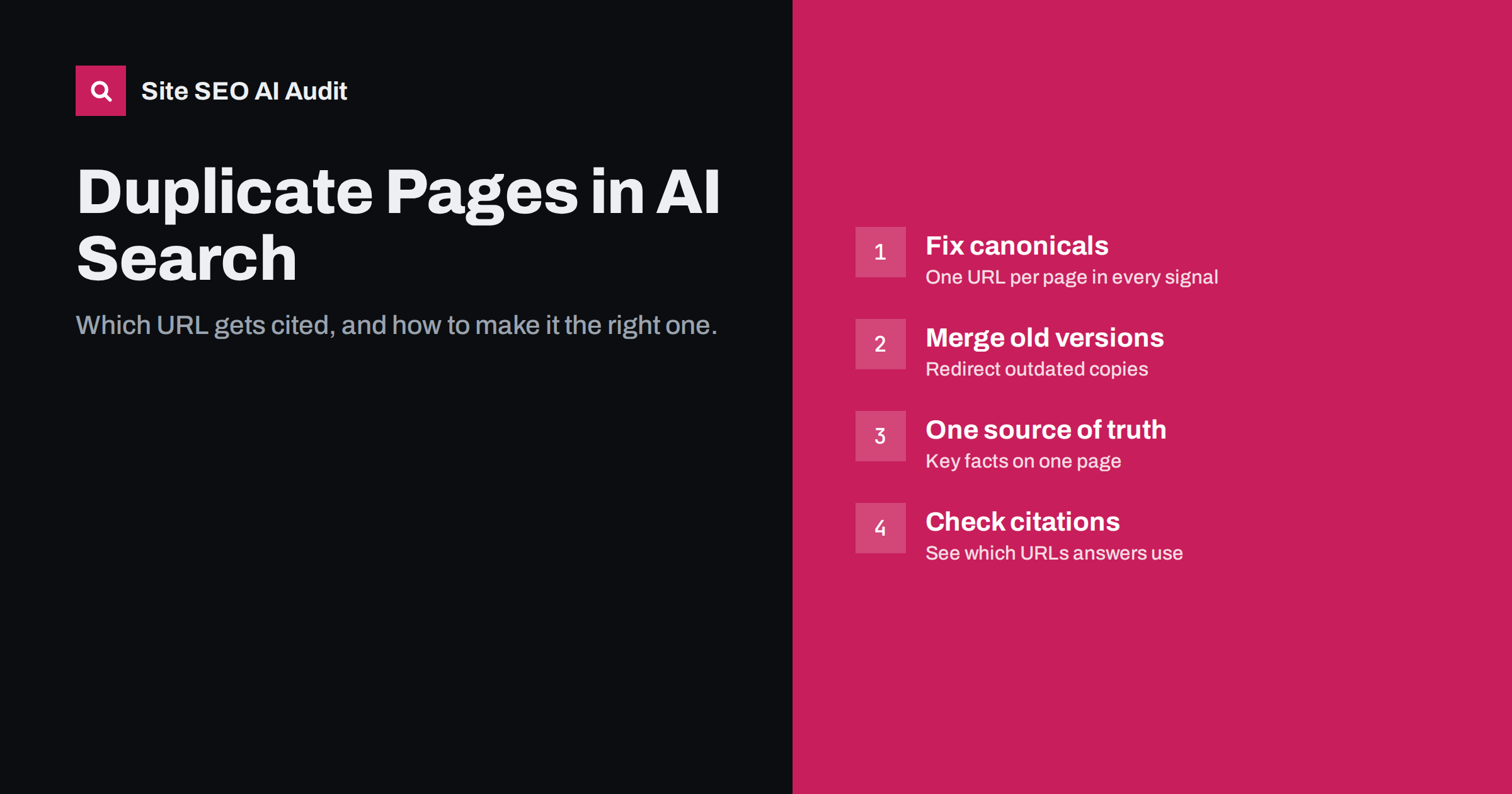
Short answer: AI search tools usually retrieve pages through a search index, so they inherit that index’s choice of canonical URL, and duplicates cause the same problems they cause in classic search, plus some new ones. An answer may cite a parameter URL, a print version, an old copy with outdated prices or a thin variant instead of your best page. Reduce the choice: consolidate near-duplicate pages, set correct canonicals, redirect retired versions, keep one current source for each fact, and make sure the page you want cited is the most complete and clearly dated one.
Why duplicates matter more in AI answers
In classic search, duplicate content mainly wastes crawl effort and splits signals between URLs. Search engines usually pick one version to show, and the visitor sees a list of options anyway.
AI answers narrow the choice to one or a few sources. That raises the stakes:
- The cited URL is the one people click. If it is a stripped-down variant or a page with an outdated offer, the visit starts badly.
- Facts are quoted, not just linked. If an old duplicate says your delivery takes five days and the current page says two, the answer may repeat the wrong figure.
- Conflicting versions reduce confidence. When sources disagree, systems may hedge, mix the facts or pick another site altogether.
- Measurement becomes confusing. Citations spread across several URLs make it hard to see what works.
How AI tools retrieve and choose sources is explained in how AI search engines work.
Where duplicate pages come from
Most duplication is not deliberate. Common sources:
- URL variations: parameters for tracking, sorting or sessions; http and https; www and non-www; trailing slashes; uppercase letters.
- Print, PDF and AMP versions of articles and product sheets.
- Old and new versions of the same content: a 2023 guide and a 2026 guide on the same topic, both live.
- Near-identical landing pages for campaigns, cities or audiences, differing by a few words.
- Staging, test or mirror hosts that became indexable.
- Tag, category and archive pages that repeat full post content.
- Documentation versions: several product versions with largely the same text.
Each of these can put two or more URLs in front of an AI system for the same question. The technical side of parameters is covered in URL parameters and duplicate content.
How canonical choices carry into AI answers
Many AI search tools rely on a web search index to find candidate pages, either their own or a partner’s. Search indexes group duplicates and choose one canonical URL for each group. If the index chose the wrong canonical, the AI answer will often cite the wrong URL too.
So the classic canonical work is the foundation:
- Self-referencing canonicals on every indexable page.
- Canonicals pointing to the main version on true duplicates, such as parameter or print URLs.
- Consistent signals: internal links, sitemaps and hreflang should all use the canonical URL, so the canonical tag is not contradicted.
- Checking the selected canonical in Search Console’s URL Inspection, and in Bing Webmaster Tools, which matters because several AI tools draw on Bing’s index. See why Bing indexing matters for AI search.
The mechanics of the tag itself are covered in canonical tags explained.
Keep in mind that not every AI tool uses a search index in the same way. Some fetch pages directly when a user asks about them, and those fetchers may not apply canonical logic at all. That is another reason to remove true duplicates rather than rely on canonical tags alone.
Old versions: the biggest risk for wrong facts
The most harmful duplicates for AI answers are outdated copies: last year’s pricing page kept for reference, an old guide that was replaced by a new one, a discontinued product that still describes features. They may be well linked and long established, so they can win over the newer page.
Handle them deliberately:
- Find pages on the same topic. Search your own site, check your content inventory and look for similar titles.
- Decide which page is the main one for each topic, usually the most complete and current.
- Merge any unique, still-valid information from the old page into the main page.
- Redirect the old URL to the main page with a 301, so links and signals transfer.
- If the old page must stay (for legal or archival reasons), label it clearly as archived with its date, link to the current version prominently and consider a canonical to the current page if the content is largely the same.
This is the same process as content pruning, described in when merging or removing pages helps, applied with an eye on facts that AI answers might quote.
Near-duplicates and topic overlap
Not all duplication is exact. Several pages that answer the same question in slightly different ways also compete. For classic search this is known as keyword cannibalization. In AI search, it makes it less predictable which page is used and can lead to answers built from the weaker page.
Signs of overlap:
- Several of your URLs receive impressions for the same queries in Search Console.
- AI answers cite different pages of yours for the same question at different times.
- Pages share most of their headings and examples.
The fix is to give each page a clear, distinct purpose, or merge them. A comprehensive page with clear sections usually serves both readers and answer engines better than three partial ones.
One source of truth for key facts
Businesses repeat key facts across many pages: prices, delivery times, opening hours, contact details, product specifications, policies. When one page is updated and others are not, you create conflicting versions within your own site.
- Keep a canonical page for each type of fact, such as a pricing page, a shipping page, a contact page.
- Link to that page from other pages instead of repeating detailed figures everywhere.
- Where facts must be repeated, generate them from one data source (a CMS field, a template variable) rather than typing them by hand.
- Show update dates on pages with time-sensitive facts. Dates help systems prefer the current version, as explained in content dates and freshness.
How to see which URL AI answers cite
You cannot fully control citations, but you can observe them:
- Ask AI search tools the questions your customers ask and note which of your URLs they link to.
- Check AI referral traffic in analytics by landing page. Visits from AI tools arriving on unexpected URLs, such as parameter or old pages, point to duplicate problems.
- Repeat periodically, because answers change.
A structured approach to this tracking is in how to measure brand visibility in AI answers.
A quick consolidation plan
For most sites, one focused round of work removes the bulk of the problem:
- Week 1: technical duplicates. Enforce one protocol and host, one trailing slash style and lowercase URLs with redirects. Add canonicals to parameter, print and filtered URLs, and make sure staging hosts are closed.
- Week 2: content inventory. List pages by topic and mark groups that overlap. Pick the main page for each group.
- Week 3: merge and redirect. Move unique information into the main pages, redirect the rest and update internal links and sitemaps.
- Week 4: facts. Check prices, delivery times, contact details and policies across the site and point everything to one source page.
- Afterwards: monitor. Recrawl, confirm selected canonicals, and repeat your AI citation checks after a few weeks.
Smaller sites can do all of this in a few days; larger sites may need to work section by section.
Finding duplicates at scale
Manual checks catch obvious cases; a crawl finds the rest. Site SEO AI Audit crawls your site like a search engine and reports duplicate titles and descriptions, thin and duplicate content, canonical problems such as canonicals pointing to redirected pages, redirect chains and parameter issues, all weighted by how many pages they affect. Its AI visibility area adds checks on AI crawler access, content that needs JavaScript and the structure and dates answers quote. Paid plans include re-audits to confirm that consolidation worked.
Related reading
- Duplicate title tags and meta descriptions: how to fix them
- When AI gets your business wrong: how to fix it
- Staging site indexed by Google? How to fix and prevent it
The bottom line
AI answers pick one or a few sources, so duplicates on your site decide which URL and which version of your facts people see. Fix canonicals and URL variations, merge and redirect old and overlapping pages, keep one source of truth for key facts and date time-sensitive content. Then check which of your URLs AI tools actually cite, and keep consolidating until it is the page you would choose.
الأسئلة الشائعة
Do AI search tools respect canonical tags?
Indirectly, in many cases. Tools that retrieve pages through a search index inherit the index’s canonical choice. Direct fetchers may not apply canonical logic, so removing true duplicates is safer than relying on the tag alone.
Why does an AI answer cite my old page instead of the new one?
The old page may be better linked, longer established or chosen as canonical. Merge useful content into the new page, redirect the old URL and update internal links to point to the new one.
Is duplicate content a penalty in AI search?
It is not a penalty, but it causes confusion: signals split, the wrong URL may be cited and outdated facts may be quoted.
Should I delete old blog posts that overlap with new ones?
Usually merge and redirect rather than delete. Move any unique, valid information into the main page and redirect the old URL so links and visitors are not lost.
How do I know which of my pages AI answers use?
Ask AI tools typical customer questions and note the cited URLs, and review AI referral traffic by landing page in your analytics. Repeat the checks regularly.