ENEnglish
 LTLietuviškai
 DEDeutsch
 FRFrançais
 RUРусский
 ESEspañol
 PLPolski
 ITItaliano
 UKУкраїнська
 CSČeština
 PTPortuguês
 JA日本語
JA日本語 LVLatviešu valoda
 ETEesti
 HUMagyar
 IDBahasa Indonesia
 TRTürkçe
 HIहिन्दी
 ELΕλληνικά
 ARالعربية
 THไทย
THไทย VITiếng Việt
 RORomână
 MSBahasa Melayu
 BNবাংলা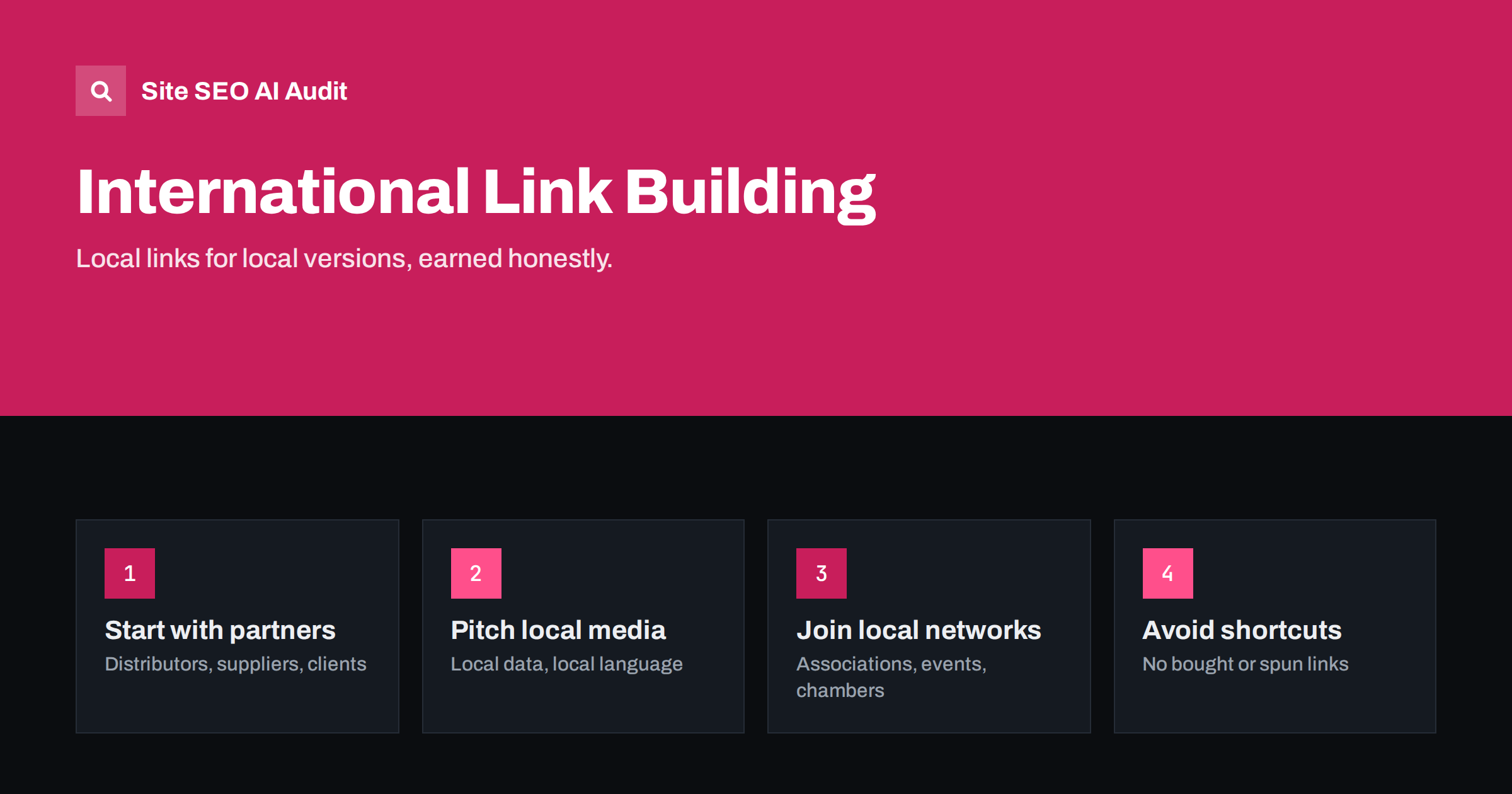
Short answer: international link building means earning links from websites in each target market to the matching language or country version of your site. The best sources are the ones a local business would naturally have: partners and distributors, local industry associations, local media interested in local data or stories, events and community involvement. Links from relevant local sites help search engines see that a version belongs in that market and send visitors who are already in the right country. Buying links or mass-translating guest posts tends to cost more than it returns.
Why links matter differently across markets
Links remain one of the ways search engines discover pages and judge their importance. In international SEO they carry an extra message: where a site belongs. A German version that is linked from German trade associations, German news sites and German customers looks like a real participant in that market. A German version whose only links come from the English site and a handful of US blogs looks like a translation that nobody in Germany uses.
Local links also do something rankings cannot: they send qualified visitors. A link from a regional trade magazine brings readers who already speak the language, pay in the local currency and understand the context. That traffic is valuable regardless of any effect on rankings.
There is also a practical asymmetry. Your home market probably has years of accumulated links, press mentions and partner pages. A new market starts close to zero, so even a modest number of relevant local links can make a visible difference to how quickly the new version is discovered, crawled and trusted. That is why link building deserves a place in every market launch plan, not only in the home market.
Links are not the only local signal, of course. Language, currency, addresses, local reviews and contact details all contribute. Our guide to local trust signals for country versions covers the full set.
How your site structure affects link value
Where links point, and how that value flows, depends on how the international site is built:
| Structure | How link value is shared | What it means for link building |
|---|---|---|
Subfolders (example.com/de/) |
All versions share one domain, so links to any version strengthen the whole site | Easiest to start; links earned by the main version also support new markets |
Subdomains (de.example.com) |
Often treated as closely related but more separate than subfolders | Each version needs more of its own links |
Country domains (example.de) |
Each domain builds its own link profile from scratch | Strong local signal, but every market needs a dedicated link effort |
This is one of the practical reasons many smaller businesses start with subfolders. Our comparison of ccTLDs, subdomains and subfolders covers the trade-offs in more detail. Whatever the structure, point local links to the matching local version, not to the English home page.
Start with relationships you already have
The easiest local links usually come from businesses that already know you in each market:
- Distributors, resellers and agents that list the brands they carry.
- Suppliers and technology partners with “partners” or “customers” pages.
- Local customers who publish case studies, supplier lists or project pages, with their permission.
- Local offices and staff who speak at events, write for trade publications or appear in local directories.
- Integrations and marketplaces with country-specific listings.
Make a list per market of every organisation you work with, check which already mention you, and ask where appropriate for the link to point to the local version of your site. Often the link exists but points to the international home page, and a friendly request fixes it.
Local media and digital PR
Journalists and bloggers write for their audience. A story that works in the UK often needs a different angle in Spain or Poland:
- Local data: if you publish research, break it down by country and offer each market its own figures. “How Polish small businesses handle X” is a story for Polish media; a global average is not.
- Local spokespeople: offer comment from someone in the market, speaking the language, rather than a translated quote from headquarters.
- Local timing: tie stories to local events, holidays, regulations or seasons rather than to your home market’s calendar.
- Native-language pitches: a short, well-written pitch in the local language gets a better hearing than an English e-mail.
Content that earns links in one market often needs to be localised rather than translated. Our article on translation vs localization for SEO explains the difference.
Associations, events and community
Every market has its own networks, and being active in them produces links as a side effect:
- Industry associations and chambers of commerce usually list members, and membership often includes a profile with a link.
- Trade fairs and conferences list exhibitors and speakers on their websites.
- Sponsorships of local events, clubs or causes that genuinely fit your brand. Sponsored links should carry
rel="sponsored"ornofollow, but they still bring visibility and visitors. - Universities and training providers sometimes link to tools or resources used in teaching.
- Quality local directories for your industry, not bulk directory submissions.
For rules on paid and sponsored links, see our guide to nofollow, sponsored and UGC links.
Outreach tips that work across languages
Outreach that works at home can fall flat abroad. A few principles help:
- Use native speakers for pitches and follow-ups. Machine-translated outreach is easy to spot and easy to ignore.
- Respect local norms for formality, titles and how directly you ask for something.
- Offer something local: a resource in their language, a local data point, an expert who can speak at their event.
- Keep anchor text natural. Let the linking site choose its wording; brand names and descriptive phrases in the local language are normal.
- Follow data protection rules when contacting people, especially in the EU, where unsolicited e-mail is regulated.
A simple link plan for a new market
When you launch in a new country, a short plan keeps link building realistic rather than overwhelming:
- Month one: ask existing partners, distributors and customers in that market to link to the new local version, and update any links that point to the international home page. Claim listings in the main local industry directories and association member lists.
- Months two and three: publish one or two pieces of genuinely local content, such as a guide to a local regulation or a breakdown of your data for that country, and pitch them to a short list of relevant local publications.
- Months four to six: pick one or two local events, associations or communities to take part in properly, with a speaker, sponsorship or useful contribution.
- Ongoing: keep a simple sheet of contacts, pitches and links earned per market, and review what worked every quarter.
The numbers will be modest at first. Ten relevant local links earned this way are usually worth more than a hundred bought placements, and they keep working for years because they reflect real relationships.
What to avoid
International link building has its own versions of familiar shortcuts, and they carry the same risks:
- Bought links on local “news” sites that sell articles to anyone. Paid links that pass ranking signals violate search engine spam policies in every language.
- Translated guest posts spread across many sites, often low-quality blogs created to sell placements.
- Link networks of expired local domains redirected or filled with thin content.
- Cross-linking your own country domains heavily in footers to “share” authority. Sensible links between language versions help users; footer link farms do not.
- Ignoring relevance. A link from an unrelated site in the right country is worth far less than one from a relevant site.
Measuring progress per market
Track links per version, not only for the whole site. Useful measures include the number of referring domains pointing to each country or language version, how many of them are from that market, referral traffic by country, and the Links report in Search Console for each version’s property. Our guide to internal linking on multilingual sites helps make sure value from new links flows to important pages within each version.
Links bring crawlers and visitors to your pages, so those pages need to work. Site SEO AI Audit checks every page for broken internal and external links, links to redirects, weakly linked pages and language problems such as missing hreflang return links. Start with a free audit before investing in outreach for a new market.
Related reading
- International SEO for Small Businesses: When It Pays Off
- Anchor Text Best Practices for Internal and External Links
- Outbound Links and SEO: When Linking to Other Sites Helps
The bottom line
Earn links in each market the way a local business would: through partners, associations, local media and community involvement, with content and pitches built for that audience. Point links to the matching local version, keep anchors natural, avoid bought and spun links, and measure progress per market rather than for the site as a whole.
الأسئلة الشائعة
Do links from the same country help international SEO?
They help search engines see that a version belongs in that market and bring visitors from the right country. Relevance to your field still matters more than location alone.
Should links point to the local version or the main domain?
Point them to the local version that matches the linking site’s audience. With subfolders, the whole domain still benefits, but the local pages gain the most direct value.
Do I need separate link building for each ccTLD?
Largely yes. Each country domain builds its own link profile, which is one reason ccTLD setups need more ongoing effort than subfolders on one domain.
Can I translate a guest post and publish it in several countries?
Translating the same article onto many sites adds little value and can look manipulative. Create content that fits each publication and audience, with local examples and data.
Are sponsored links from local events useful?
Yes, for visibility and visitors, even though they should be marked sponsored or nofollow. They also support the impression that you are active in that market.