ENEnglish
 LTLietuviškai
 DEDeutsch
 FRFrançais
 RUРусский
 ESEspañol
 PLPolski
 ITItaliano
 UKУкраїнська
 CSČeština
 PTPortuguês
 JA日本語
JA日本語 LVLatviešu valoda
 ETEesti
 HUMagyar
 IDBahasa Indonesia
 TRTürkçe
 HIहिन्दी
 ELΕλληνικά
 ARالعربية
 THไทย
THไทย VITiếng Việt
 RORomână
 MSBahasa Melayu
 BNবাংলা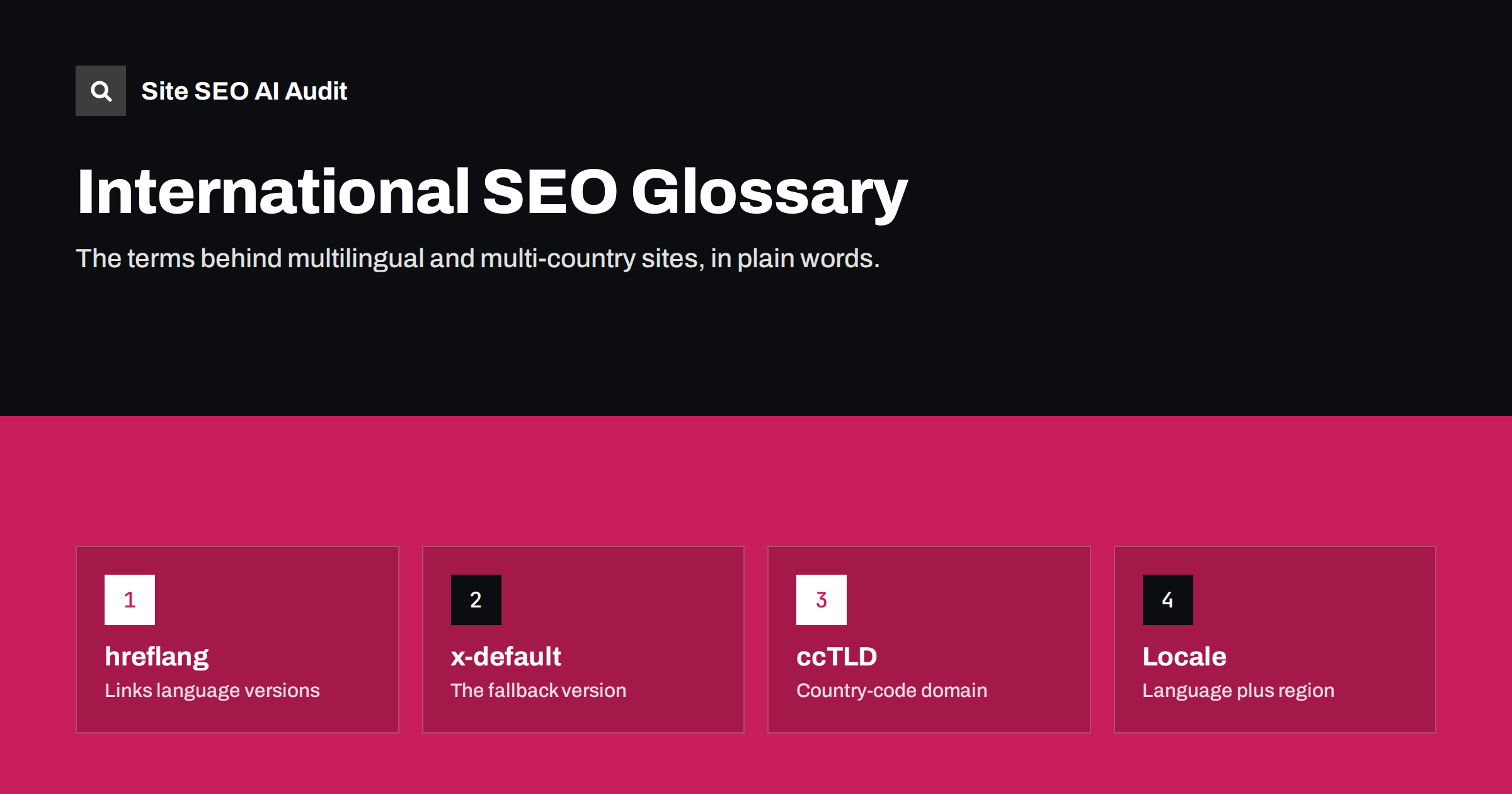
Short answer: International SEO has its own vocabulary: hreflang, x-default, return links, ccTLD, locale, geotargeting, localization and more. Most terms describe one of three things: how language and country versions are structured, how they are connected for search engines, or how content is adapted for each market. This glossary explains each term in plain language, with a note on why it matters in practice.
Site structure terms
Multilingual site. A site that offers content in more than one language, for example English, German and French versions of the same pages. The offer is usually the same for every language; only the language changes.
Multi-regional site. A site with versions for different countries, usually because prices, products, delivery or legal terms differ. Versions may share a language, as with English for the US and the UK.
ccTLD (country-code top-level domain). A domain ending tied to a country, such as .de, .fr or .lt. It is a strong signal that a site targets that country, but each ccTLD usually has to build its own authority.
gTLD (generic top-level domain). A domain ending not tied to a country, such as .com, .org or .net. Some country codes, such as .io and .co, are treated as generic by Google.
Subdirectory or subfolder. A section of one domain used for a language or country, such as example.com/de/. The most common structure for small and medium international sites.
Subdomain. A separate host under the main domain, such as de.example.com. Technically separate, with no clear SEO advantage over subfolders in most cases.
Language switcher. The navigation element that lets visitors move between language versions of a page. It should use real links to equivalent pages.
hreflang terms
hreflang. An annotation that tells search engines which language and regional versions of a page exist and which audience each is for. It can be placed in the HTML head, XML sitemaps or HTTP headers.
hreflang cluster. The group of pages that are versions of each other. Every page in the cluster should list all members, including itself.
Return link (return tag). The confirming link back: if page A lists page B as an alternate, page B must list page A. Without it, search engines may ignore the annotation.
Self-referencing hreflang. The entry in which a page lists itself within its own cluster, using its own canonical URL.
x-default. A special hreflang value that names the fallback page for searchers who match none of the listed versions, often a language selector or the international English version.
Language code. The two-letter ISO 639-1 code for a language, such as en, de, sv or ja. Used first in every hreflang value.
Region code. The optional two-letter ISO 3166-1 alpha-2 code for a country, such as us, gb or br, added after the language: en-gb, pt-br.
Script subtag. A four-letter code describing a writing system, such as Hans (Simplified Chinese) or Hant (Traditional Chinese), used in tags like zh-Hant.
Language signal terms
lang attribute. The HTML attribute that declares the language of a page or element, such as <html lang=”de”>. Essential for screen readers and browsers; Google relies on visible text rather than this attribute to detect language.
dir attribute. The HTML attribute that sets text direction, used as dir=”rtl” for right-to-left languages such as Arabic and Hebrew.
Content-Language. An HTTP header or meta tag stating the intended audience language. Google does not rely on it; Bing has said it considers it.
Language detection. The process by which search engines determine the language of a page, mainly from its visible text.
Mixed-language page. A page combining several languages, often because templates or parts of the content were not translated. It weakens language signals and confuses readers.
Targeting and detection terms
Geotargeting. Making a site or section relevant to a specific country. Today it relies on signals such as ccTLDs, hreflang with region codes, local content and local links; Search Console’s manual country setting was retired in 2022.
IP-based redirect. Automatically sending visitors to a version based on the location of their IP address. Risky, because crawlers often come from one country and may never see other versions.
Accept-Language header. The browser’s list of preferred languages sent with each request. Crawlers usually send none, so pages that rely on it show crawlers only their default.
Locale-adaptive page. A single URL that changes its language or content depending on the visitor. Search engines usually index only one variant.
Locale. A combination of language and region that determines formats and conventions, such as de-AT for German in Austria. CMS and plugins use locales to generate lang attributes and hreflang codes.
Content and localization terms
Translation. Converting text from one language to another while keeping its meaning.
Localization. Adapting a page to a market: keywords, currency, units, examples, legal details, contact information and tone, in addition to translation.
Machine translation. Translation produced by software. Useful as a draft; publishing it at scale without review can produce low-value pages.
Translation memory. A database of previously approved translations that lets translators and tools reuse them, keeping terminology consistent and reducing cost.
Glossary (terminology list). An approved list of how key terms, product names and phrases are translated in each language.
Endonym. The name of a language in that language, such as Deutsch or Français. Recommended for language switcher labels.
Fallback content. Original-language text displayed on a translated URL when no translation exists. Best avoided, or kept out of the index.
Technical and indexing terms
Canonical tag. A tag naming the main URL among duplicates. On international sites, each language version should normally canonicalise to itself, never to another language.
Cross-language canonical. A canonical tag on one language version pointing to another language. It tells search engines the page is a duplicate and can remove it from search.
Sitemap index. A file listing several XML sitemaps, often organised per language on multilingual sites.
Partial cluster. An hreflang cluster in which a page exists in only some languages. Normal and valid, as long as only existing versions are listed.
Soft 404. A page that returns status 200 but shows “not found” or empty content. In hreflang clusters, soft 404s behave like missing pages.
Redirect chain. Several redirects in a row before reaching the final URL. hreflang and internal links should point directly to final URLs.
Change of address. A Search Console tool used when moving a site from one domain to another, for example when merging country domains into one domain.
Measurement terms
Market. A combination of country and, where relevant, language that a business targets, such as German-speaking Switzerland. Reporting per market, rather than site-wide, reveals problems that totals hide.
Country filter. The filter in Search Console’s performance report that limits data to searches from one country. Combined with a page filter for a language folder, it shows whether the intended version appears in that market.
URL-prefix property. A Search Console property covering URLs that start with a given prefix, such as a language folder. Useful for per-language reports and sitemaps.
Domain property. A Search Console property covering a whole domain, including all subdomains and protocols. Country domains each need their own.
Google-selected canonical. The URL Google chooses as the main version of a page, shown in URL inspection. When it points to another country version, Google treats the pages as duplicates.
Version swap. An informal term for the wrong language or country version appearing in a market, such as the US page in UK results. Usually caused by broken hreflang, canonical conflicts or nearly identical versions.
Indexed share. The proportion of published pages in a language that are indexed. A low or falling share in one language is an early warning sign of quality or technical problems.
Putting the terms to work
Most international SEO problems can be described with a handful of these terms: a missing return link, a cross-language canonical, a wrong language code, a redirected hreflang target, a forced IP redirect or an untranslated template. Knowing the vocabulary makes it easier to read audit reports, brief developers and translators, and explain problems to colleagues.
Site SEO AI Audit reports these issues in its Languages area, which covers hreflang return links, broken language versions, x-default and lang attributes, alongside canonicals, redirects and on-page checks elsewhere in the report. Each issue is explained with steps to fix it. The first audit is free.
Related reading
- International SEO for beginners: how to take a site global
- hreflang language and region codes: a practical reference
- Multilingual vs multi-regional sites: what is the difference?
The bottom line
International SEO vocabulary describes three things: how versions are structured (ccTLDs, subfolders, subdomains), how they are connected for search engines (hreflang, return links, x-default, canonicals) and how they are adapted for people (translation, localization, glossaries). With these terms clear, audit findings and technical discussions become much easier to follow and act on.
الأسئلة الشائعة
What is the difference between hreflang and the lang attribute?
hreflang lists the alternate language or country versions of a page for search engines. The lang attribute declares the language of the current page for browsers and assistive technology.
What does “return link” mean in hreflang?
It is the confirming link: if page A lists page B as an alternate, page B must list page A. Without it, search engines may ignore the annotation.
What is a locale?
A locale combines a language and a region, such as de-AT, and determines formats and conventions. Many systems use locales to generate lang attributes and hreflang values.
What is the difference between translation and localization?
Translation converts the words; localization adapts the whole page to a market, including keywords, prices, formats, examples and contact details.
Is x-default a language?
No. It is a special hreflang value that marks the fallback page for searchers who match none of the listed language or country versions.