ENEnglish
 LTLietuviškai
 DEDeutsch
 FRFrançais
 RUРусский
 ESEspañol
 PLPolski
 ITItaliano
 UKУкраїнська
 CSČeština
 PTPortuguês
 JA日本語
JA日本語 LVLatviešu valoda
 ETEesti
 HUMagyar
 IDBahasa Indonesia
 TRTürkçe
 HIहिन्दी
 ELΕλληνικά
 ARالعربية
 THไทย
THไทย VITiếng Việt
 RORomână
 MSBahasa Melayu
 BNবাংলা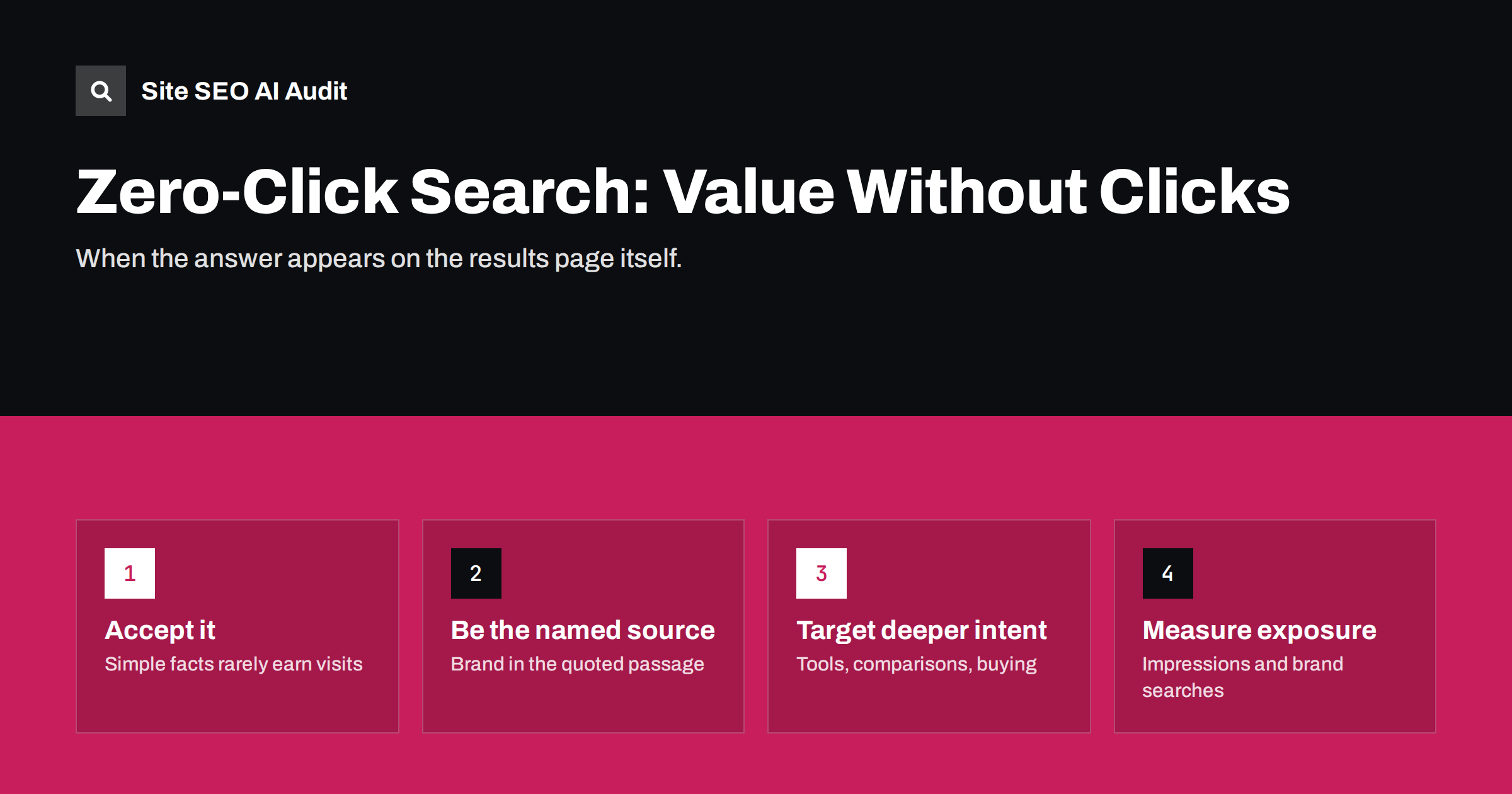
Short answer: A zero-click search is one where the user gets what they need on the results page, from a snippet, a knowledge panel, a local pack or an AI answer, and does not visit any website. AI Overviews and assistants make this more common for simple questions. The practical response is to accept that some informational queries will not bring visits, make sure your brand is named in the answers that are shown, focus content on questions where a visit adds real value, and measure impressions, brand demand and conversions rather than clicks alone.
What zero-click search means
The term describes searches that end without a click to an external site. It is not new. Weather boxes, calculators, sports scores, currency conversions, featured snippets, knowledge panels and map results have answered questions directly on the results page for years. Various clickstream studies over the past decade have estimated that a large share of searches, often around half or more on mobile, end without a click to the open web, though methods and numbers differ.
AI features extend this pattern. An AI Overview or an assistant’s answer can summarise several pages in a few sentences. For a question like “how long to boil an egg” or “what does a 301 redirect do”, many users now read the summary and move on. For more complex questions, users still click, but they may click fewer sources, and they arrive better informed.
The important point is that zero-click is not the same as zero value. A user who reads your brand name, your recommendation or your price in an answer has been exposed to your business, even if your analytics recorded nothing.
Which queries lose clicks and which do not
Not all searches are affected equally. It helps to sort your keywords by how likely they are to be answered in place.
| Query type | Example | Click risk |
|---|---|---|
| Simple facts and definitions | “what is a canonical tag” | High |
| Quick how-to with few steps | “how to clear browser cache” | High |
| Comparisons and choices | “shopify vs woocommerce for small shop” | Medium |
| Detailed tutorials | “migrate wordpress to new host step by step” | Medium to low |
| Tools and calculators | “website speed test”, “mortgage calculator” | Low |
| Local services and bookings | “emergency plumber near me” | Low for the action, high for info |
| Purchases and sign-ups | “buy running shoes size 44” | Low |
If most of your organic traffic comes from the first two rows, expect pressure. If it comes from the last rows, AI answers are more likely to be a route to you than a replacement for you.
Strategy 1: be the named source
When an answer appears without a click, the best outcome is that it names you. That is more likely when your content makes attribution natural:
- Put your brand in the passage. “At Example Bakery, sourdough loaves rest for 36 hours before baking” carries your name into a quote; “our loaves rest for 36 hours” does not.
- Publish original facts. Your own data, test results, prices and policies are things an answer can only attribute to you.
- Coin clear names for methods and products, and use them consistently, so that a summary refers to them by name.
- Keep facts consistent across your site and profiles, so that the named fact is correct.
Being named repeatedly in answers builds familiarity. When the user later needs the service, your name is one they have seen.
Strategy 2: shift effort towards high-value intent
Content budgets are limited. Given zero-click trends, it often makes sense to move effort from generic definitions towards content where visits turn into business:
- Decision content. Honest comparisons, buying guides and “which option for which situation” pages. Users often want detail they cannot get from a summary.
- Tools. Calculators, checkers, templates and configurators that require interaction on your site.
- Deep tutorials. Multi-step processes with screenshots and troubleshooting, where users keep the page open while they work.
- Local and transactional pages. Service pages, product pages and booking pages with complete information.
- Experience-based content. Case studies, reviews and lessons learned that are specific to you.
This does not mean abandoning informational content. Definitions and simple answers still build topical authority and can feed AI answers that name you. It means not measuring them only by clicks.
A useful exercise is to take your twenty highest-traffic informational pages and ask, for each one, what a reader could do next on your site. If the answer is “nothing”, add a relevant next step: a related tool, a deeper guide, a product or a way to get help. Pages with a clear path onward keep more of their value even when fewer people arrive.
Strategy 3: make the click worth it
Users who do click from an AI answer or a snippet have usually read a summary already. They come for something the summary could not give. Pages that meet that expectation keep them:
- Start with the answer, then go straight into depth: examples, edge cases, steps, visuals.
- Offer something to do next: a tool, a template, a checklist, a consultation, a product.
- Avoid making users scroll through introductions that repeat what the summary already said.
- Make contact and purchase options easy to find without being intrusive.
How to measure visibility without clicks
If clicks are an incomplete measure, you need others. None is perfect, but together they show whether your visibility is growing:
- Impressions in Search Console. Rising impressions with stable or falling clicks often indicate visibility in results that answer in place.
- Branded search volume. Growth in searches for your brand name suggests exposure somewhere, including in AI answers.
- Direct traffic trends. Some users who see your name type your address directly.
- AI referrals. A dedicated analytics channel for assistant domains shows the clicks that do happen.
- Manual answer checks. A fixed list of questions checked monthly in major assistants, recording whether you are named.
- Customer surveys. A “how did you hear about us” field with an AI assistant option captures what analytics misses.
- Conversions per visit. Fewer but better-informed visitors can mean steady or higher revenue.
Explaining the change to stakeholders
Traffic reports can look alarming when informational clicks fall. Before anyone concludes that SEO has stopped working, separate the effects. Group queries by type, compare impressions and clicks for each group, and check whether conversions from organic search changed in the same period. Often the picture is “fewer visits for definitions, stable business from commercial pages”. That is a very different story from “search is dying”, and it leads to different decisions.
It also helps to agree in advance which metrics define success. If the team knows that impressions, brand searches and conversions matter as much as sessions, a drop in informational clicks will not trigger panic or bad decisions such as cutting all content.
For agencies, include a short explanation of zero-click trends in every search report, with the query-type breakdown above. Clients who understand why clicks behave differently are far less likely to judge the work on a single traffic chart.
What not to do
- Do not block search engines or AI search crawlers in an attempt to force clicks. You will simply disappear from the answers, and competitors will be named instead.
- Do not hide answers behind forms or long introductions. Systems will cite a clearer source.
- Do not use nosnippet site-wide without understanding that it also strips descriptions from regular search results.
- Do not judge content only by sessions. Some of your most valuable pages may be the ones that get quoted rather than visited.
How Site SEO AI Audit helps
Being named in answers starts with being readable. Site SEO AI Audit checks whether AI crawlers are allowed on your site, whether content depends on JavaScript, and whether pages carry the structure and dates that AI answers quote, next to the classic crawl, on-page, link and speed checks. Pro and Agency plans add weekly audits and the ability to compare audits over time, listed on the pricing page, which helps you connect visibility changes to site changes.
Related reading
- Google AI Overviews: How Sources Are Chosen and How to Be One
- How to Track AI Referral Traffic in Google Analytics 4
- How to Write Content That AI Answers Actually Quote
The bottom line
Zero-click search is growing, and AI answers accelerate it for simple questions. Treat it as a change in how visibility works rather than a loss of visibility. Get your brand named in the passages that are quoted, invest in content where a visit adds value, make every click worth it and measure impressions, brand demand and conversions alongside sessions.
الأسئلة الشائعة
What is a zero-click search?
It is a search where the user finds the answer on the results page, for example in a snippet, a knowledge panel or an AI Overview, and does not click through to any website.
Are AI Overviews increasing zero-click searches?
Independent studies have generally found lower click-through rates on queries that show AI Overviews, especially for simple informational questions. The effect varies by topic and query type.
Is informational content still worth writing?
Yes, if it is genuinely useful and connected to your business. It builds topical authority and can get your brand named in answers, but judge it by impressions and influence as well as clicks.
How can I tell if AI answers mention my brand?
Check a fixed list of important questions in the main assistants every month and record which brands are named. Rising branded searches and survey responses also indicate exposure.
Should I block AI Overviews to get more clicks?
Limiting snippets with nosnippet or max-snippet reduces how your content appears in AI Overviews but also in regular results. For most businesses, the loss of visibility outweighs any gain in clicks.