ENEnglish
 LTLietuviškai
 DEDeutsch
 FRFrançais
 RUРусский
 ESEspañol
 PLPolski
 ITItaliano
 UKУкраїнська
 CSČeština
 PTPortuguês
 JA日本語
 LVLatviešu valoda
 ETEesti
 HUMagyar
 IDBahasa Indonesia
 TRTürkçe
 HIहिन्दी
 ELΕλληνικά
 ARالعربية
 THไทย
 VITiếng Việt
 RORomână
 MSBahasa Melayu
 BNবাংলা
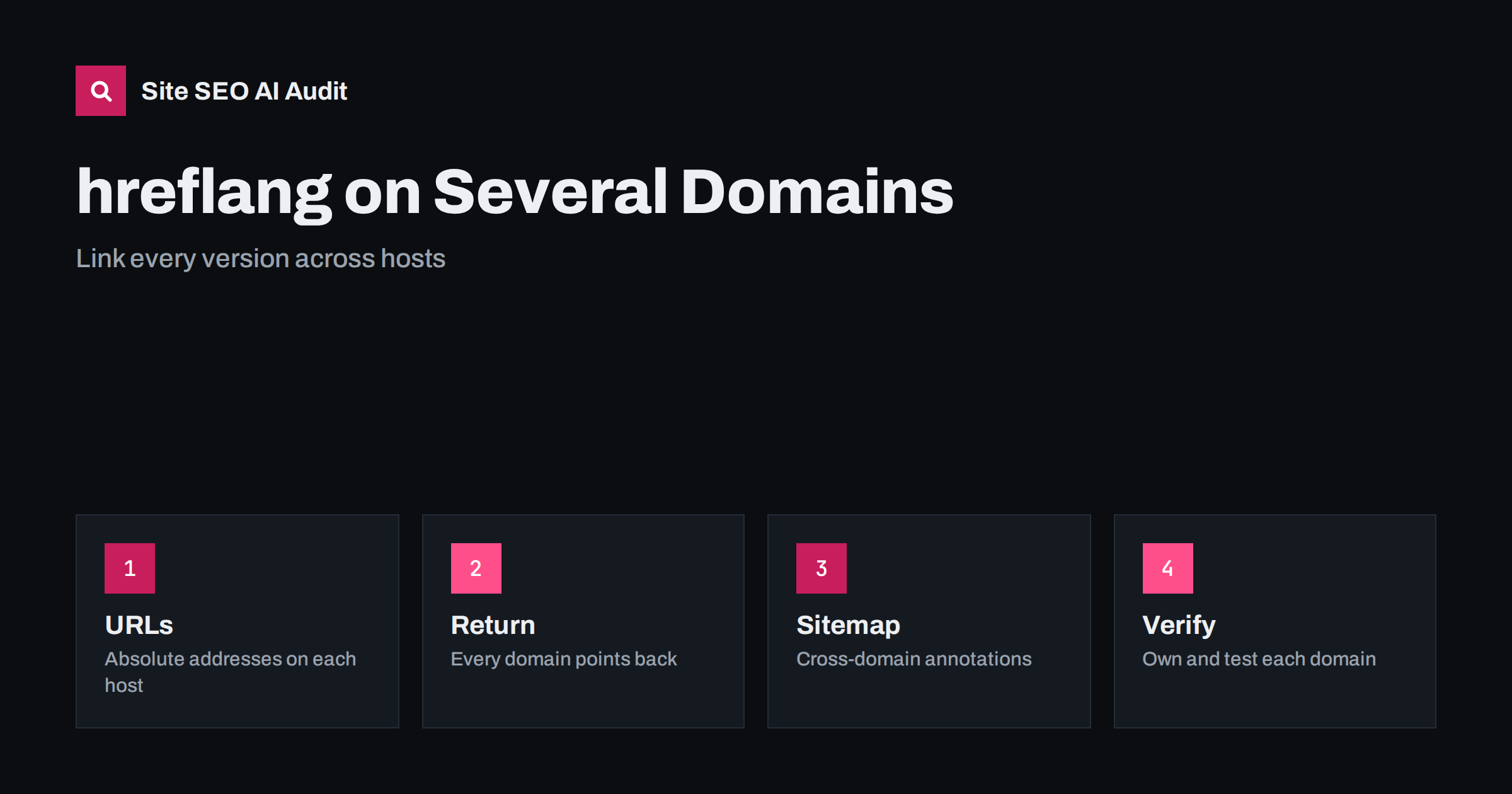
Short answer: hreflang works across different domains as long as every version lists all versions, including itself, with full absolute addresses, valid language and region codes and one-to-one pairs. Each domain must point back to the others, canonical tags must stay on the same domain and page, and every page named must return a normal success status. Cross-domain sitemaps are possible when you can verify ownership of each site.
Many international sites use a separate domain for each country or language, such as one domain with a country extension for each market. This keeps the markets apart and can support local trust, but it makes hreflang harder, because the annotations must travel between hosts that may be run by different teams. This guide explains the setup, shows where errors arise and gives a way to test. If you are deciding between structures, read the comparison of ccTLDs, subdomains and subfolders first.
What changes with several domains
The rules of hreflang do not change: each page lists the alternate versions of itself with language and optional region codes. What changes is the effort. On one domain, a single template can generate the list. On several domains, each site may have its own platform, release cycle and owners, so a change in one place must be mirrored in others. Mistakes in one domain break the pairs for all the others, and search engines may then ignore the annotations. A written plan, with one owner, is more important here than the technique you choose.
Use absolute addresses and exact matches
With several hosts, always write the full address of each alternate, including the protocol and the host name. The address in the annotation must match the real final address of the page, with the same host form, trailing slash and letter case. If the page redirects from the address named in hreflang, or the address differs from the canonical, the pair may fail. Check that every annotated address returns a normal success status, is not blocked, and is not marked noindex. The guide to hreflang return links describes the most frequent failures.
Return links across hosts
If the page on the first domain lists the page on the second domain, the second page must list the first. Each page must also list itself. With several domains, check the pairs in both directions, not only from the main site. A common problem is that a new market site is launched with annotations pointing to the main site, but the main site is never updated, so the pairs are incomplete. Keep a master table of all pages and their equivalents, and generate the annotations on each domain from that table so that they cannot drift apart.
Choose a method: tags, headers or sitemaps
You can place the annotations in the head of each page, in HTTP headers or in XML sitemaps. For several domains, sitemaps are often the easiest to manage, because one file can list the alternates across hosts, and generating it from the master table is simple. A sitemap that names pages on other domains requires that you can prove ownership of those domains, usually by verifying each in Search Console or by allowing cross-submission through the robots.txt file of the other host. The comparison in hreflang in sitemaps and HTML helps you decide.
Canonical tags stay on their own domain
Each page should have a self-referencing canonical tag that points to its own address on its own domain. Do not point the canonical of one market page to another domain, because that tells search engines to drop the page and ignore its hreflang annotations. Use cross-domain canonicals only for true duplicates, such as an identical page in the same language, which belongs to a different problem, covered in the guide to canonical and hreflang together. Keep canonical, hreflang and sitemap entries consistent for the same address.
Language and country codes
Use valid codes: a language code, optionally followed by a region code. Write codes in the right order and form, and avoid made-up values. When several domains serve the same language in different countries, such as English for two countries, use language and region together to separate them. Add an x-default entry for the page that should serve users who match none of the versions, such as a global home page or a country selector. The guides on language codes and x-default list the details.
Verify every domain and watch reports
Add each domain to Search Console as its own property, so that you can see indexing, errors and performance per market. Check each property for coverage problems and messages. International targeting reports and the other tools listed in the guide to Search Console for international sites help you see where problems occur. Compare the countries from which each domain receives clicks with your intended market; if a domain gets most of its clicks from another country, a version may be missing or mismatched.
Test before and after launch
Crawl every domain and extract the annotations. Then check pairs automatically: for every page A that names page B, confirm that B names A, that both return success, that both are indexable and that codes are valid. Do this before launching a new market and after each release. Check a sample by hand in the rendered page source. The steps in the guide to testing hreflang cover tools and checks. Many errors can be found in minutes with a script, and the cost of finding them early is small.
Think about content differences between domains. If two domains show nearly identical content in the same language for different countries, they still need distinct signals, such as currency, local addresses, shipping details and phone numbers. Without them, search engines may treat the versions as duplicates and choose one. Where the content differs, make the difference real and visible, not only a change of country name.
Coordinate releases between teams. When one domain adds a page, removes a product or changes an address, the others must be updated. A shared channel, a change log and a regular check help. If a version is retired, remove it from the lists on all other domains, redirect its addresses where there is a good equivalent and update the sitemaps. Leaving annotations that point to removed pages creates errors that can persist for months.
Finally, be realistic about benefits. hreflang does not boost rankings; it helps the right version appear for the right user. If your domains are new or weak, they may rank low whatever the annotations say. Build local relevance with content, links and trust signals in each market, and use hreflang to make sure that once a page ranks, it reaches the right audience.
An example shows how easily pairs break. A company runs three domains: one for its home country, one for a neighbouring country with the same language and one for an English-language global audience. Each page names the other two. During a redesign, the team of the neighbouring country changes its address structure and does not tell the others. Overnight, two thirds of the annotations on the other domains point to addresses that now redirect. Search engines see broken pairs and may ignore them, so users in the neighbouring country start to see pages from the wrong domain. The repair is quick once found, but the delay in noticing is costly. A weekly automated check would have caught it in days.
A second example is about a shared product catalogue. The three domains sell the same products, but prices, delivery and legal text differ. The team uses a master table with a row for each product and a column for each domain, giving the address of the product page on that domain, or an empty cell if the product is not sold there. The generator creates annotations only for the pairs that exist. When a product is added to one market, the table is updated and every other domain receives the new annotation at the next build. This method handles gaps in a catalogue without leaving broken references.
Think about the user interface too. hreflang tells search engines which version to prefer, but visitors also need a clear way to switch between markets. Provide a country or language selector that links to the matching page on the other domain, not only to its home page, and does not force people into a version based on their location. Allow visitors to choose, and remember the choice in a cookie without redirecting crawlers. The guide to language switchers covers the design in more detail, and its advice applies equally to separate domains.
Documentation matters most in a multi-domain setup. Write down who owns each domain, which platform it runs on, where the master table lives, how annotations are generated, who approves new markets and how errors are reported. When staff change or an agency is replaced, this document keeps the setup working. Without it, the knowledge lives in the memory of a few people, and each departure raises the risk of silent breakage.
Site SEO AI Audit crawls your site and checks hreflang annotations, return links, language attributes, canonical tags, status codes and sitemaps on the domain you audit, so you can find missing pairs and broken targets. The first audit of up to 200 pages is free; larger sites can see the pricing page.
Related reading
The bottom line
Name every version with absolute addresses on every domain, keep return links and self-references complete, keep canonicals on their own domain and test the pairs automatically.
FAQ
Does hreflang work across different domains?
Yes. Each page must list all versions, including itself, with absolute addresses.
Do I need to verify all domains?
Verify each in Search Console, which also allows cross-domain sitemaps.
Should the canonical point to another domain?
No. Use a self-referencing canonical on each page and domain.
What is the best method for many domains?
Sitemaps are often easiest, generated from one master table of equivalent pages.
Does hreflang improve rankings?
No. It only helps the right version appear for the right audience.