ENEnglish
 LTLietuviškai
 DEDeutsch
 FRFrançais
 RUРусский
 ESEspañol
 PLPolski
 ITItaliano
 UKУкраїнська
 CSČeština
 PTPortuguês
 JA日本語
 LVLatviešu valoda
 ETEesti
 HUMagyar
 IDBahasa Indonesia
 TRTürkçe
 HIहिन्दी
 ELΕλληνικά
 ARالعربية
 THไทย
 VITiếng Việt
 RORomână
 MSBahasa Melayu
 BNবাংলা
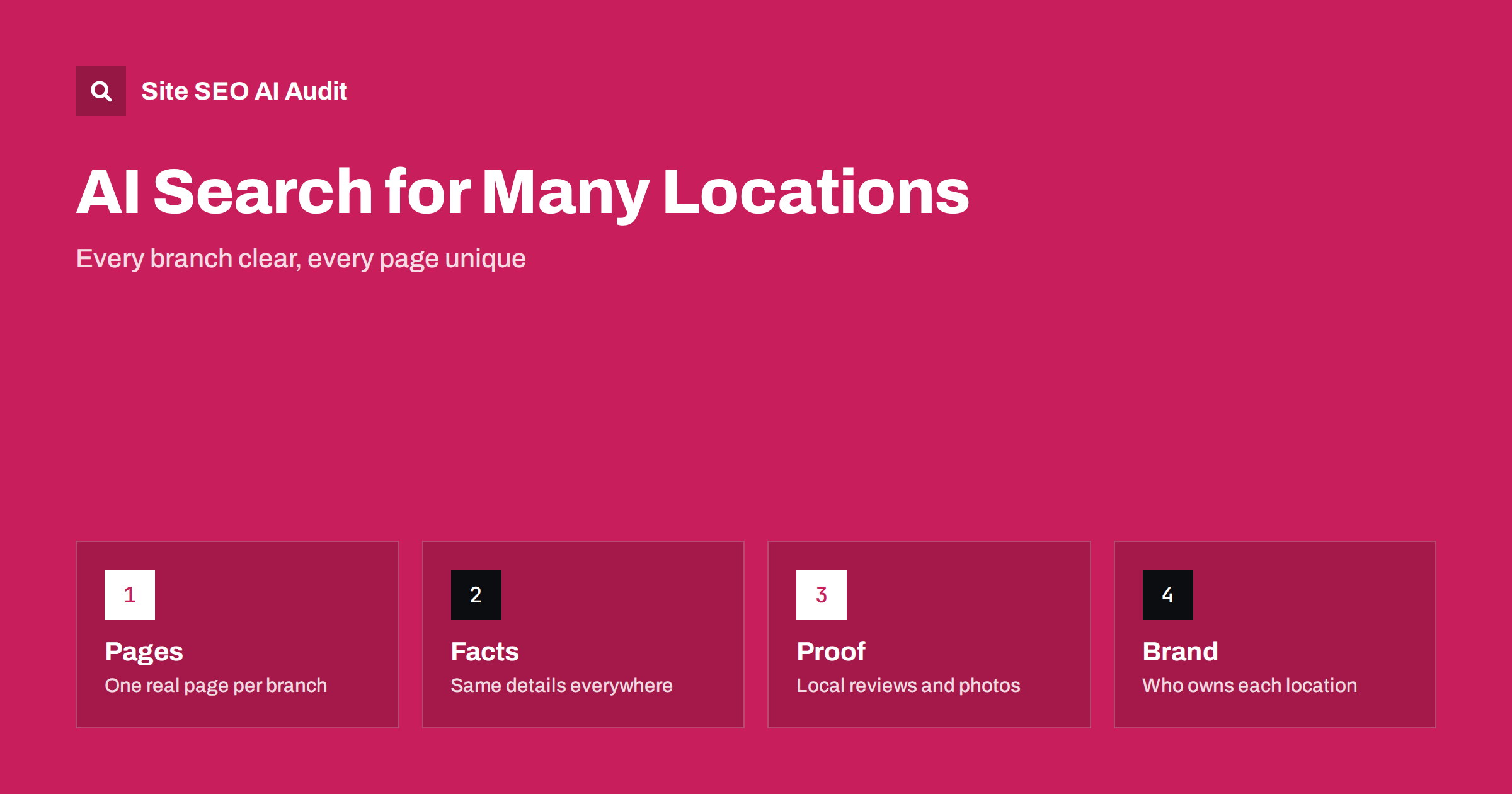
Short answer: A business with many locations is understood by AI search when each branch has its own real page with unique, accurate information, the same name, address, hours and services everywhere they appear, local proof such as reviews and photos, and clear markup that links every branch to the parent brand. Copying one template across hundreds of pages with only the town name changed gives AI systems nothing useful to quote.
People ask AI assistants questions such as which dentist near them takes new patients on Saturday, or where to find a specific product in their town. To answer, the system needs a trustworthy fact about one specific place. Chains, franchises and companies with several offices often have the opposite problem: many similar pages, conflicting details and unclear ownership. This guide shows how to organise a multi-location website so that each branch can be found and described correctly. It extends the advice in the local business guide to organisations with many sites.
Give every location its own useful page
Each branch needs a page that exists for real visitors, not only for search. Include the full address, phone number, opening hours, a map, directions, parking or transport notes, the services offered at that branch, and the names of staff where it is appropriate. Add a short description written for that place: what is nearby, which neighbourhoods it serves and what makes it different. When every page is the same text with a different town name, search engines treat them as near duplicates and AI systems have no unique fact to use. A branch that cannot support a unique page may be better described inside a list on a regional page.
Keep names, addresses and hours consistent
AI systems compare what your website says with what directories, map listings, review sites and social profiles say. If the opening hours differ, or the branch has three spellings of the street, confidence falls. Create one master record for each location and use it everywhere: the website, the business profile, the schema markup and any third-party listing. When something changes, such as holiday hours or a new phone number, update the master record first and then every place that copies it. The guide to aligning your business profile with your website explains the checks in more detail.
Use structured data for each branch
Mark up each location page with LocalBusiness markup, or a more specific subtype, and include the name, address, coordinates, phone number, hours and the URL of the page. Mark up the parent company with Organization markup on the home page, and connect branches to it with a parent organisation property. This gives machines a clear map: one brand, many places, each with its own page. Keep the markup identical to what visitors see. The article on LocalBusiness schema lists the fields and common mistakes.
Build a sensible site structure
A simple structure works best: a locations index page, optional regional or city pages for large networks, and then the individual branch pages. Use clear, stable addresses such as a folder for locations followed by the town or branch name. Link from the index to every branch, and from each branch back to the index and to related services. Avoid hiding the list of locations behind a search form or a script that crawlers cannot use, because a store finder that only works with a typed postcode may leave branch pages without any links. Provide plain links as well, as described in the guide to location pages.
Show local proof and local content
Reviews, photos, team introductions, local events and case examples show that a branch is real and active. Gather reviews per location, not only for the brand as a whole, and display a few on the branch page with the date. Add original photos of the premises and the team instead of stock images. Local news, community involvement and answers to local questions give AI systems material that is specific to the place. Do not invent reviews or copy them from one branch to another, since that misleads visitors and damages trust.
Handle services, prices and availability per branch
Customers ask practical questions: is this service offered here, how much does it cost, can I book online, is the branch accessible? If these answers sit only in a booking system or a downloadable brochure, AI systems may never see them. Put the facts in text on the branch page, such as a list of services with short descriptions, a statement about accessibility, the languages spoken and the booking options. Where prices vary between branches, show the price for that branch or explain the difference. Where a service is offered only at some locations, say which, so that nobody travels for something that is unavailable. Keep this information current, and remove services that are no longer offered instead of leaving old text on the page.
Make clear who runs each location
Franchises and partner networks add a layer of complexity. A location may be operated by an independent owner under the brand, and customers need to know who they are dealing with. State the brand, the operator where relevant, the services each branch provides and any differences in prices or hours. If branches truly differ, say so on the page, because AI answers that assume every branch offers the same thing will send customers to the wrong place. Keep brand pages consistent so that the name and description of the company are the same everywhere, which helps with the problems described in brand name confusion.
Manage closures, moves and new openings
Networks change constantly. When a branch closes, do not delete the page without a plan. If another branch serves the same area, redirect to it and say so; if there is no equivalent, return a proper not found status and remove the branch from the list, the sitemap and the markup. When a branch moves, update the address everywhere and keep the old address in a note for a time, so that visitors who know the old place are not confused. New branches should launch with complete information, not a placeholder, because an empty page is worse than no page.
Monitor accuracy across the whole network
With many locations, small errors multiply. Schedule regular checks of a sample of branches: ask an AI assistant and a search engine about your brand in different towns, and compare the answers with the truth. Look for wrong hours, closed branches that still appear, mixed up phone numbers and pages from competitors that outrank your own branch. Keep a log of what you fix. The guide to fixing wrong information in AI answers describes how to correct sources that systems rely on.
Staff training matters as much as markup. The people running each branch should know that their listing, their page and their reviews are part of how customers find them, and they should have a simple way to report changes to the central team. A short form or a shared sheet is often enough. Without it, the website says one thing and the shop window another, and machines notice the difference before customers do.
Decide what belongs at brand level and what belongs at branch level. Brand pages should explain the services, standards, prices policy and history of the company once, in one authoritative place. Branch pages should link to those pages and focus on what is local. This avoids copying long text blocks across hundreds of pages, keeps maintenance manageable and gives AI systems a clear source for each kind of fact.
Think about internal links between neighbouring branches as well. A visitor on a page for one town may be better served by a branch in the next town, for example when the first has closed for the day or does not offer a service. A short, honest line pointing to the nearest alternatives helps visitors, spreads crawling across the network and shows machines how places relate to each other. Avoid long lists of every other branch on every page, which only adds clutter and repeated text.
Finally, think about how the network appears in comparisons. People ask which chain has the best service in their town, and AI answers draw on reviews, guides and news. Encourage genuine feedback at each branch, respond to complaints in public with calm and useful answers, and fix repeated problems at their source. A reputation built branch by branch is more believable to people and machines than a single brand claim.
Site SEO AI Audit crawls your site and checks titles, descriptions, duplicate and thin pages, structured data, broken links, canonical tags and AI crawler access, so you can see which location pages are near copies or have missing details. It does not check your directory listings or verify opening hours. The first audit of up to 200 pages is free; larger sites can see the pricing page.
Related reading
The bottom line
Give each branch a real, unique page, keep every fact identical wherever it appears, show local proof, mark up branches and the brand clearly, and check the network regularly for errors.
FAQ
Should every branch have its own page?
Yes, if it serves customers in person or by appointment. Give it unique details, not a copied template.
Does LocalBusiness markup help AI search?
It helps machines read the facts on the page, but only if the markup matches the visible content and the details are accurate.
How do I handle a branch that closes?
Redirect to a nearby equivalent when one exists. Otherwise return a not found status and remove the branch from lists and markup.
Can franchises share brand text across locations?
Share it through links to brand pages rather than copying it into every branch page, and keep branch pages focused on local facts.
How often should I check the details?
Review a sample every month and every branch at least twice a year, and update immediately when hours or addresses change.