ENEnglish
 LTLietuviškai
 DEDeutsch
 FRFrançais
 RUРусский
 ESEspañol
 PLPolski
 ITItaliano
 UKУкраїнська
 CSČeština
 PTPortuguês
 JA日本語
 LVLatviešu valoda
 ETEesti
 HUMagyar
 IDBahasa Indonesia
 TRTürkçe
 HIहिन्दी
 ELΕλληνικά
 ARالعربية
 THไทย
 VITiếng Việt
 RORomână
 MSBahasa Melayu
 BNবাংলা
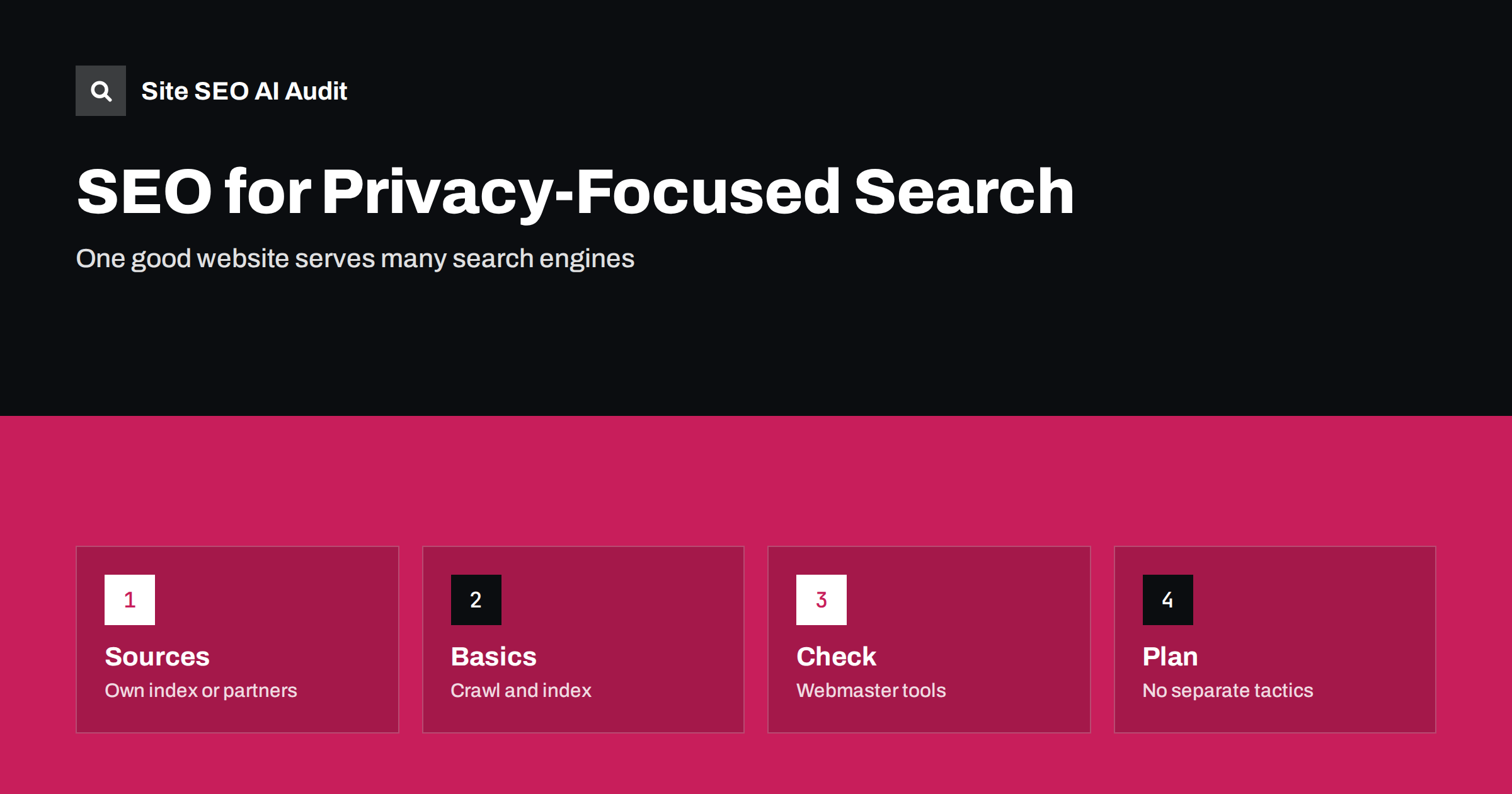
Short answer: You do not need a separate SEO strategy for DuckDuckGo, Brave Search or Ecosia. Each gets results from its own crawler, from partner indexes, or from a mix, and the signals they reward are the familiar ones: crawlable pages, clear content, good titles, helpful links and a fast, secure site. Make sure you do not block their crawlers, submit your site where they offer tools, check how you appear and spend the remaining effort on the basics that help every search engine.
Most SEO advice talks about Google, and for good reason: it handles the majority of searches in most countries. Yet a growing group of people choose search engines that promise more privacy, a smaller environmental footprint or independence from large advertising companies. For some sites, such as privacy tools, ethical shops or developer resources, these visitors are a meaningful share of traffic. This guide explains how such engines work in general terms, what actually differs, and what to check on your own site. Details about the partners behind each engine change from time to time, so always confirm current information in their official documentation before you build plans on it.
How privacy-focused engines get their results
A search engine can build results in three ways. It can crawl the web itself and keep its own index. It can license results from another provider. Or it can combine its own index with partner data and with specialised sources such as maps and answer boxes. Privacy-focused engines use all three approaches.
DuckDuckGo has its own crawler and also draws on several sources, including partner search results. Brave Search runs an independent index and promotes that independence as a feature. Ecosia has historically relied on partner results and has been working with others on European search infrastructure. The practical consequence is that your page may reach these engines through your own accessibility to their crawlers, through a partner’s index, or both.
What stays the same
Whatever the source, a page must be found, fetched, understood and judged useful before it can appear. That means the same fundamentals. The page returns a normal status, is not blocked by robots.txt or a noindex directive, is linked from other pages or listed in a sitemap, loads quickly and has text that states what it is about. Titles and headings describe the topic, content answers the question better than alternatives and links from reputable sites give additional trust.
If you have already followed good practice for Google or Bing, you have done most of the work. Sites that fix crawl and index problems often see improvements everywhere at once. The checklist in the technical SEO audit checklist applies to all of them.
What can differ
Differences appear in coverage, freshness and ranking details. A smaller index may know fewer of your pages, or discover new ones later. A partner’s index may reflect that partner’s view of your site rather than what Google sees. Local and shopping results may come from different data providers, so a business listing that exists on one map service may be missing from another.
Privacy-focused engines also tend to personalise less, since they avoid storing detailed search histories. That means results vary less between users, and position tracking is simpler to interpret. On the other hand, fewer people use them, so keyword data is thin and statistics can look noisy. Do not draw big conclusions from small numbers; look at trends over months.
Do not block their crawlers
Check your robots.txt, your firewall and your content delivery network for rules that block unknown bots. Some security settings reject any crawler other than the biggest few, which would keep smaller engines away. Each engine documents the name of its crawler, and you can allow it in robots.txt by that name. Remember that an unfamiliar user agent is not always genuine, so verify through the methods the engine recommends, such as reverse DNS lookups or published address lists.
If you block crawlers on purpose, for example to limit server load, do it knowingly. The guide to CDN and firewall rules that block crawlers explains how accidental blocks happen and how to find them in your logs.
Use the webmaster tools that exist
Bing Webmaster Tools matters more than people expect, because Bing’s index feeds several other products and search engines. Adding your site and submitting your sitemap there takes a few minutes. Brave and DuckDuckGo offer less in the way of dashboards, so do not expect the detailed reports you see in Google Search Console. Where an engine accepts suggestions for crawling or reporting problems, use the official channel and keep the request polite and rare.
The IndexNow protocol lets a site notify participating engines when a page changes. Not every engine takes part, so treat it as a helpful extra, as explained in the guide to IndexNow.
Content and trust signals
Trust is built from details that a visitor can check: who runs the site, where it is based, how to contact the team and what happens to personal data. Put this information in places that are easy to find and keep it consistent across pages and profiles.
Privacy-focused searchers often value transparency. A clear privacy policy, honest cookie handling, minimal tracking and visible contact details fit that audience and are good practice anyway. Pages that load heavy advertising and dozens of tracking scripts may rank no worse, but they will feel at odds with the visitor’s reasons for using the engine.
Write for people who ask direct questions, with answers near the top, and back claims with sources. That style also suits AI answers and featured results, which many of these engines display. Our article on writing content that AI answers quote describes the format in detail.
Measuring traffic from small engines
In analytics, these visitors appear as referrals or as organic traffic from the named engine, depending on how your tool classifies them. Some privacy settings hide the referring address, so part of the traffic may land in the “direct” group. Create a simple segment for each engine you care about and watch it monthly. If the numbers are tiny, there is no reason to invest in special tactics; if they are meaningful, check that the landing pages are the ones you expect and that your site works well for visitors who block trackers.
Also test your own pages in each engine by searching for your brand and your main topics. Missing pages, outdated titles or odd snippets point to indexing or partner-data problems you can then investigate.
Myths worth dropping
One myth says that these engines rank pages by completely different rules, so you need separate keyword lists. In practice, people type the same queries everywhere, and the engines try to answer them with relevant, trustworthy pages. A second myth says that privacy-focused engines ignore links. They do not; links remain a way to discover pages and judge their reputation, although the exact weight differs and is not published.
A third myth is that ranking well on Google guarantees the same position elsewhere. Often the order is similar, but a smaller index, a different partner or a different treatment of freshness can shift results. The opposite myth is that you should create special pages for each engine. That risks duplicate content and wastes effort. Publish one good version of each page, serve it to everyone and let the engines decide.
A last myth concerns tracking: some site owners fear that appearing in privacy-focused results means they must remove analytics. That is not required. Respect consent rules in your region, keep the tracking you use proportionate and describe it honestly in your privacy policy. Visitors choose these engines for their own searches, but what your site does with their data is your responsibility.
A sensible plan
Set a review date, for example every quarter, to check whether the engines you care about have changed their sources or their webmaster tools.
Start by auditing the basics: status codes, robots rules, canonical tags, sitemap, titles, links and speed. Then verify your site in Bing Webmaster Tools, allow the crawlers you want and test a handful of searches. Treat anything beyond that as optional. Site SEO AI Audit checks the basics across seven areas, including whether AI crawlers can read your site, and the first audit of up to 200 pages is free.
If you discover a problem that affects only one engine, fix it if it is cheap and move on. Chasing small differences between engines is rarely the best use of limited time. A technically sound, helpful and well-linked site is what every one of them is trying to find.
Related reading
The bottom line
Privacy-focused engines reward the same crawlable, helpful and fast pages as others, so allow their crawlers, verify your site and keep to the basics.
FAQ
Do I need to submit my site to DuckDuckGo?
Usually not. Make sure it can be crawled and is included in sitemaps and Bing’s index, and check how it appears by searching for it.
Does Brave Search use Google results?
Brave Search says it runs its own independent index. Check its current documentation for how it describes its sources.
Is Bing Webmaster Tools worth the effort?
Yes. Verification and a sitemap submission take minutes, and Bing’s index feeds several other products.
Why is traffic from these engines so small?
Their market share is much smaller than Google’s in most countries. Small samples make short-term changes hard to interpret.
Should I block their crawlers to save bandwidth?
Only if you have a clear reason. Blocking removes you from those results, and well-behaved crawlers follow your crawl rules.