ENEnglish
 LTLietuviškai
 DEDeutsch
 FRFrançais
 RUРусский
 ESEspañol
 PLPolski
 ITItaliano
 UKУкраїнська
 CSČeština
 PTPortuguês
 JA日本語
JA日本語 LVLatviešu valoda
 ETEesti
 HUMagyar
 IDBahasa Indonesia
 TRTürkçe
 HIहिन्दी
 ELΕλληνικά
 ARالعربية
 THไทย
THไทย VITiếng Việt
 RORomână
 MSBahasa Melayu
 BNবাংলা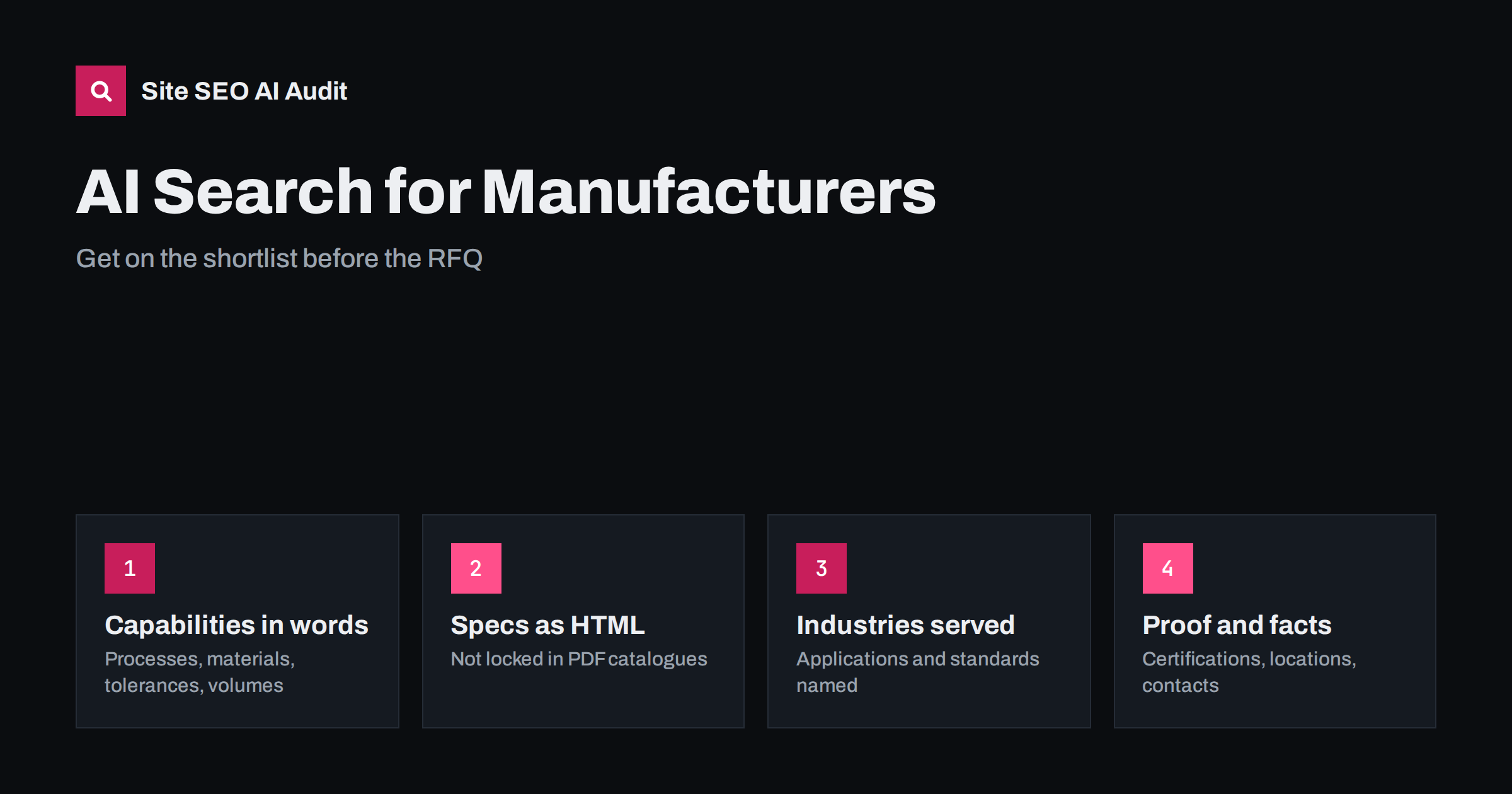
Short answer: Engineers and buyers increasingly use AI assistants to find and compare suppliers, asking for things like “CNC machining for aluminium prototypes in small batches” or “EN 1090 certified steel fabricator near Hamburg”. AI answers can only recommend manufacturers whose websites clearly describe what they make, which processes, materials and volumes they handle, which industries and standards they serve and where they are. Publish that information as readable HTML pages, not only in PDF catalogues, keep company facts consistent everywhere, and make sure AI crawlers can access the site.
Industrial websites have long been built for people who already know the company: a home page, a “products” page with a PDF catalogue and a contact form. Discovery happened through trade fairs, distributors and personal networks. That is changing. Buyers, engineers and procurement teams use search and AI assistants early in the process, to build a longlist of possible suppliers before anyone sends a request for quotation. If your capabilities are hidden in a 40-page PDF, you are unlikely to be on that list.
How buyers use AI assistants in industrial purchasing
Industrial queries are usually specific. Typical questions combine several requirements:
- a process: injection moulding, laser cutting, powder coating, sheet metal bending;
- a material or specification: stainless steel 316, food-grade plastics, tight tolerances;
- a volume: prototypes, small series, high-volume production;
- a certification or standard: ISO 9001, IATF 16949, ISO 13485, EN 1090;
- a location or delivery area: a country, a region, “within the EU”.
An AI system answering such a question looks for sources that state these facts explicitly. A page that says “we offer high-quality solutions for demanding customers” matches nothing. A page that says “we machine aluminium and stainless steel parts up to 600 mm, in batches from 1 to 5,000, with ISO 9001 certification” matches many questions. The same logic applies to B2B software, as described in our guide to AI search for B2B SaaS.
Describe capabilities in words, not adjectives
The most valuable page on a manufacturer’s website is often a clear capabilities page, or a set of pages, one per process. Each should cover:
- The process and equipment in plain terms, with the main machine types if they matter to buyers.
- Materials you work with, and those you do not.
- Size, tolerance and finish ranges, where you can state them reliably.
- Volumes and lead times in typical ranges, such as prototypes, small batches or series production.
- Secondary services: design support, assembly, finishing, testing, packaging, logistics.
- Industries and applications where you have real experience.
Be honest about limits. Saying clearly what you do not do helps buyers and assistants match you to the right enquiries, and saves your sales team from requests you cannot fulfil.
Move key information out of PDF catalogues
PDF catalogues and data sheets are useful for engineers, but they are a weak foundation for search. Text inside PDFs can often be read, yet scanned catalogues, tables built from images and very long files are harder for search engines and AI systems to use, and the PDF usually lacks the context of your website. Our article on what AI search can read in PDFs, images and video explains the limits.
A practical approach:
- Create an HTML page for each product family or main product, with a description, main specifications in a table and typical applications.
- Link the PDF data sheet from that page as a download, rather than making the PDF the only source.
- Give each product a stable URL that distributors and partners can link to.
- Keep specifications in one place, so that the website, the data sheet and distributor listings do not contradict each other.
If your product information is managed in a configurator or a script-heavy catalogue, check that the content is present in the HTML; our guide to JavaScript content and AI crawlers shows how.
Industries, applications and standards
Buyers often search by their own industry or application rather than by your process: “suppliers of enclosures for railway applications” or “machined parts for medical devices”. Pages that connect your capabilities to industries help both people and AI systems make that link. For each industry you genuinely serve, explain:
- which products or processes you supply to it;
- which relevant standards and certifications you hold;
- typical requirements you meet, such as traceability, cleanliness or documentation;
- anonymised examples of typical projects, if you cannot name clients.
Only list certifications you actually hold, with the exact name and, where useful, the certifying body. Vague claims such as “certified quality” are less useful than “ISO 9001:2015 certified”. Industry pages should not be copies with the industry name swapped; each needs content specific to that sector.
Company facts that AI systems can trust
When an assistant mentions a supplier, it usually adds a few facts: location, size, specialisation. Make those easy to find and consistent:
- Legal name and brand name, explained if they differ.
- Production sites with addresses, and which processes happen where.
- Year founded and ownership, if relevant to buyers.
- Export markets and delivery areas.
- Keeled your sales and support teams work in.
- Contact routes for quotations, technical questions and distributors.
Add Organization structured data that matches these facts, as described in our guide to Organization schema for AI systems, and keep the same information on business directories and industry platforms. Consistent facts across sources help AI systems understand that they are all describing the same company; our article on entity SEO explains why.
Distributors, directories and trade platforms
Many industrial products are sold through distributors, B2B marketplaces and supplier directories, and these sites are often well indexed. AI answers may draw on them as much as on your own site. That makes consistency important:
- Give distributors accurate, current product descriptions and specifications, and update them when products change.
- Keep your company profile complete on the industry directories and trade platforms you use, with the same name, locations and certifications as your website.
- Ask partners to link to the matching product page on your site, not only to the home page.
- Check how your company is described on trade fair exhibitor pages and association member lists, which often stay online for years.
When the same facts appear on your site and on independent sources, an AI system has more reason to trust them. When they differ, it may repeat an old address, a discontinued product or a certification that has expired.
Content that earns citations
Beyond product and capability pages, a modest amount of expert content can make a manufacturer the source an AI answer quotes. Good topics come straight from the questions your engineers and sales staff answer every week:
- design guidelines for your process, such as minimum wall thickness or bend radius;
- material selection guides and comparisons;
- explanations of tolerances, surface finishes or testing methods;
- how to prepare drawings or files for a quotation;
- what affects cost and lead time.
This kind of content is genuinely useful, rarely available elsewhere in such practical form and naturally relevant to buyers at the start of a project. Our guide to original data and first-hand experience explains why specific, experience-based content tends to be cited.
Several languages and export markets
Manufacturers often sell across borders, and buyers ask assistants in their own language. If export markets matter, provide at least the key capability, product and contact pages in the main languages of those markets, translated by people who know the technical vocabulary. Machine-translated technical terms are a common source of confusion. Link language versions with hreflang so that search engines show the right one. Our article on AI search in other languages covers this in more detail.
Technical checks for industrial websites
Industrial sites are often old, built by an agency years ago and rarely updated. Common technical gaps include AI crawlers blocked by a firewall or robots.txt rule, product information that loads only through scripts, missing or duplicate titles across hundreds of product pages, slow pages full of large images and broken links to old PDF files. Site SEO AI Audit crawls your site like a search engine and checks these areas, including AI crawlers in robots.txt, content that needs JavaScript, titles and descriptions, broken links, structured data and language versions, then ranks the fixes by impact. The first audit of up to 200 pages is free.
Related reading
- Comparison pages that AI answers trust
- Help center and documentation pages in AI answers
- Product pages for AI shopping answers
The bottom line
AI assistants are becoming part of how industrial buyers build their supplier longlists, and they can only recommend what they can read. State your processes, materials, ranges, volumes, industries and certifications in plain words on HTML pages, move key specifications out of PDF-only catalogues, keep company facts consistent everywhere and publish practical expert content from the questions buyers already ask. Then make sure the site is technically open to the crawlers that build those answers.
KKK
Do AI assistants really recommend industrial suppliers?
Yes, buyers and engineers use AI assistants to explore options and build longlists, especially early in a project. The assistant can only mention suppliers whose capabilities it can find and understand from public sources.
Is a PDF catalogue enough for AI search?
Usually not. PDFs can sometimes be read, but scanned or image-based catalogues are hard to use, and they lack page context. Publish key product and capability information as HTML pages and link the PDF as a download.
Should we publish tolerances and capacities?
Where you can state them reliably, yes. Concrete ranges for size, tolerance, material and volume help buyers and AI systems match you to the right enquiries. If values vary by project, give typical ranges and explain what affects them.
Do certifications help AI visibility?
They help when stated clearly, because buyers often include standards in their questions. Name each certification exactly, such as ISO 9001:2015, and list only those you currently hold.
Do manufacturers need a blog?
Not necessarily a blog, but practical technical content helps. Design guidelines, material comparisons and quotation guides answer real buyer questions and are the kind of content AI answers tend to cite.