ENEnglish
 LTLietuviškai
 DEDeutsch
 FRFrançais
 RUРусский
 ESEspañol
 PLPolski
 ITItaliano
 UKУкраїнська
 CSČeština
 PTPortuguês
 JA日本語
JA日本語 LVLatviešu valoda
 ETEesti
 HUMagyar
 IDBahasa Indonesia
 TRTürkçe
 HIहिन्दी
 ELΕλληνικά
 ARالعربية
 THไทย
THไทย VITiếng Việt
 RORomână
 MSBahasa Melayu
 BNবাংলা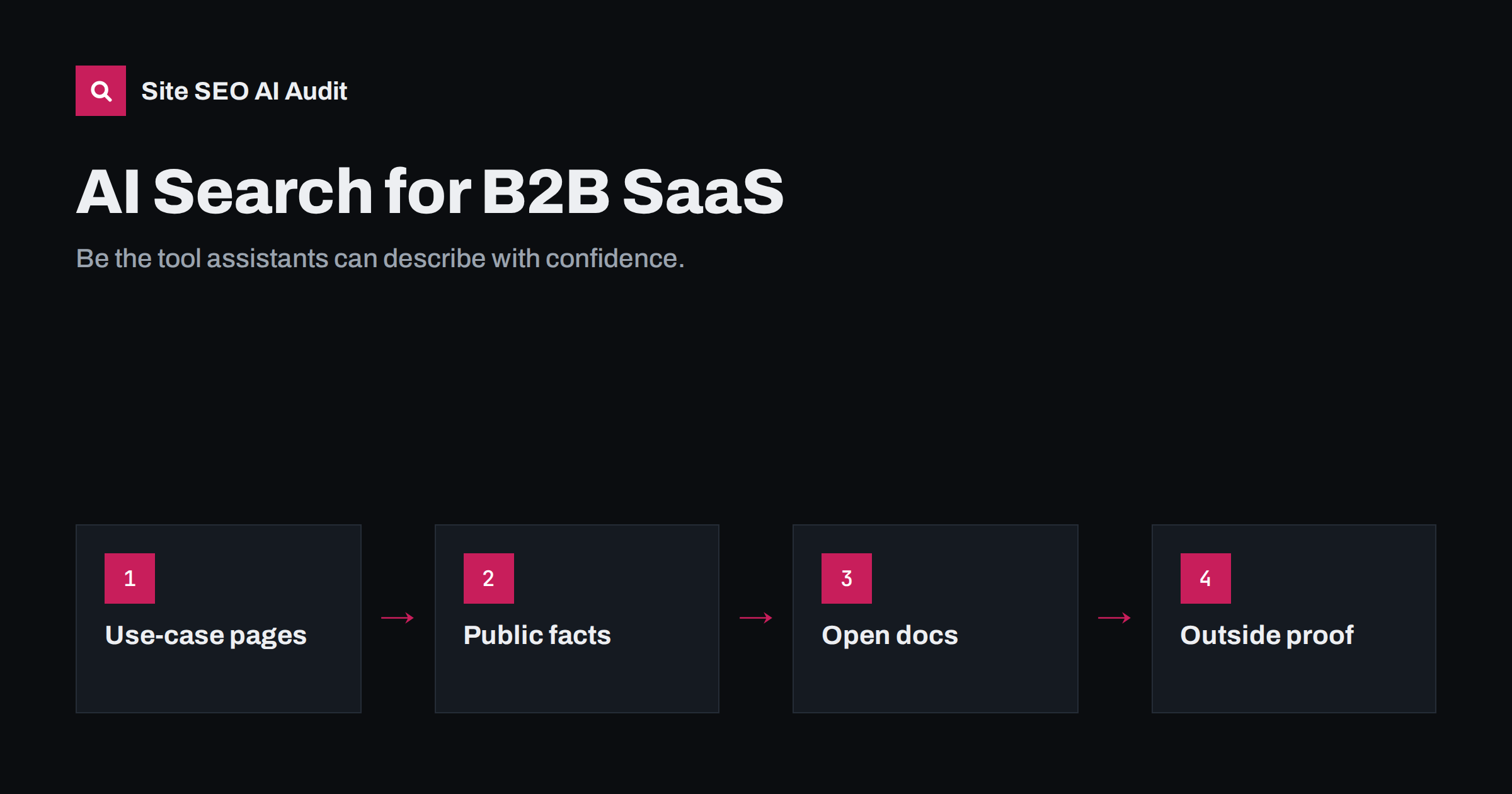
Short answer: B2B buyers increasingly ask AI assistants for shortlists, such as “best project management tool for a 15-person agency with client portals”. To appear, a SaaS company needs pages that state clearly what the product does, for whom, with which integrations and at what price; crawlable documentation; honest comparison and alternatives pages; and consistent third-party proof on review platforms, directories and industry articles. Assistants recommend tools they can describe with confidence, and vague marketing pages give them nothing to work with.
How buyers use AI assistants
B2B software research has always involved long lists, review sites, demos and conversations with peers. AI assistants compress the first part. Instead of opening twenty tabs, a buyer describes the situation and asks for options: team size, budget, must-have features, existing tools, compliance needs. The assistant replies with a handful of products and short reasons for each.
This changes where the first impression happens. A buyer may form a shortlist before visiting any vendor site. If your product is not mentioned, or is described inaccurately, you may never get the chance to make your case. Being on the shortlist, with an accurate one-line description, is the new top of the funnel.
Assistants build these answers from what they can find and trust: vendor pages, documentation, review platforms, comparison articles, community discussions and their training data. Each of these is something you can influence, directly or indirectly.
Make your product easy to describe
Many SaaS home pages say a great deal without saying what the product does: “The platform that empowers teams to achieve more.” An assistant cannot recommend that for a specific need. Make sure your site answers the basic questions in plain words:
- What category is the product in, and what does it actually do?
- Who is it for: company size, industry, role?
- What are the three to five core capabilities, named consistently?
- Which tools does it integrate with?
- Where is data hosted, and which compliance standards does it meet, if relevant?
- How is it priced?
Put these facts in text on crawlable pages, not only in videos, demos or gated PDFs.
A useful test is to paste your home page text into a conversation with a colleague who does not know the product and ask them to explain, in one sentence, what it does and who should buy it. If they struggle, an AI system will too. Rewrite until the answer is obvious, and then make sure the same description appears on your profiles and listings.
Build use-case and industry pages
Shortlist questions are phrased around jobs and situations, not product names. Pages that match those situations give assistants passages to retrieve:
- One page per main use case, such as “client onboarding for agencies” or “inventory tracking for small warehouses”, explaining the problem, how the product handles it, and limits.
- Industry pages where your product genuinely fits specific sectors, with sector-specific details rather than swapped nouns.
- Role pages where different buyers care about different things, such as finance teams versus operations teams.
- Integration pages for important integrations, describing what syncs, in which direction and on which plans.
Avoid producing dozens of thin template pages. A smaller number of detailed, honest pages is more useful to readers and more likely to be retrieved.
Each use-case page should end with a clear next step, such as a free trial, a demo or a relevant guide, so that buyers who arrive from an assistant can act on what they read.
Publish pricing and limits
Price is one of the first filters buyers apply, and assistants are often asked about it directly. If your pricing is hidden behind “contact sales”, the assistant must either guess, rely on third-party sites, or leave you out of budget-based answers.
Where your business model allows, publish plan names, prices or starting prices, what each plan includes, user or usage limits and billing options. If enterprise pricing is custom, say so and give the entry point. A clear pricing page reduces the risk of wrong numbers spreading, and it makes you eligible for questions like “tools under 50 euros per user per month”.
Also state the limits that matter for fit: maximum users, storage, number of projects, API rate limits, supported regions. Buyers ask about limits, and a product that states them clearly looks more trustworthy than one that hides them in the terms of service.
Open your documentation to crawlers
Documentation is often the most specific and trustworthy content a SaaS company has. It answers technical questions buyers and evaluators ask: “Does it support SSO with this identity provider?”, “Can I export data via API?”, “Is there a webhook for this event?”
- Keep public documentation crawlable and indexable, on your main domain or a clearly linked subdomain.
- Make sure docs are server-rendered; some documentation platforms render content only with JavaScript.
- Use descriptive page titles and headings that match how people phrase questions.
- Consider an llms.txt file for your docs. Documentation is where this proposed convention has the most real adoption, especially among developer tools.
- Keep version information clear so that outdated instructions are not quoted.
Write honest comparisons and alternatives
Buyers ask assistants to compare named tools. If the only comparisons available are written by competitors or affiliates, their framing wins. Publish your own comparison pages for your main competitors and an “alternatives” page where relevant.
| Element | What to include |
|---|---|
| Criteria | Pricing model, core features, integrations, limits, support, hosting |
| Facts about competitors | Checked against their official pages, with a review date |
| Honest strengths | Where the competitor is the better choice |
| Verdict by use case | Which type of team should choose which tool |
| Disclosure | That you make one of the products compared |
Link these comparison pages from your pricing page and relevant use-case pages, so that both readers and crawlers find them. Review them whenever a competitor changes pricing or ships a major feature; an outdated comparison is worse than none.
Earn third-party proof
Assistants rarely rely only on what vendors say about themselves. Independent sources carry weight in shortlists:
- Review platforms for business software, with a steady flow of genuine, detailed reviews.
- Industry articles and roundups from respected publications and bloggers in your niche.
- Community discussions in forums and professional communities, where real users mention tools. Participate honestly; do not astroturf.
- Integration marketplaces of the platforms you connect with, which often rank well and describe your product.
- Consistent company information across profiles, so every source describes the same product in the same category.
When you find a wrong description of your product on a third-party site, such as an old price, a discontinued feature or the wrong category, ask the site owner to correct it. Review platforms usually let vendors update their listing details. These small corrections add up, because they remove conflicting facts that assistants might otherwise repeat.
Measure shortlist presence
Traditional rankings do not capture shortlist visibility. Build a set of twenty to forty realistic buyer questions covering your main use cases, company sizes and comparisons. Check them in the main assistants each month, and record whether you are named, how you are described, which competitors appear and which sources are cited. Combine this with AI referral traffic in analytics, demo requests that mention an assistant, and branded search trends. Look for direction over several months rather than reacting to single answers.
Share the findings with product marketing and sales, not only with the SEO team. The way assistants describe you is effectively your positioning in the market, and gaps often point to messaging problems rather than technical ones.
How Site SEO AI Audit helps
SaaS sites often combine a marketing site, documentation, a blog and app pages, each built differently. Site SEO AI Audit crawls them together and flags issues such as JavaScript-rendered docs, blocked AI crawlers, duplicate titles across use-case pages, broken internal links, canonicals pointing to the wrong URLs and invalid structured data. Pro and Agency plans cover several sites, listed on the pricing page.
Related reading
- How to Write Comparison Pages That AI Answers Trust
- Entity SEO: Helping AI Systems Understand Your Brand
- llms.txt Explained: What It Is and Whether You Need One
- Why AI Crawlers Miss JavaScript Content and How to Fix It
The bottom line
AI shortlists reward SaaS companies that are easy to describe accurately. State plainly what your product does and for whom, publish pricing and limits, open your documentation to crawlers, write fair comparisons and build independent proof. Then measure your presence in realistic buyer questions and improve the pages behind any gaps.
KKK
How do AI assistants choose which SaaS tools to recommend?
They combine training data with retrieved sources such as vendor pages, documentation, review platforms and comparison articles. Tools with clear, consistent and well-supported information are easier to recommend accurately.
Should SaaS companies publish their prices?
Where the business model allows, yes. Public pricing lets assistants include you in budget-based answers and reduces the risk of wrong numbers circulating. For custom enterprise pricing, publish a starting point or explain how pricing works.
Does documentation help with AI visibility?
Yes. Public, crawlable documentation answers the specific technical questions buyers ask, and it is often the most precise source about your product. Make sure it is server-rendered and indexable.
Are review platforms important for AI shortlists?
Independent reviews are a common source for recommendations and descriptions. A steady flow of genuine, detailed reviews helps assistants describe your strengths accurately.
How can I track whether assistants recommend my product?
Check a fixed set of realistic buyer questions monthly in the main assistants, record mentions and descriptions, and combine this with AI referral traffic and demo request sources.