ENEnglish
 LTLietuviškai
 DEDeutsch
 FRFrançais
 RUРусский
 ESEspañol
 PLPolski
 ITItaliano
 UKУкраїнська
 CSČeština
 PTPortuguês
 JA日本語
 LVLatviešu valoda
 ETEesti
 HUMagyar
 IDBahasa Indonesia
 TRTürkçe
 HIहिन्दी
 ELΕλληνικά
 ARالعربية
 THไทย
 VITiếng Việt
 RORomână
 MSBahasa Melayu
 BNবাংলা
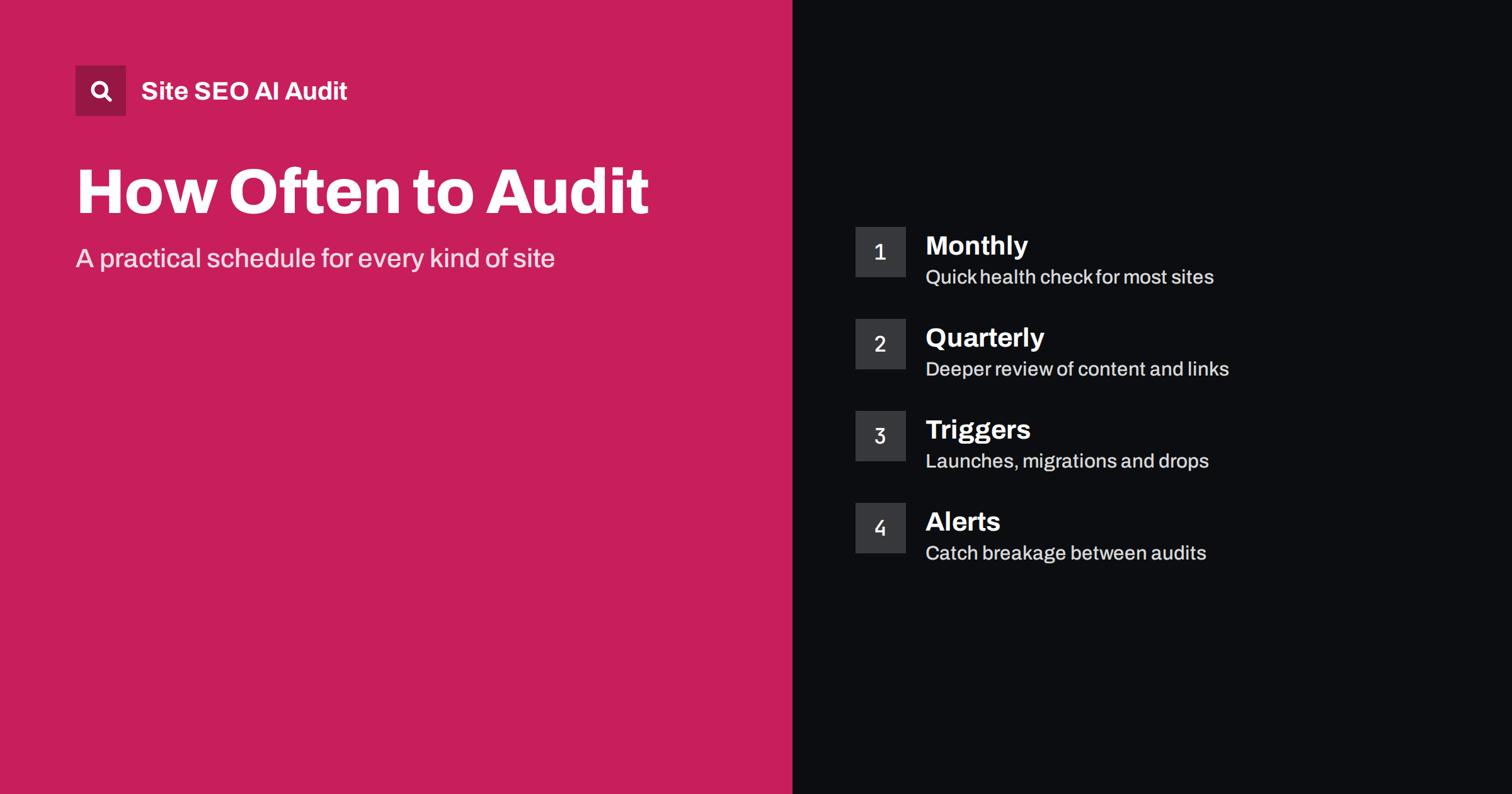
Short answer: Most websites benefit from a full SEO audit every three to six months and a lighter automated check every month, with additional audits after any major change such as a redesign, migration, new language version, platform update or sudden traffic drop. Large or fast-changing sites, such as shops with daily stock changes or publishers adding dozens of pages a day, should crawl weekly and watch alerts continuously. Small brochure sites that rarely change can run a full audit twice a year. The right frequency depends on how often the site changes, how much revenue depends on search and how costly a hidden problem would be. What matters more than the exact interval is that audits are repeated, compared over time and followed by fixes in order of impact.
A single audit is a snapshot. Websites change constantly: editors publish pages, developers deploy updates, plugins update themselves, redirects are added and forgotten, certificates expire, and search engines change their guidelines and crawlers. A problem introduced on a Tuesday can quietly remove pages from the index, and the first sign may be a drop in traffic weeks later. Regular audits turn SEO from a one-time project into maintenance, much like servicing a car. This guide explains how to set the frequency, what to check at each level, which events call for an immediate review and how to avoid audit fatigue, where reports pile up and nothing gets fixed. If you need a checklist for the audit itself, see the technical SEO audit checklist.
Factors that decide the frequency
Three questions help. How often does the site change? A site with a new product feed every day, user-generated content or several editors needs more frequent checks than a ten-page company site. How much does organic traffic matter to the business? If search brings most of the revenue, a hidden problem is expensive and detecting it quickly is worth the effort. How complex is the setup? Multiple languages, subdomains, several templates, JavaScript rendering and many plugins all multiply the chances of breakage. Add the risk of external change, since algorithm updates, new AI crawlers and browser standards can make yesterday’s setup a problem. Rate your site on these factors and choose a schedule from the tiers below. If in doubt, run more checks at the light level rather than more full audits.
A schedule by site type
For a small business site with a few dozen pages that changes occasionally, run a full audit twice a year and a quick check after each significant edit. For a content site or blog that publishes weekly, run a full audit quarterly and a light check monthly. For an online shop with a changing catalogue, run a crawl weekly or at least every two weeks, because stock changes, new filters and plugin updates create issues quickly. For a large publisher or marketplace, run continuous monitoring with weekly crawls and alerts on key templates. For agencies managing many client sites, schedule audits per client in line with their risk and report changes over time. The aim is to match effort to risk, not to follow a universal rule. See technical SEO monitoring for continuous checks between audits.
What to cover in a light monthly check
A monthly check should be short and mostly automated. Review the indexing report for new errors, excluded pages and spikes in noindexed or blocked URLs. Look at the crawl stats for changes in response time, error rate and crawl volume. Check that the sitemap still lists the right addresses and that robots.txt has not changed unexpectedly. Scan for new broken links, redirect chains and 5xx errors, confirm that the main templates still have unique titles, one H1 and valid structured data, and check that Core Web Vitals have not worsened. Compare against last month: the trend is more informative than the absolute number. Details on the reports are in the page indexing report and the crawl stats report.
What to cover in a quarterly or half-yearly audit
The deeper audit goes beyond error detection. Crawl the entire site, compare with the sitemap and Search Console, and review on-page elements across templates: titles, descriptions, headings, thin and duplicate content, images and internal links. Examine site architecture, click depth and orphan pages, check redirects and canonicals, test speed on real devices and review structured data coverage. For multilingual sites, validate hreflang and language versions. Add an AI visibility review: are AI crawlers allowed in robots.txt, is key content available without scripts, are facts and dates clear, and what do assistants say about you? Then review content performance and decide what to update, merge or remove. Methods are in the on-page SEO audit guide and, for multiple languages, the international SEO audit checklist.
Events that call for an immediate audit
Some changes should always trigger a check, not wait for the calendar. Audit before and after a redesign, a platform change, a domain or URL migration, a switch to HTTPS or a CDN, the launch of a new language or section, a major plugin or theme update, or a change of hosting. After launch, check redirects, indexing, canonicals, robots rules and speed within days, not weeks. A sudden drop in traffic or impressions, a spike in errors in Search Console, a manual action notice, or a confirmed core update affecting your sector are further triggers. Never launch a staging site into production without checking that noindex rules and password protection are removed, and that the old addresses redirect correctly. Related guides: the site migration checklist, website redesign SEO and core update recovery.
Turn findings into fixes
The biggest failure of audit programmes is not frequency but follow-through. A report with two hundred items overwhelms the team, and nothing changes. Group findings by impact and effort, fix issues that affect many pages or important pages first and schedule the rest. Assign an owner and a date to each fix, retest after deployment and record what changed. Rank by how many pages an issue affects and how much it limits crawling, indexing or conversions, as described in how to prioritise SEO fixes. A smaller list that gets done every month beats a perfect list that gets done once a year.
Auditite võrdlus ajas
Keep each audit result and compare it with the previous one. Did the total number of issues fall? Did the score improve? Are the same problems returning, which points to a process cause such as a template or plugin? Which fixes produced measurable changes in indexing, impressions or clicks? Annotate your analytics with the dates of changes so that you can connect cause and effect. Over time you learn which areas break most often and can add specific alerts for them. Good records also help when you change agencies or developers, since the history explains why settings exist.
Involve the right people. Technical findings often need a developer, content findings need an editor and link findings may need a marketer or an agency, so share the report in a form each person can act on, with the affected addresses and the reason it matters. Agree who approves changes to templates, redirects and robots rules, because those edits can affect the entire site. A short monthly meeting of fifteen minutes to review the top five open issues is often enough to keep the programme alive. When a fix has side effects or needs a larger project, record it as a ticket with an estimated effort so that it can be planned rather than forgotten.
Checklist and audit
- Full audit every three to six months, depending on site size and change rate.
- Light monthly check of indexing, crawl stats, sitemap and speed.
- Extra audit before and after redesigns, migrations and major updates.
- Alerts for sudden errors, noindex changes and robots.txt edits.
- Findings ranked by impact, with owners and dates.
- Results stored and compared with previous audits.
Site SEO AI Audit crawls your site across seven areas with about 50 checks per page, scores the result and ranks fixes by the points they add, so a repeat audit shows exactly what improved. The first audit of up to 200 pages is free; the pricing page lists plans for regular re-audits and several sites.
Related reading
- Technical SEO Monitoring
- Technical SEO Audit Checklist
- How to Prioritize SEO Fixes
- On-Page SEO Audit Guide
The bottom line
Audit on a rhythm that matches how your site changes: a light check every month, a full audit every few months, and extra audits around any major change. Rank the findings, fix the high-impact ones, retest and keep the history. Regular, smaller checks catch problems while they are cheap to fix.
KKK
Is an SEO audit once a year enough?
Only for small, rarely changed sites. Most sites benefit from a light monthly check and a full audit every three to six months, plus extra audits after major changes.
How long does a full audit take?
The crawl can take minutes or longer on big sites, but the real time is in reviewing findings and fixing them. Plan the fixes, not only the report.
What should trigger an unscheduled audit?
A redesign, migration, platform or hosting change, new language version, sudden traffic drop, spike in Search Console errors or a manual action.
Can I rely on Search Console instead of audits?
It is essential but incomplete. It reports what Google saw, while a crawl finds issues across all pages, including those not yet indexed, and checks areas Search Console does not cover.
How do I avoid audit fatigue?
Rank findings by impact, fix the top items first, assign owners and dates and compare each audit with the last one to show progress.