ENEnglish
 LTLietuviškai
 DEDeutsch
 FRFrançais
 RUРусский
 ESEspañol
 PLPolski
 ITItaliano
 UKУкраїнська
 CSČeština
 PTPortuguês
 JA日本語
 LVLatviešu valoda
 ETEesti
 HUMagyar
 IDBahasa Indonesia
 TRTürkçe
 HIहिन्दी
 ELΕλληνικά
 ARالعربية
 THไทย
 VITiếng Việt
 RORomână
 MSBahasa Melayu
 BNবাংলা
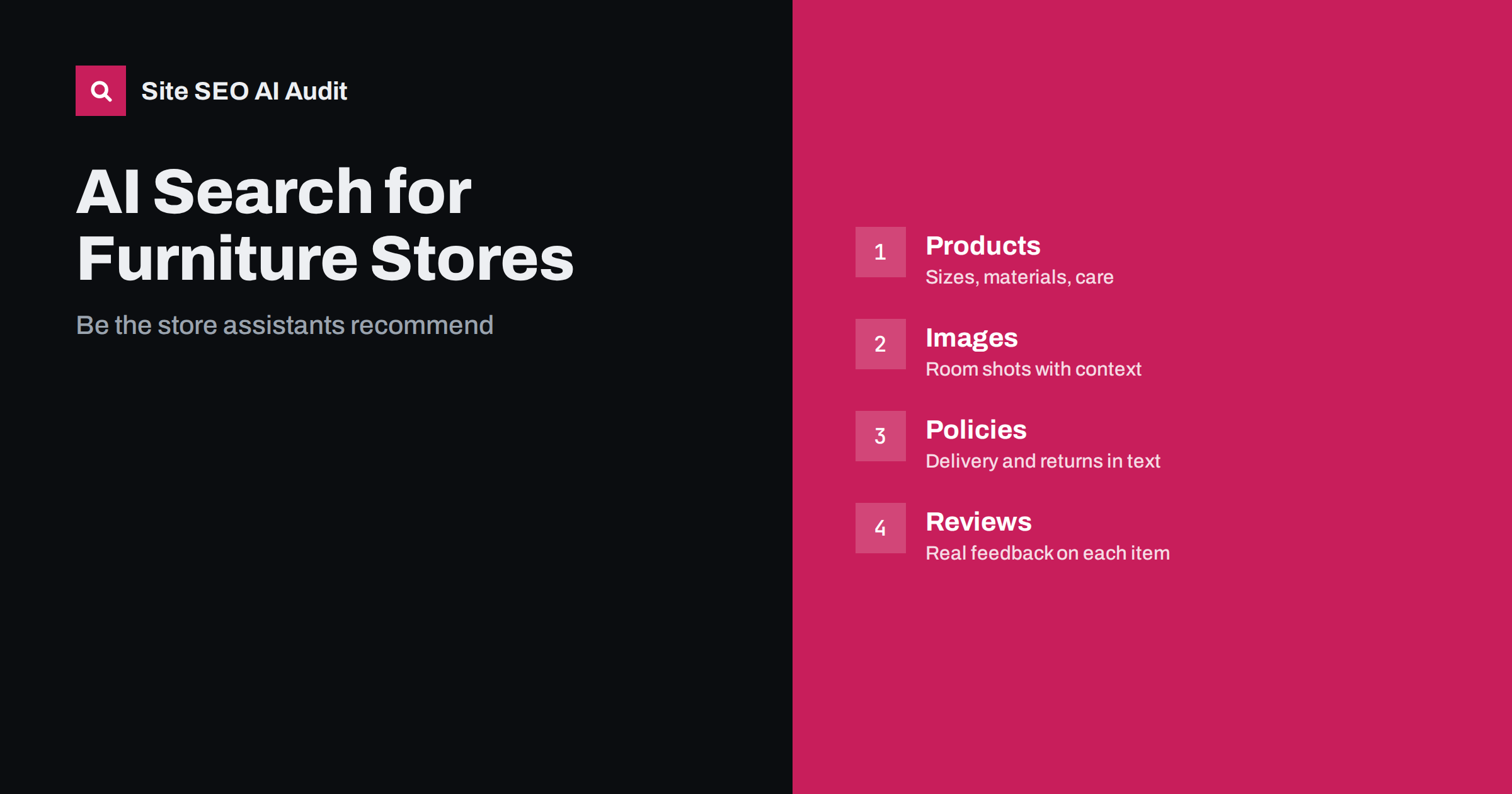
Short answer: Furniture and home decor shoppers increasingly ask AI assistants questions such as which sofa fits a small living room or which dining table seats six, and the assistants recommend stores whose pages answer those questions clearly. To be included, make every product page state the exact dimensions, materials, colours, weight, assembly needs and care instructions in plain text, mark them up with product structured data, show the item in real rooms with descriptive alt text, publish delivery, assembly and return terms where assistants can read them, and collect genuine reviews. Keep AI crawlers allowed in robots.txt, avoid hiding specifications inside images or scripts, and build category and buying-guide pages that explain how to choose. Stores that describe their products as precisely as a good salesperson would are the ones that get named.
Furniture is a considered purchase. People measure rooms, compare materials, worry about delivery of large items and read reviews before they pay. That behaviour fits AI assistants well, because a single conversation can replace many searches. A shopper may ask for a three-seater sofa under a certain width with removable covers, and the assistant looks for pages that contain those facts. Stores with thin descriptions, photos without text and delivery terms hidden in a PDF are hard to quote. This guide explains what to fix first in a furniture or home decor store, using the same fundamentals that apply to any shop but adapted to the questions this category creates. It builds on product pages for AI shopping answers and the general AI search visibility checklist.
Understand the questions shoppers ask
List the real questions behind your category before editing any page. Typical ones are size and fit (“will this sofa fit through an 80 cm door”), material and durability (“is solid oak better than veneer”), style (“Scandinavian living room ideas”), practical use (“easy to clean for pets or children”), assembly and delivery (“is it delivered assembled”), and price comparison. Collect them from customer service emails, chat logs, search queries in Search Console and the questions in the People Also Ask boxes. Each cluster should have a page that answers it: product pages for facts, category pages for choosing, and guides for decisions. Write the answers in the words customers use, not in catalogue jargon. This research is the same method described in prompt research for AI search.
Put specifications in text, in a consistent order
The most common weakness is that critical facts live only in images, tabs that load late or supplier PDFs. Put dimensions (width, depth, height, seat height, clearances), weight, materials, finish, colours, assembly time, load capacity and care in plain HTML on the product page, ideally in a short table or list that always follows the same order. Use units that your market expects and state both metric and imperial if you serve both. Say whether a size refers to the item or the packaging. Where a product has variants such as fabric or leg colour, make sure each option has its own readable description and, where sensible, its own address, following the advice in product variants and SEO. Consistency matters because assistants compare products and prefer pages where the same facts appear in the same place.
Add product structured data that matches the page
Structured data gives machines a clean copy of the facts on the page. Mark each product with its name, description, images, brand, SKU, price, currency, availability, material and colour where supported, and aggregate rating only when real reviews are shown on the page. The values must match what visitors see, including price and stock. Test the markup after each template change and fix errors at the source, not page by page. The details of fields and common mistakes are in the product schema guide. Structured data does not guarantee recommendations, but it removes ambiguity, and it also supports shopping features in conventional search.
Show products in rooms, with useful alt text
Images are central in this category, and assistants and search engines increasingly interpret them. Use sharp photographs of the product alone and in realistic rooms, add images that show scale next to common objects, and include close-ups of materials and joints. Give each image a descriptive file name and alt text that says what it shows, for example the item, colour and setting, without stuffing keywords. Put the key information near the image in text so that nothing depends on the picture alone. Serve modern formats at sensible sizes to keep pages fast. For more on this, see image SEO beyond alt text and visual search and Google Lens.
Make delivery, assembly and returns easy to quote
For bulky goods, logistics decide the purchase. Publish clear pages for delivery areas and costs, typical lead times, whether delivery is to the door or the room, assembly services, what to do when an item does not fit, and return and warranty terms. Link to them from product pages and the footer, and write them as normal HTML rather than scanned documents. State conditions plainly and keep them accurate, because an assistant that quotes a wrong promise creates a support problem for you. If terms differ by country, give each market its own page. Avoid vague wording such as “fast delivery” and give real ranges. The same approach to policy pages appears in privacy policy and legal pages.
Build category pages and buying guides that help people choose
Assistants answer comparison and selection questions by combining several sources, and your category pages can be one of them. Add a short introduction to each category that explains how to choose: sizes for room types, materials and their trade-offs, style families and care. Link to the relevant guides and to subcategories, and keep filters from creating endless thin URLs, as explained in category page SEO and faceted navigation SEO. Buying guides such as “how to measure for a sofa” or “how to choose a rug size” are evergreen and often quoted. Use headings that match real questions and answer each in the first sentences, in the style of answer-first introductions.
Collect real reviews and keep them visible
Reviews influence both shoppers and the systems that summarize opinions. Ask customers for feedback after delivery, show reviews on the product page in text, and include details that help others, such as room size, colour accuracy and assembly experience. Respond to negative reviews professionally. Do not publish fake or incentivized ratings without disclosure, and do not mark up reviews that are not on the page. The wider topic is covered in reviews and reputation in AI recommendations. Third-party platforms where customers also leave reviews matter too, so keep your business details consistent there.
Keep crawlers, speed and stock data in order
Check that your robots.txt and firewall do not block the crawlers you want, that product content does not depend on scripts that crawlers cannot run, and that pages load quickly with large images handled sensibly. Keep stock and price data accurate, and handle discontinued items with care instead of leaving dead pages or soft errors; see out-of-stock and discontinued products. If your platform duplicates supplier text, rewrite the descriptions with your own measurements, photos and advice, as discussed in manufacturer product descriptions and duplicate content. Review which assistants send visitors by tracking referrals, using the method in tracking AI referral traffic in GA4.
Checklist and audit
- Dimensions, materials, weight, assembly and care in text on every product page.
- Product structured data that matches visible price, stock and reviews.
- Room photos and close-ups with descriptive alt text.
- Delivery, assembly, returns and warranty pages in plain HTML.
- Category introductions and buying guides that answer selection questions.
- AI crawlers allowed, fast pages, accurate stock and unique descriptions.
Site SEO AI Audit crawls your store, flags duplicate titles, missing structured data, heavy pages and blocked AI crawlers, and ranks the fixes by how many points each adds. The first audit of up to 200 pages is free; for larger catalogues see the pricing page.
Related reading
- Product Pages for AI Shopping Answers
- Product Schema Guide
- AI Search for Fashion and Apparel Stores
- Category Page SEO
The bottom line
Assistants recommend furniture stores that answer buying questions with precise, readable facts. State dimensions and materials in text, support them with matching structured data, show products in context, make delivery and returns clear, publish guides that help people choose and keep your site open to crawlers. These improvements also help ordinary search, so the work pays off twice.
FAQ
Which product details matter most for AI recommendations?
Exact dimensions, materials, colours, weight, assembly needs and care instructions, shown in text on the page and repeated in structured data. Price, stock and delivery terms come next.
Do I need a separate page for every colour or size?
Not always. Use separate addresses when variants differ enough that people search for them separately, and otherwise keep one page with clear variant text and a canonical address.
Are lifestyle photos useful if assistants read text?
Yes. Images show scale and style to shoppers and are increasingly interpreted by search systems. Add alt text and nearby text so that the information does not depend on the picture alone.
Should I block AI crawlers to protect my product descriptions?
That is a business decision. Blocking removes you from answers that rely on those crawlers, so decide deliberately for each crawler and keep the rules documented.
How do I know if assistants send me visitors?
Track referral sources in your analytics, look for known assistant domains and compare landing pages over time. Treat the numbers as an indication, because not every assistant passes referrer data.