ENEnglish
 LTLietuviškai
 DEDeutsch
 FRFrançais
 RUРусский
 ESEspañol
 PLPolski
 ITItaliano
 UKУкраїнська
 CSČeština
 PTPortuguês
 JA日本語
JA日本語 LVLatviešu valoda
 ETEesti
 HUMagyar
 IDBahasa Indonesia
 TRTürkçe
 HIहिन्दी
 ELΕλληνικά
 ARالعربية
 THไทย
THไทย VITiếng Việt
 RORomână
 MSBahasa Melayu
 BNবাংলা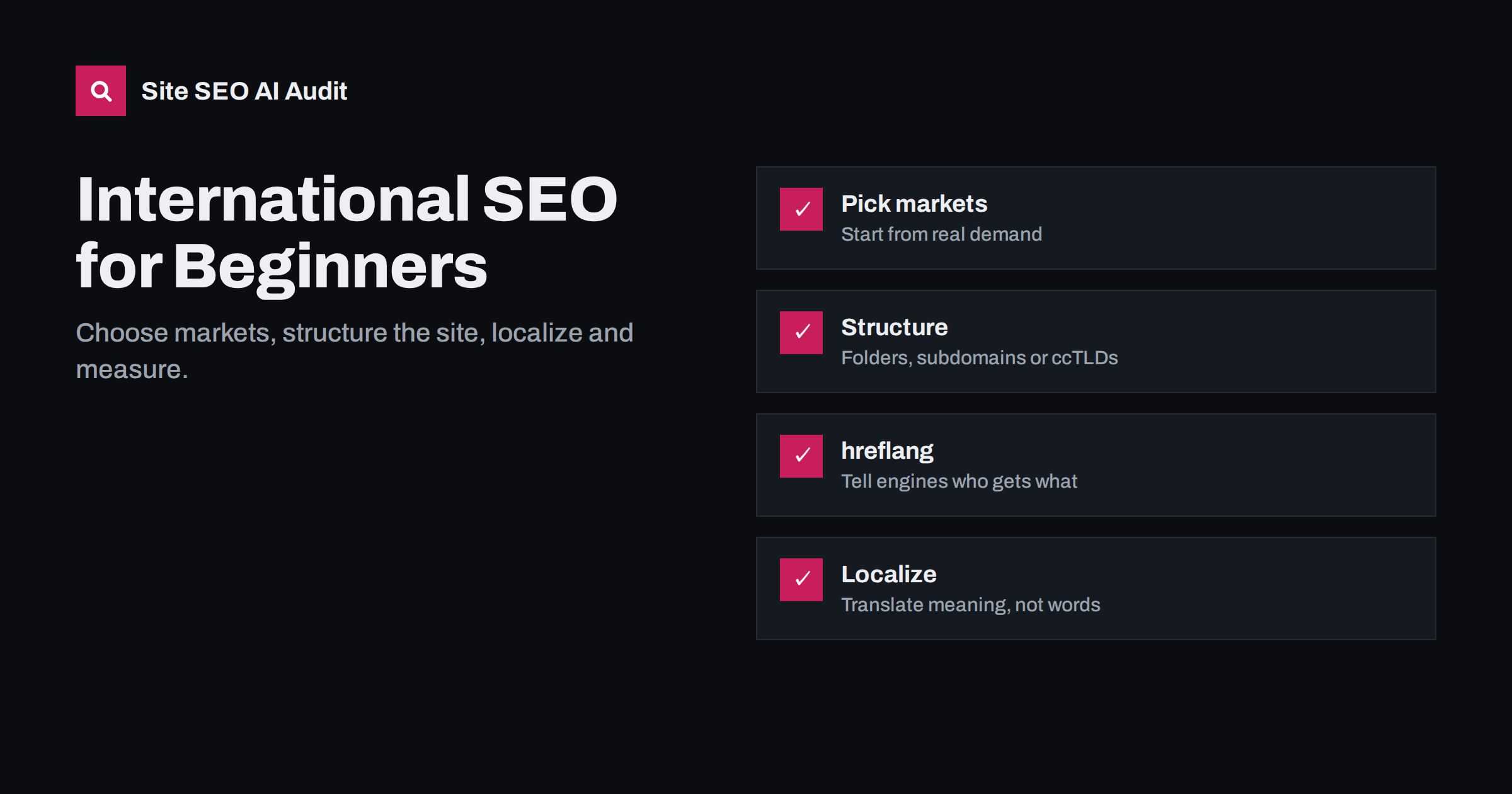
Short answer: International SEO means making your website findable in more than one country or language. In practice you choose target markets based on real demand, pick a URL structure, publish properly localized content for each market, connect the versions with hreflang, and measure each market separately. Most failures come from thin machine translations, forced redirects and hreflang that nobody checks after launch.
What international SEO covers
Regular SEO asks one question: can searchers find and use this page? International SEO adds two more: which searchers, and in which language? A page that ranks well in the United States can be invisible in Germany, not because it is bad, but because German searchers use German words and search engines prefer to show them German pages.
International SEO therefore sits across several areas at once:
- Strategy: which markets and languages are worth the effort.
- Architecture: where each version lives, such as a country domain, a subdomain or a subfolder.
- Signals: hreflang, lang attributes, local content and local links that tell search engines who each version is for.
- Content: translation and localization that reads naturally to local people.
- Measurement: reports that separate markets, so you know what is working where.
It is worth separating two ideas early. A multilingual site offers content in several languages. A multi-regional site targets several countries. Many sites are both, but the difference matters: a Spanish page for all Spanish speakers is a language decision, while separate pages for Spain and Mexico are a country decision.
Step 1: Choose markets based on evidence
The most expensive international SEO mistake is translating a site into languages nobody asked for. Before you create anything, look at the evidence you already have:
- Existing traffic. Your analytics and Search Console already show visitors and impressions from other countries. Where do they come from, and do they convert?
- Sales and enquiries. Customers who find you despite the language barrier are a strong signal that a localized version would do better.
- Search demand. Keyword research in the target language shows whether people search for what you offer, and with which words.
- Ability to serve. Can you ship there, support customers in that language, and meet local legal requirements? SEO cannot fix an offer that does not work for the market.
- Competition. Some markets are crowded with strong local players; others have few good local-language pages.
Start with one or two markets and do them well. Adding markets later is easy once the structure and workflow are in place; fixing ten half-finished language versions is not.
Step 2: Pick a URL structure
There are three main ways to organise international versions:
- Country-code domains such as example.de: the clearest country signal, but the most work, because each domain builds authority separately.
- Subdomains such as de.example.com: technically separate, with no real SEO advantage over folders in most cases.
- Subfolders such as example.com/de/: one domain, one set-up, shared authority, and the easiest to grow.
For most small and medium businesses, subfolders are the practical default. Choose once and stay consistent, because changing structure later is a full migration. Avoid language parameters such as ?lang=de; they are fragile and harder to report on.
Step 3: Localize, do not just translate
Search engines want to show pages that are genuinely useful to local readers. A literal translation of your English page often is not. Localization adapts the content to the market:
- Keywords. Research the terms people actually use. The direct translation of your main keyword is often not what locals type.
- Currency, units and formats. Prices in local currency, metric or imperial units, local date and number formats.
- Examples and references. Local holidays, regulations, payment methods and cultural references.
- Contact and trust details. Local phone numbers, addresses, delivery terms and reviews from local customers where you have them.
- Everything around the content. Titles, meta descriptions, navigation, buttons, image alt texts, structured data and error pages should be translated too.
Machine translation can speed up the work, but publishing it unreviewed is risky. Google’s spam policies target content generated at scale mainly to rank rather than to help people, and unedited translations of large sites can fall into that category. Have a fluent speaker review at least the most important pages.
Step 4: Connect the versions with hreflang
hreflang tells search engines which version of a page is meant for which language or country. Each version lists all versions, including itself, with valid codes such as de or en-gb, and every link must be returned by the other side. An optional x-default names the fallback for everyone else.
Most multilingual plugins and platforms generate hreflang automatically once translations are linked. That is helpful, but it is not a guarantee. Missing translations, renamed slugs, redirects and canonical conflicts break clusters silently. Plan to check hreflang after launch and after every major change.
Also set the lang attribute on each page’s html element to the page’s language. It is not a ranking signal for Google, but browsers, screen readers and other search engines use it.
Step 5: Avoid the classic technical traps
A few mistakes cause most international SEO problems:
- Forced redirects by IP or browser language. Crawlers often come from one country and send no language preference. If you always redirect them, they may never see some versions. Suggest the local version with a banner instead.
- Canonical tags pointing across languages. A German page whose canonical points at the English page is telling search engines the German page is a duplicate. Each language version should normally canonicalise to itself.
- Half-translated pages. Translated body text inside English menus and footers sends mixed signals and looks careless to visitors.
- Language switchers that are not links. Switchers built with JavaScript or forms may not be crawlable. Use normal links to the equivalent page, not just the home page of each language.
- Missing sitemaps for new versions. Make sure every language version is in your XML sitemap so it is discovered quickly.
Step 6: Measure each market separately
International results are easy to misread when all markets are mixed together. Set up reporting that separates them from the start:
- In Search Console, filter the performance report by country and by page (for example, URLs containing
/de/) to see how each version does where it should. - In analytics, segment by language folder or domain and by country.
- Watch for the wrong version appearing in a market, for example English pages getting German impressions. That usually points to hreflang or content problems.
- Give new markets time. A new language version often takes months to build visibility, just like a new site.
A simple launch checklist for your first new market
When the first new language version is ready, run through this list before and right after launch. It catches most problems while they are still cheap to fix.
- Every page planned for the market is translated, including navigation, footer, forms, error messages and legal pages.
- Titles and meta descriptions are written in the new language, not copied from the original.
- Each page has a self-referencing canonical tag and a lang attribute that matches its language.
- hreflang is present on both the original and the new version, with return links and valid codes.
- The language switcher links to the equivalent page in each language, not only to the home page.
- New URLs are included in the XML sitemap, and the sitemap is submitted in Search Console.
- No automatic redirect forces visitors or crawlers away from the version they requested.
- Prices, currency, shipping, contact details and structured data match the new market.
- Analytics and Search Console reports are filtered so the new market can be measured on its own.
- A crawl after launch confirms that every new page returns status 200 and is indexable.
Keep the checklist and reuse it for every market you add later. The second and third launches are usually much faster, because the workflow and templates are already proven.
How Site SEO AI Audit supports international sites
Site SEO AI Audit crawls a site the way a search engine does and scores seven areas, one of which is Languages: hreflang return links, broken language versions, x-default and lang attributes on every crawled page. The same crawl covers canonicals, redirects, sitemaps and on-page basics, so problems that affect only one language version still show up, weighted by how many pages they touch. It is a way to check the technical side after launch rather than a replacement for good translation. You can run a free first audit.
Related reading
- ccTLD vs subdomain vs subfolder for international sites
- What is hreflang? A plain-English guide for site owners
- hreflang language and region codes: a practical reference
The bottom line
International SEO is not a switch you flip by translating a site. Pick markets where demand already exists, choose one URL structure, localize content properly, connect versions with hreflang, avoid forced redirects and cross-language canonicals, and measure each market on its own. Start small, get one market right, and then repeat the process.
FAQ
What is the difference between international SEO and local SEO?
Local SEO helps a business appear for searches in a specific city or area, often through map results. International SEO helps a website appear in other countries or languages. A business can need both, but the techniques are different.
Do I need a separate website for each country?
No. Most businesses do well with one domain and a subfolder per language or country. Separate country domains make sense mainly for large brands with local teams.
Is machine translation bad for SEO?
Machine translation is not banned, but unreviewed translation at scale often produces low-quality pages. Use it as a starting point and have fluent speakers review and adapt at least your most important pages.
How long does international SEO take to show results?
A new language version often behaves like a new site and can take several months to gain visibility. Existing authority on the domain usually helps subfolders more than brand-new country domains.
Should I redirect visitors to their language automatically?
It is safer not to force it. Show a banner suggesting the local version and let visitors choose. Forced redirects can stop search engines from crawling all versions.