ENEnglish
 LTLietuviškai
 DEDeutsch
 FRFrançais
 RUРусский
 ESEspañol
 PLPolski
 ITItaliano
 UKУкраїнська
 CSČeština
 PTPortuguês
 JA日本語
JA日本語 LVLatviešu valoda
 ETEesti
 HUMagyar
 IDBahasa Indonesia
 TRTürkçe
 HIहिन्दी
 ELΕλληνικά
 ARالعربية
 THไทย
THไทย VITiếng Việt
 RORomână
 MSBahasa Melayu
 BNবাংলা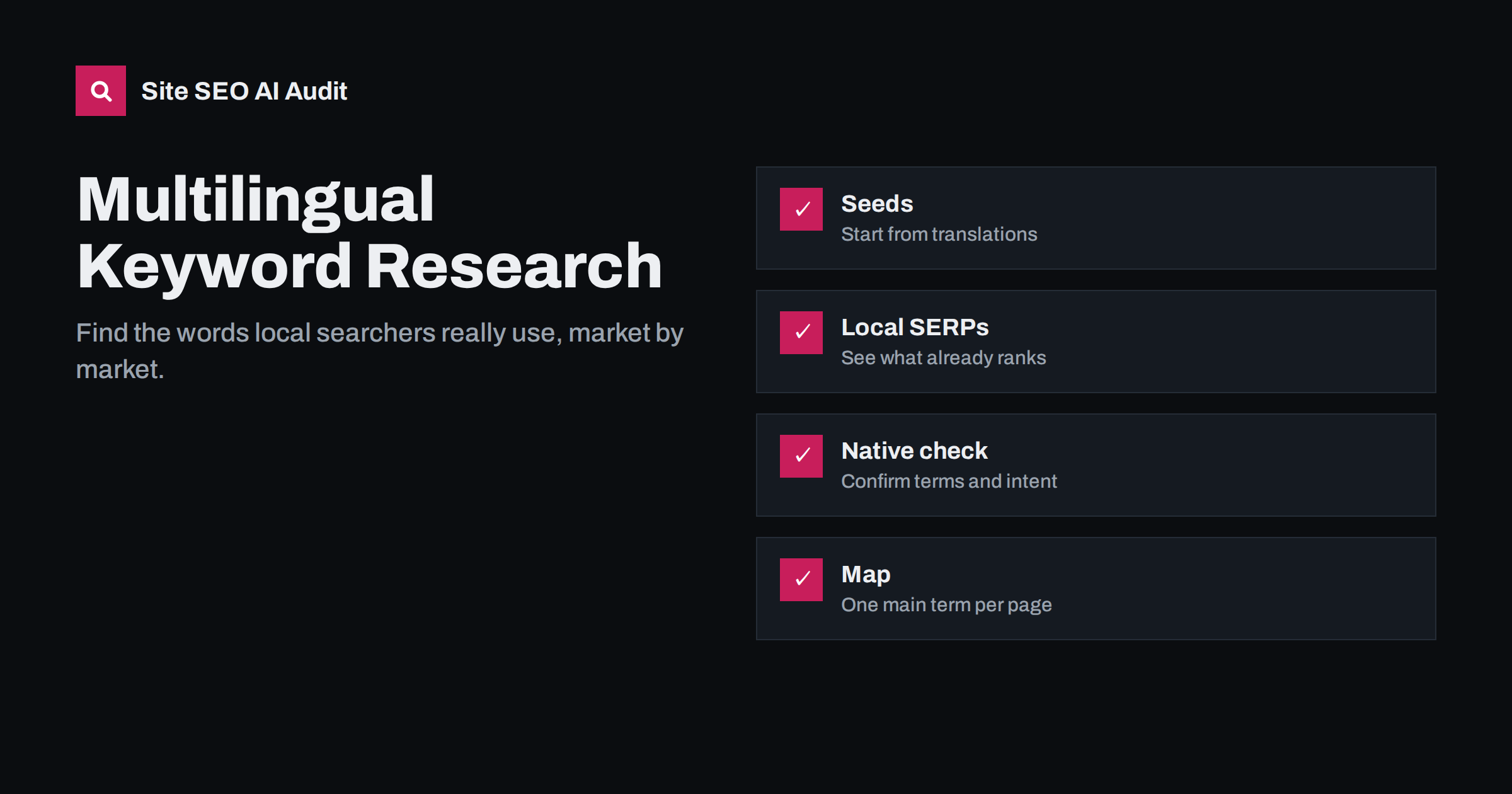
Short answer: Multilingual keyword research means finding the terms people actually search for in each target language and country, rather than translating your existing keyword list. Start with translated seed terms, expand them with local autocomplete, keyword tools set to the right country and language, and the pages that already rank there. Then have a native speaker confirm the terms and their intent, and map one main term to each localized page.
Why translated keywords fail
A keyword list is a record of how people in one market describe their needs. Translate it, and you get a record of how your translator would describe those needs, which is not the same thing. There are several reasons the two diverge:
- Vocabulary differs. Languages often have several candidate words for one concept, and searchers typically favour one of them. Translators may choose a more formal or literary option.
- English terms survive. In technology, marketing and many other fields, people in non-English markets often search with English words or a mix of English and local words.
- Spelling and grammar vary. Inflected languages produce many forms of the same word; searchers may type without diacritics, such as “zurich” instead of “Zürich”, or in a colloquial form.
- Intent shifts. A phrase that means “I want to buy” in one market can mean “I want to learn” in another, so the same page type does not fit.
- The market is different. Some products are known under a local brand name, or solved in a different way locally, which changes what people search for.
None of this is visible from a spreadsheet of translations. It becomes visible only when you look at real search data and real results in each market.
Step 1: Build seed terms
Seeds are the starting points of research. For each target market, gather:
- Professional translations of your main topics and product categories, with alternatives where the translator sees several options.
- The terms local competitors use in their navigation, headings and titles.
- Words your local customers use in emails, support tickets, reviews and sales calls.
- Terms already bringing impressions to your site from that country, visible in Search Console when you filter by country.
At this stage, quantity beats precision. The next steps will filter the list.
Step 2: Expand with local data
Next, expand each seed using sources that reflect the target market:
- Autocomplete. Search suggestions show common completions. Make sure you see the local version: use the local Google domain or settings for the right language and country, or a browser profile set to that locale.
- Keyword tools set to the right location and language. Most tools let you choose both. A common mistake is researching Spanish terms with the location set to the United States, which returns US Spanish data rather than data for Spain or Mexico.
- Related searches and “people also ask” in local results, which show the questions people ask in their own words.
- Local forums, marketplaces and communities, which show the everyday language people use about your topic.
Record search volume where tools provide it, but treat small-market numbers with caution. In smaller countries, volumes are often low and estimates can be rough. A term with modest estimated volume may still be the right one if it clearly matches what you offer.
Step 3: Study the local results
For your most important terms, look at the actual search results in the target market. They answer questions no volume number can:
- What type of page ranks? Product pages, category pages, guides, comparison articles, videos or local business listings. Your page should match the dominant type.
- Who ranks? Local sites, international brands or marketplaces. Strong local competitors may mean a harder market; international sites ranking with thin translations may mean an opportunity.
- Which language appears? In some markets, English pages rank for certain terms because little local content exists.
- What vocabulary do top pages use? Titles and headings of ranking pages confirm the terms searchers respond to.
Checking results from the right location matters. Your own results are shaped by where you are and your settings, so use tools or settings that show the market you are researching.
Step 4: Validate with a native speaker
A fluent speaker who knows the market, ideally someone who also knows your industry, should review the shortlist. Ask them concrete questions:
- Which of these terms would you type when looking for this?
- Does this term sound natural, formal, dated or slangy?
- Would someone searching this want to buy, compare or learn?
- Are there terms we are missing?
- Are any terms misleading, offensive or associated with something else locally?
This step catches errors that no tool can: a word that is technically correct but never used, or a phrase with an unfortunate second meaning.
Step 5: Map keywords to pages
A localized keyword list is only useful when it is attached to pages. For each market, map terms to URLs the same way you would for your home market:
- One main term per page, plus closely related variants the page can cover naturally.
- Equivalent pages first. Map the local terms to the translated versions of your existing pages, so each localized page has a clear target.
- Gaps become new content. Terms without a matching page point to topics you may need to create for that market only.
- Avoid overlap. Two localized pages targeting the same main term compete with each other, the same way they would in your home market.
Hand the mapping to translators before they start. Using the target term naturally in the title, headings and body during translation is far easier than rewriting pages afterwards.
Special cases: shared languages and multilingual countries
Some markets need extra care:
- One language, several countries. Spanish in Spain and Mexico, English in the UK and the US, and German in Germany and Austria often differ in vocabulary. Research each country if you plan separate country pages. If you plan one page for all, choose terms that work widely and check results in the largest markets.
- Several languages, one country. In Switzerland, Belgium or Canada, research each official language you plan to publish in. People search in their own language, not in the country’s “main” one.
- Non-Latin scripts. For languages such as Japanese, Chinese or Arabic, searchers may use several scripts or transliterations. A native reviewer is essential here.
- Different search engines. In a few markets, other search engines have significant share. Their keyword tools and results can differ from Google’s.
Mistakes that waste the research
Even good research can be undone by how it is used. These are the mistakes that most often turn a solid keyword list into poor results:
- Research done after translation. The pages are already written with the translator’s word choices, and nobody has time to rewrite them. Research first, translate second.
- Wrong tool settings. Location and language set to the home market, which quietly returns the wrong data for every term.
- Chasing volume over fit. A broad, high-volume term that does not describe your offer brings visitors who leave immediately.
- Ignoring local page types. Writing a long guide when local results are dominated by product listings, or the reverse.
- Keyword stuffing in translation. Asking translators to repeat a term unnaturally makes pages worse for readers and does not help rankings.
- No owner per market. Nobody is responsible for the keyword list in each language, so it is never updated after launch.
Assigning a named owner to each market’s keyword list, even part-time, is one of the simplest ways to keep the research alive.
Keeping the research up to date
Keyword research is not a one-time project. Language changes, new competitors appear and your own site starts to generate data. Once localized pages are live:
- Review the queries each language version receives in Search Console, filtered by country and by page folder.
- Look for queries where the wrong language version appears, which may point to hreflang or targeting problems.
- Add new terms that appear in real query data to the relevant pages or to your content plan.
- Repeat a lighter version of the research every six to twelve months for each important market.
The technical foundation matters too. Localized pages cannot rank for local terms if search engines do not index them or show the wrong version. Site SEO AI Audit crawls a site like a search engine and checks both on-page elements, such as titles, descriptions and headings, and the Languages area, including hreflang return links and broken language versions. You can run a free first audit before investing in content for a new market.
Related reading
- Translation vs localization for SEO: what actually changes
- Keyword cannibalization: how to spot it and fix it
- International SEO for beginners: how to take a site global
The bottom line
Do not translate keyword lists; research them in each market. Start with translated seeds, expand with local autocomplete, correctly configured keyword tools and local results, check the terms with a native speaker, and map one main term to each localized page before translation starts. Then keep refining with the real queries each language version receives.
FAQ
Can I use Google Translate for keyword research?
Only to create seed terms. Translation tools do not tell you what people actually search for, so each translated term needs checking against local search data and results.
How do I see search results for another country?
Use a keyword or rank tool set to that country and language, or adjust search settings for region and language. Your own results are influenced by your location, so a normal search from home is not reliable.
What if local search volumes are very low?
In smaller markets, volumes are often low and estimates rough. Choose terms that clearly match your offer and that local results confirm, rather than chasing the highest number.
Should I use English terms on non-English pages?
Sometimes, yes. If local searchers commonly use an English term, it can belong on the local page alongside the local word. Local search data and a native reviewer will show whether that is the case.
Do I need separate research for Spanish in Spain and Mexico?
If you plan separate pages for each country, yes, because vocabulary often differs. For a single Spanish page, check that your chosen terms work in your most important Spanish-speaking markets.