ENEnglish
 LTLietuviškai
 DEDeutsch
 FRFrançais
 RUРусский
 ESEspañol
 PLPolski
 ITItaliano
 UKУкраїнська
 CSČeština
 PTPortuguês
 JA日本語
JA日本語 LVLatviešu valoda
 ETEesti
 HUMagyar
 IDBahasa Indonesia
 TRTürkçe
 HIहिन्दी
 ELΕλληνικά
 ARالعربية
 THไทย
THไทย VITiếng Việt
 RORomână
 MSBahasa Melayu
 BNবাংলা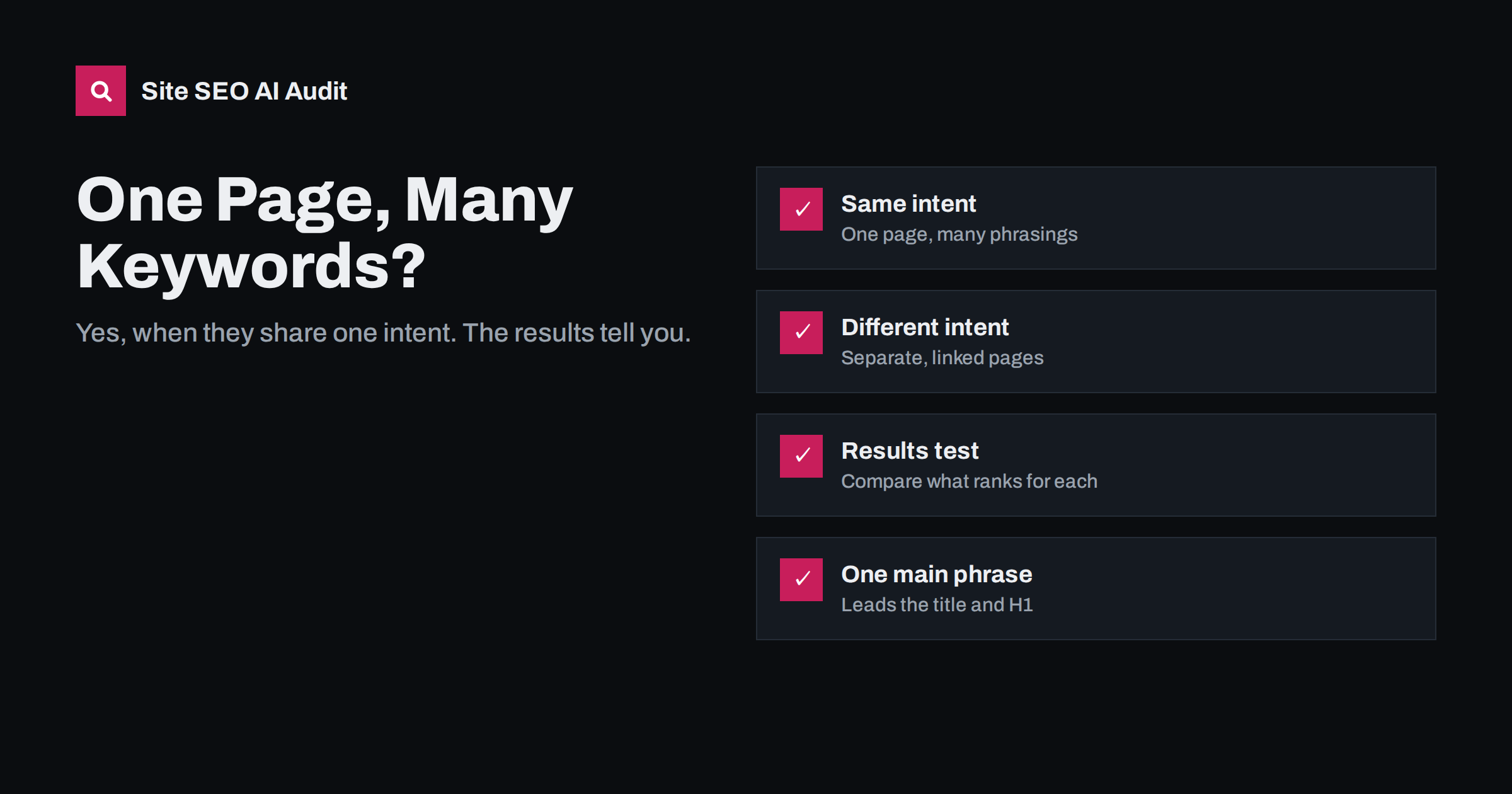
Short answer: Yes, one page can and usually does rank for many keywords, as long as they share the same search intent. A good page about writing meta descriptions will rank for dozens of phrasings of that question. What does not work is targeting unrelated intents on one page, such as a buying guide and a repair tutorial. The test is simple: if the same pages rank for two phrases, they belong on one page; if the results differ, they need separate pages.
Why one page ranks for many keywords
People describe the same need in many different ways. “How to write a meta description”, “meta description tips”, “writing a good meta description”, “meta description examples” and “what to put in a meta description” are different strings, but almost everyone typing them wants the same thing: to learn how to write a good description.
Search engines understand this. They recognize synonyms, related phrasing and the intent behind a query, so a single strong page on the topic can appear for all of these. If you look at a successful page in Google Search Console, you will usually find it receives impressions for many queries, often hundreds, most of them phrases the author never explicitly targeted.
So the question is not “how many keywords can a page target?” but “how many intents can a page serve well?” The answer to the second question is usually one main intent, plus closely related questions.
Same intent, different words: one page
Group phrases onto one page when they share the intent. Signs that phrases belong together:
- They are synonyms or rephrasings: “running shoes” and “trainers for running”.
- One is a narrower version of the other that the main page naturally covers: “meta description length” within “how to write meta descriptions”.
- They are questions a reader of the main topic would ask next: “why is Google not showing my meta description?”
- The search results for them are largely the same pages.
A page serving this group should answer the core question directly, then cover the related questions in sections or an FAQ. The variants appear naturally as you do.
Different intents: separate pages
Split phrases onto different pages when the need behind them is different, even if the words overlap:
- “best running shoes” (comparing options) and “how to clean running shoes” (a task) share words but not intent.
- “payroll software” (looking for a product) and “how to run payroll” (learning a process) need different pages.
- “boiler repair” (a service) and “boiler pressure too high” (a problem to understand) are related but distinct.
The overlap in words is what makes these cases tricky. Keyword tools often group such phrases together because they share terms, and it is easy to assume one page can handle them all. Always check the intent before accepting a tool’s grouping.
Trying to serve both intents on one page usually produces a page that serves neither well: too salesy for learners, too long and indirect for buyers.
The search results test
The most reliable way to decide is to let the search results tell you:
- Search the first phrase in a private window and note the top results.
- Search the second phrase and compare.
- If several of the same pages appear in both, the phrases share an intent. Target them with one page.
- If the results are mostly different, or a different type of page ranks, target them with separate pages.
This test reflects how search engines currently understand the queries, which is more reliable than guessing from the words alone.
Two refinements make it more useful. First, look at the type of page as well as the specific URLs: if both queries return how-to guides from different sites, they may still share an intent even without much URL overlap. Second, repeat the test from time to time for important groups. Search engines adjust how they interpret queries, and two phrases that once returned the same pages can drift apart, or the other way round.
How to optimize one page for a group of keywords
| Element | How to handle the group |
|---|---|
| Title tag | Main phrase near the start; do not list variants |
| H1 | Main phrase or a close variant |
| Opening paragraph | Answer the core question directly |
| H2 and H3 headings | Use important variants and related questions where they describe sections |
| Body text | Cover subtopics fully; variants and related terms appear naturally |
| FAQ | Answer short related questions that do not need their own section |
| Internal links | Other pages link here with varied, descriptive anchors |
The title and H1 carry the main phrase. Everything else is about covering the topic well enough that the rest of the group is answered.
Choosing the main keyword for a page
Within a group, pick one phrase to lead the title and H1. Good criteria:
- It describes the page best. The phrase a reader would recognize as “exactly what I want”.
- It is how most people say it. Search Console data and search suggestions show which phrasing is most common for your audience.
- It fits naturally in a title. Some phrases are common but awkward; choose one that reads well.
Do not agonize over this. The other phrases in the group will still bring traffic if the page covers them.
After publishing, check which queries the page actually receives impressions for. If a variant you considered secondary turns out to bring most of the impressions, and the page ranks poorly for it, consider adjusting the title or adding a section that addresses that phrasing more directly. The data will often show you the words your audience really uses.
Signs a page is trying to do too much
- The title is a list of phrases joined by commas or pipes.
- The page has sections for clearly different audiences or tasks that do not connect.
- It ranks moderately for many unrelated queries but well for none.
- Visitors from different queries all leave quickly, because each finds only a small part of what they wanted.
- Your site has another page competing for some of the same queries.
These pages often grow gradually: a section added for a new service, another for a seasonal question, a third after a customer asked something. Each addition made sense at the time, but together they blur the page’s purpose.
If you see these signs, split the page along intent lines: keep the strongest intent on the existing URL, move the others to new or existing pages, and link between them.
A worked example
Suppose a garden centre has one page titled “Lawn Care” that tries to rank for “lawn care tips”, “when to mow the lawn”, “best lawn mower”, “lawn feed”, “how to get rid of moss in the lawn” and “lawn care services”. Checking the search results shows:
- “lawn care tips” and “when to mow the lawn” return similar seasonal guides: one intent, one guide.
- “how to get rid of moss in the lawn” returns specific moss-removal guides: its own page, linked from the main guide.
- “best lawn mower” returns comparison pages and product listings: a buying guide or category page.
- “lawn feed” returns product categories: a category page.
- “lawn care services” returns local service businesses: a service page, if the centre offers the service.
The original URL keeps the seasonal lawn care guide, since that was its strongest intent and it already had links and history. The new pages are linked from it where a reader would naturally want to go next.
One overloaded page becomes five focused pages, each serving one intent well and linked to the others where readers would naturally move between them.
Checking for overlap on your site
When pages try to do too much, or several pages chase the same intent, the symptoms often show in a crawl: duplicate or near-duplicate titles, near-duplicate content and weakly linked pages. Site SEO AI Audit reports these across every page, weighted by how many pages each issue affects. You can run a free first audit and use the results alongside Search Console queries to see which pages need splitting or merging.
Related reading
- Keyword Mapping: Give Every Search Topic One Clear Page
- Keyword Cannibalization: How to Spot It and Fix It
- Search Intent: How to Match Your Page to What Searchers Want
- Keyword Placement: Where to Use Keywords on a Page
The bottom line
A page can rank for many keywords when they share one intent, and good pages usually do. Group phrases by intent using the search results test, give each group one page led by the clearest main phrase, and cover related questions in sections and an FAQ. Split pages that try to serve different intents, and link the resulting pages to each other.
FAQ
How many keywords can one page rank for?
There is no limit. Strong pages often rank for hundreds of queries that share the same intent. The practical limit is intent: one main need per page.
Should I put several keywords in the title tag?
No. Lead with one main phrase and write a natural title. Listing variants makes the title look spammy and increases the chance it is rewritten.
How do I know if two keywords need separate pages?
Search both. If the same pages rank for each, one page can serve both. If the results are different, or a different type of page ranks, create separate pages.
Can a page rank for both informational and commercial keywords?
Sometimes, when the results for a query are mixed. Usually it works better to have a guide for the informational intent and a product or service page for the commercial one, linked together.
What is a keyword group?
A set of search phrases that share the same intent and can be served by one page, such as different ways of asking how to write a meta description.