ENEnglish
 LTLietuviškai
 DEDeutsch
 FRFrançais
 RUРусский
 ESEspañol
 PLPolski
 ITItaliano
 UKУкраїнська
 CSČeština
 PTPortuguês
 JA日本語
 LVLatviešu valoda
 ETEesti
 HUMagyar
 IDBahasa Indonesia
 TRTürkçe
 HIहिन्दी
 ELΕλληνικά
 ARالعربية
 THไทย
 VITiếng Việt
 RORomână
 MSBahasa Melayu
 BNবাংলা
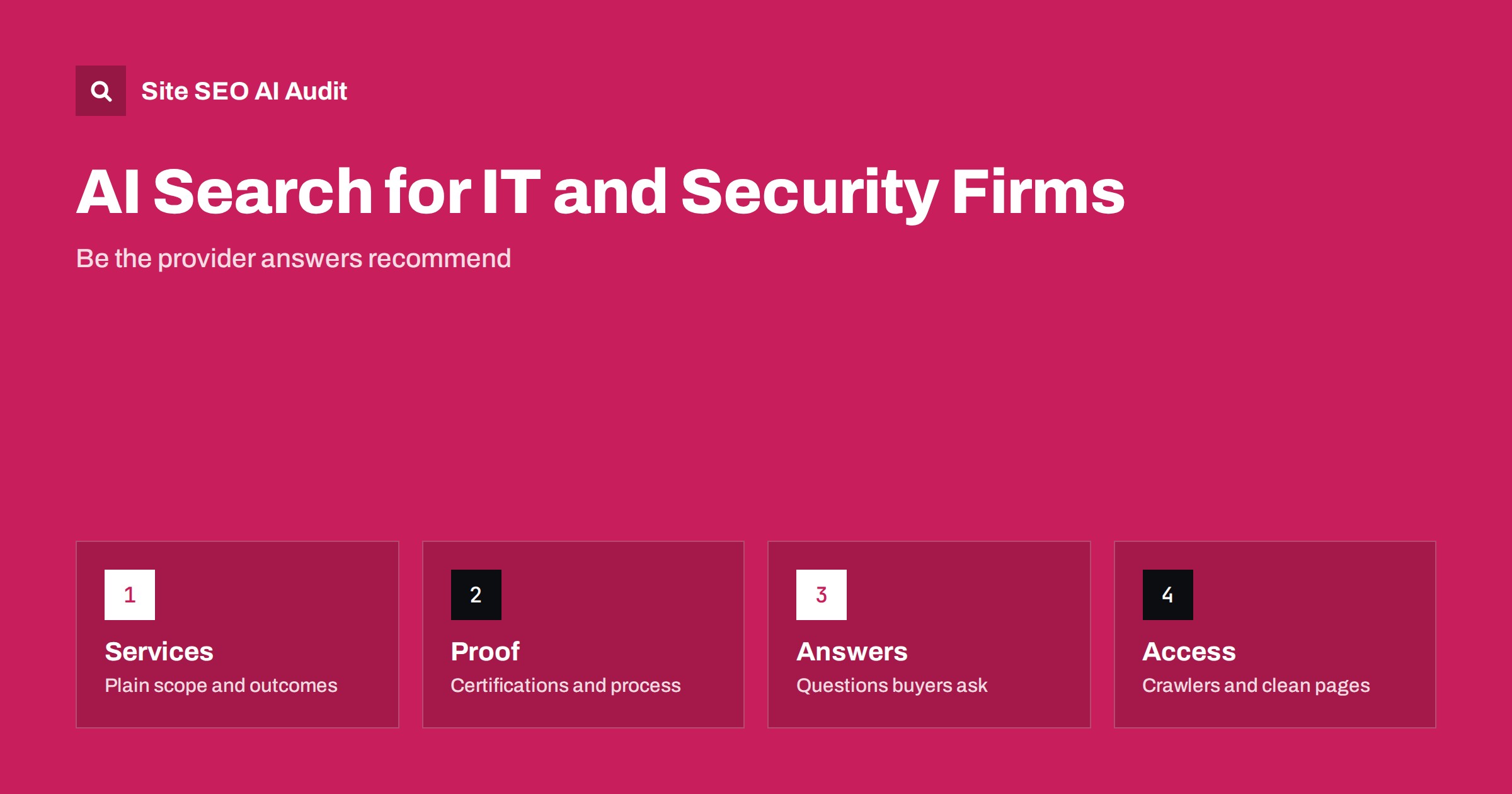
Short answer: IT services and cybersecurity companies earn mentions in AI answers by publishing clear, specific, verifiable pages: what each service covers, who it is for, how the work is done, which standards and certifications apply and what a first engagement looks like. Answer engines favour sources that explain concepts accurately, show real expertise and make facts easy to extract. Write pages that answer the questions buyers ask before they contact a provider, keep your company details consistent across the web, allow the crawlers you want and check regularly what AI systems say about you.
Choosing an IT or security provider is a high-trust decision. Buyers used to compare a handful of search results and a few review sites. Now many start by asking an assistant questions such as which managed service provider suits a twenty-person firm, what a security assessment includes or how to prepare for an audit. The answer often names a few companies and summarises what they offer. If your firm is missing from that summary, or described wrongly, you lose the earliest stage of the buying process. This guide explains what to publish, how to structure it and how to check the result. For the wider picture, see how AI search engines work.
Why this sector is different
Technology buyers are cautious, and AI systems are cautious on their behalf. Security advice that is wrong can cause harm, so answer engines tend to lean on sources that look authoritative, current and consistent. Your pages compete with vendor documentation, standards bodies, public agencies, industry publications and community discussions. A services company rarely wins by volume of content. It wins by being the clearest, most specific and most credible source on a narrow set of topics tied to the services it actually sells.
The sector also has a vocabulary problem. Terms such as managed detection, penetration testing, vulnerability scanning, endpoint protection, help desk, cloud migration and disaster recovery are used loosely and mean different things at different companies. When your pages define each service in plain language and state what is and is not included, answer engines can quote your definition and buyers can compare you fairly. Vague phrases such as end-to-end solutions or cutting-edge technology give a system nothing it can safely repeat.
Describe each service on its own page
Give every distinct service its own page rather than listing everything on one overview. A good service page opens with a short answer that says what the service is, who it suits and what the buyer gets. Below that, cover the scope in a list, the typical process step by step, the deliverables, the tools or frameworks involved in general terms, how long it usually takes and what the client needs to provide. Add a short section on what the service does not cover, because honest boundaries build trust and prevent mismatched leads. The same structure works across the site, as described in service page SEO.
- Audience: small business, mid-sized company, regulated organisation, school, clinic or public body.
- Problem: the situation that sends buyers to look for this service.
- Scope: what is included, in concrete terms.
- Process: the stages from first call to handover, with typical timescales.
- Outcomes: the reports, configurations, training or monitoring delivered.
- Limits: what you do not do, and when you recommend another specialist.
Avoid inventing numbers. If you quote response times, uptime or the number of clients, make sure they are accurate, current and the same everywhere on the site.
Show expertise that can be checked
Answer engines and human buyers both look for evidence. For an IT or security firm, evidence includes recognised certifications held by named staff, membership of professional bodies, the standards and frameworks you work to, published methodology and clear descriptions of how you handle client data. Put these on pages that are easy to crawl, in text rather than only in logo images, and link to the issuing body where possible so the claim can be verified. Add author pages for the engineers and consultants who write your articles, with their role, experience and areas of focus. The principles behind this are covered in E-E-A-T and AI search.
Case studies help when they are honest and respect confidentiality. You can describe the situation, the approach and the result without naming the client, and you should never publish details that could weaken a client’s security. Where a client allows it, name them and quote their feedback. See case study pages and SEO for a structure that works.
Answer the questions buyers actually ask
Buyers ask practical questions, and each one is a chance to be quoted. Build a library of short, accurate answers around the topics your services touch. Write them for people who are not specialists, and place a direct answer in the first sentences.
- What is included in a security assessment, and how long does it take?
- What is the difference between a vulnerability scan and a penetration test?
- How much support does a company of our size need?
- What should we do in the first hour after a suspected breach?
- What do cyber insurance questionnaires usually ask for?
- How do we move to cloud services without losing data or access?
Use question headings, put the answer first and expand with steps, examples and a short list of common mistakes. A dedicated FAQ block on each service page is useful, and the method is explained in FAQ sections that AI answers can use. Avoid fear-based copy. Calm, factual guidance is more likely to be treated as a reliable source and is better for your brand.
Be careful with advice and claims
Security content can mislead if it is oversimplified. Do not promise that a service makes a company safe, immune or fully compliant, because no provider can guarantee that. Describe risk reduction honestly, and state that requirements depend on the organisation, the sector and local law. When you explain a regulation or standard, name it, say what it covers in general terms, link to the official source and add the date you last reviewed the page. If you publish technical instructions, mark the versions and products they apply to and keep them updated. Outdated advice is a quiet risk, both for readers and for how systems judge your reliability.
Make your company facts consistent
AI systems assemble a picture of your company from your website and from other sources. If your name, address, service areas, founding year, team size and service list differ between pages and profiles, the summary may be wrong or hedged. Fix the basics first: one legal and brand name, one description, one set of contact details and the same service names everywhere. Add organisation markup with your name, logo, address, contact points and links to official profiles, as explained in organization schema for AI search. Keep local profiles, directories and partner pages in line with the website, and claim the listings that buyers and assistants use to verify you. If you serve a region, state it clearly, and use LocalBusiness schema where a physical office applies.
Control crawler access deliberately
Pages cannot be cited if systems cannot read them. Check robots.txt, firewall rules, bot protection and content delivery settings, because security-minded companies often block automated traffic broadly, including crawlers that bring visibility. Decide which crawlers you want to allow, write explicit rules and test the result from outside your network. Make sure important content appears in the HTML rather than only after scripts run, keep pages fast and avoid putting service descriptions behind forms or login walls. The settings are described in AI crawlers and robots.txt, and the decision about training opt-outs is covered separately. A security company that cannot be crawled by anyone has made itself invisible by design.
Monitor what answers say about you
Once a month, ask a set of real buyer questions in several answer engines and record whether your company appears, how it is described, which pages are cited and which competitors appear beside you. Test questions about your services, your location, your size category and your reputation. Look for outdated descriptions, wrong service lists and missing mentions. Fix the source on your own site first, then correct third-party profiles. Keep the log so that you can see changes after you publish or restructure pages. Use the AI search visibility checklist as a monthly routine and remember that results vary between systems and over time.
How Site SEO AI Audit helps
Site SEO AI Audit crawls your site, checks status codes, titles, structured data, orphan pages, speed and AI crawler rules, and lists the fixes ranked by the points they add. That shows whether service pages are reachable, whether markup is valid and whether crawlers are blocked by mistake. The first audit of up to 200 pages is free; larger sites can see the pricing page.
Related reading
- AI Search for Professional Services
- B2B SaaS and AI Search
- Structured Data and AI Search
- Answer-First Introductions
The bottom line
IT and security buyers want proof, clarity and honesty. Describe each service plainly, show verifiable expertise, answer real questions, keep company facts consistent, allow the crawlers you want and check the answers every month. Companies that are specific and careful become the sources that assistants quote.
GYIK
Should a security company publish detailed technical guidance?
Yes, at a level that helps buyers and does not expose clients or weaken defences. Explain concepts, processes and checklists, and avoid publishing details about specific client environments.
Do certifications and standards matter for AI answers?
They help as verifiable evidence. State them in text, name the issuing body and link to it, and keep them current, so that both readers and systems can confirm the claim.
Can small IT firms compete with larger providers?
Yes, by being specific. A narrow focus on a sector, a region or a service, explained clearly with real examples, often earns mentions that general pages from larger firms do not.
Is blocking all bots a good security policy for my website?
Not for a public marketing site. Block abusive traffic, but allow the crawlers you want, and check that firewall rules do not stop search and answer systems from reading your pages.
How quickly will changes show up in AI answers?
It varies. Some systems read pages when answering, while others update more slowly, so track results monthly and avoid judging a change after a few days.