ENEnglish
 LTLietuviškai
 DEDeutsch
 FRFrançais
 RUРусский
 ESEspañol
 PLPolski
 ITItaliano
 UKУкраїнська
 CSČeština
 PTPortuguês
 JA日本語
JA日本語 LVLatviešu valoda
 ETEesti
 HUMagyar
 IDBahasa Indonesia
 TRTürkçe
 HIहिन्दी
 ELΕλληνικά
 ARالعربية
 THไทย
THไทย VITiếng Việt
 RORomână
 MSBahasa Melayu
 BNবাংলা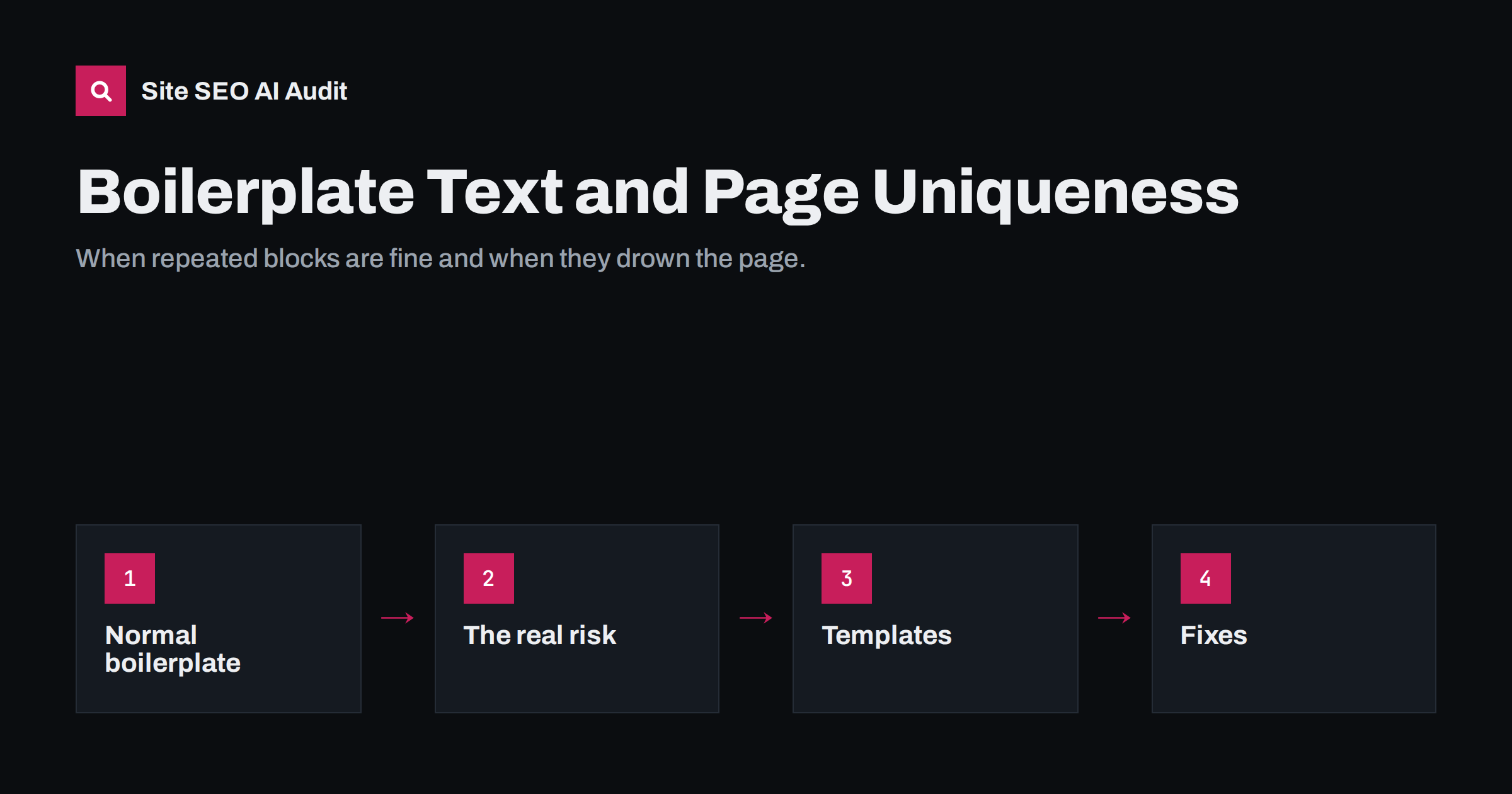
Short answer: Boilerplate is text that repeats across many pages: navigation, footers, sidebars, legal notices, shipping information and templated descriptions. Search engines expect it and generally focus on each page’s main content, so ordinary boilerplate is harmless. It becomes a problem when the unique part of a page is small compared with the repeated part, or when templates produce pages that differ only by a swapped name or city. Then pages look like near-duplicates or thin content. The fix is to trim and relocate long repeated blocks and to make the main content of each page genuinely specific.
What counts as boilerplate
Every website repeats some content. Typical examples include:
- Site-wide elements: header, main menu, footer, cookie notice, newsletter sign-up.
- Sidebars and widgets: recent posts, categories, tag clouds, promotional banners.
- Legal and compliance text: disclaimers, terms snippets, regulatory notices, author disclosures.
- Commercial blocks: shipping and returns information, guarantees, trust badges, calls to action.
- Templated content: product descriptions, location pages or service pages generated from the same text with a few variables changed.
The first four groups are normal parts of a website. The last group is different: it is repeated text posing as the unique main content of a page.
How search engines handle repeated blocks
Search engines have long separated a page’s main content from its surrounding template. When the same header, footer and sidebar appear on thousands of URLs, they can recognise those parts as boilerplate and give most weight to what is unique on each page. Google’s documentation on quality refers to the main content as the part of the page that directly helps it achieve its purpose, and that is what gets evaluated for relevance and usefulness.
This is why a footer with your address on every page does not create a duplicate content issue, and why you do not need to worry that your navigation appears everywhere. Repeated elements are expected.
The difficulty begins when there is not much else. If a page consists of a long template plus two sentences of unique text, the unique signal is weak. Search engines may treat several such pages as near-duplicates, index only some of them, or show them for no meaningful query. That is the same outcome described in thin content, arrived at through templates.
When boilerplate becomes a problem
A few patterns come up again and again in audits:
- Product pages with manufacturer text only. Hundreds of product pages share the same shipping block, warranty text and a description copied from the supplier, which also appears on every other shop selling the product.
- Location pages with swapped city names. “Plumbing services in Vilnius” and “Plumbing services in Kaunas” are the same page with one word replaced. Our guide on location pages explains why these struggle.
- Long legal notices on every page. A 400-word disclaimer at the bottom of every short blog post or product page can outweigh the actual content.
- Keyword-stuffed footers. Lists of dozens of cities, services or keywords in the footer add no value for visitors and can look manipulative.
- Huge mega menus. Hundreds of links on every page dilute internal link signals and add large amounts of repeated text.
- Tag and archive pages that show the same post excerpts in different combinations, with no introduction of their own.
Measuring the ratio of unique to repeated content
There is no official threshold, and word counts alone do not decide quality, as discussed in does word count matter for SEO. Still, a rough look at proportions helps you spot templates that are out of balance.
- Pick a few pages of each template: product, category, location, blog post, service.
- Copy the visible text of the main content area and of the whole page, and compare the word counts.
- Compare two pages of the same template side by side. Highlight what actually differs between them.
- Check for text that also appears on other websites, for example by searching a distinctive sentence in quotes.
If two pages differ by a product name and a price, or if the repeated blocks are several times longer than the unique content, the template needs work.
Fixing templated main content
The most effective fix is also the most obvious: give each page something of its own. Depending on the page type:
| Page type | Typical boilerplate | What to add that is unique |
|---|---|---|
| Product page | Supplier description, shipping text | Own description, use cases, specifications, sizing advice, reviews, Q&A |
| Location page | Same service text with city swapped | Local team, address, service area details, local projects, local prices or conditions |
| Category page | Only a product grid | Short introduction, buying guidance, links to subcategories and guides |
| Service page | Generic benefits text | Process, deliverables, examples, specific FAQs, who it is for |
| Tag or archive page | List of excerpts | A description of the topic and links to the key posts |
If you cannot add unique value to a page, question whether it should exist separately. Merging similar pages into one stronger page is often the better choice. The product page guide and category page guide go into detail for shops.
Trimming and relocating repeated blocks
For the repeated parts themselves, the goal is to keep what visitors need and move the rest out of the way.
- Shorten long notices to one or two sentences with a link to a full page, such as “See our shipping and returns policy”.
- Move detailed legal text to dedicated pages, unless regulations require it on each page.
- Replace keyword lists in the footer with a few links to your main sections or a link to a service area page.
- Simplify mega menus to the sections people actually use. Deep links belong on hub pages.
- Remove sidebars that nobody clicks, such as tag clouds and long archive lists.
- Keep calls to action short and specific to the page type rather than one long block everywhere.
These changes usually help users as much as search engines: pages become shorter, faster and easier to scan.
Help machines find the main content
Clean HTML structure makes it easier for search engines, AI systems and assistive technologies to tell the main content from the template.
- Wrap the main content in a
<main>element and, for articles, an<article>element. - Use
<header>,<nav>,<aside>and<footer>for the surrounding parts. - Put the H1 and the start of the main content near the top of the HTML, not after long menus or banners. See above the fold for what the first screen should show.
- Avoid injecting large repeated blocks into the middle of the main content, such as a full newsletter form between paragraphs of every article.
AI systems that split pages into passages benefit from the same structure: when the main content is clearly marked, the passages they retrieve are more likely to be your actual answer rather than a disclaimer or a promotional block.
A simple order of work
On a site with many templates, tackle boilerplate in the order that brings the most benefit for the least effort:
- List your templates and how many pages each one produces. A template used on 2,000 product pages matters more than one used on five landing pages.
- Fix site-wide excess first. Trimming a bloated footer or mega menu improves every page at once.
- Handle the largest template group next. Decide what unique information each page of that type should carry and add fields for it in the CMS, so editors fill them in rather than copying text.
- Merge or remove pages that cannot be given unique value, using redirects to the stronger page.
- Write guidelines for new pages, so the same problem does not return when the next batch is created.
Re-check a sample of pages after each step. The goal is not a perfect ratio, but pages that each have a clear reason to exist.
How Site SEO AI Audit helps
Site SEO AI Audit’s on-page area checks every crawled page for thin and duplicate content, alongside titles, descriptions and headings. Templates that produce near-identical pages tend to show up as groups of duplicates or thin pages in the report, and the score weighs each issue by how many of your pages it affects, so a template problem stands out from a single weak page. That makes it easier to decide which template to fix first. You can see the current state with a free audit of your website.
Related reading
- Content Pruning: When Merging or Removing Pages Helps
- Internal Linking Strategy: A Step-by-Step Guide for SEO
- Keyword Cannibalization: How to Spot It and Fix It
The bottom line
Repeated navigation, footers and short notices are normal and search engines handle them well. Problems start when templates supply most of a page’s text, so that pages differ only by a name or a city, or when long repeated blocks bury a small amount of unique content. Give each page specific main content, merge pages that cannot have it, shorten and relocate long repeated blocks and mark up the main content clearly.
GYIK
Is boilerplate text bad for SEO?
No, not in itself. Search engines expect headers, footers and repeated notices and focus on each page’s main content. It becomes a problem only when repeated text outweighs the unique content or when templates create near-duplicate pages.
Does a long footer hurt rankings?
A normal footer does not. A footer stuffed with lists of keywords or cities adds no value for visitors and can look manipulative, so it is better replaced with a few useful links.
Can I use the same shipping and returns text on every product page?
Yes. Keep it short and link to a full policy page. What matters more is that each product has its own description and details rather than only the supplier’s text.
How different do location pages need to be?
Different enough to be useful on their own: local contact details, service area, local projects, conditions or team. Swapping only the city name does not make pages unique.
Do HTML5 elements like main and article help SEO?
They help machines identify the main content and the surrounding template, which supports accessibility and clean extraction. They are good practice, though not a ranking factor by themselves.