ENEnglish
 LTLietuviškai
 DEDeutsch
 FRFrançais
 RUРусский
 ESEspañol
 PLPolski
 ITItaliano
 UKУкраїнська
 CSČeština
 PTPortuguês
 JA日本語
JA日本語 LVLatviešu valoda
 ETEesti
 HUMagyar
 IDBahasa Indonesia
 TRTürkçe
 HIहिन्दी
 ELΕλληνικά
 ARالعربية
 THไทย
THไทย VITiếng Việt
 RORomână
 MSBahasa Melayu
 BNবাংলা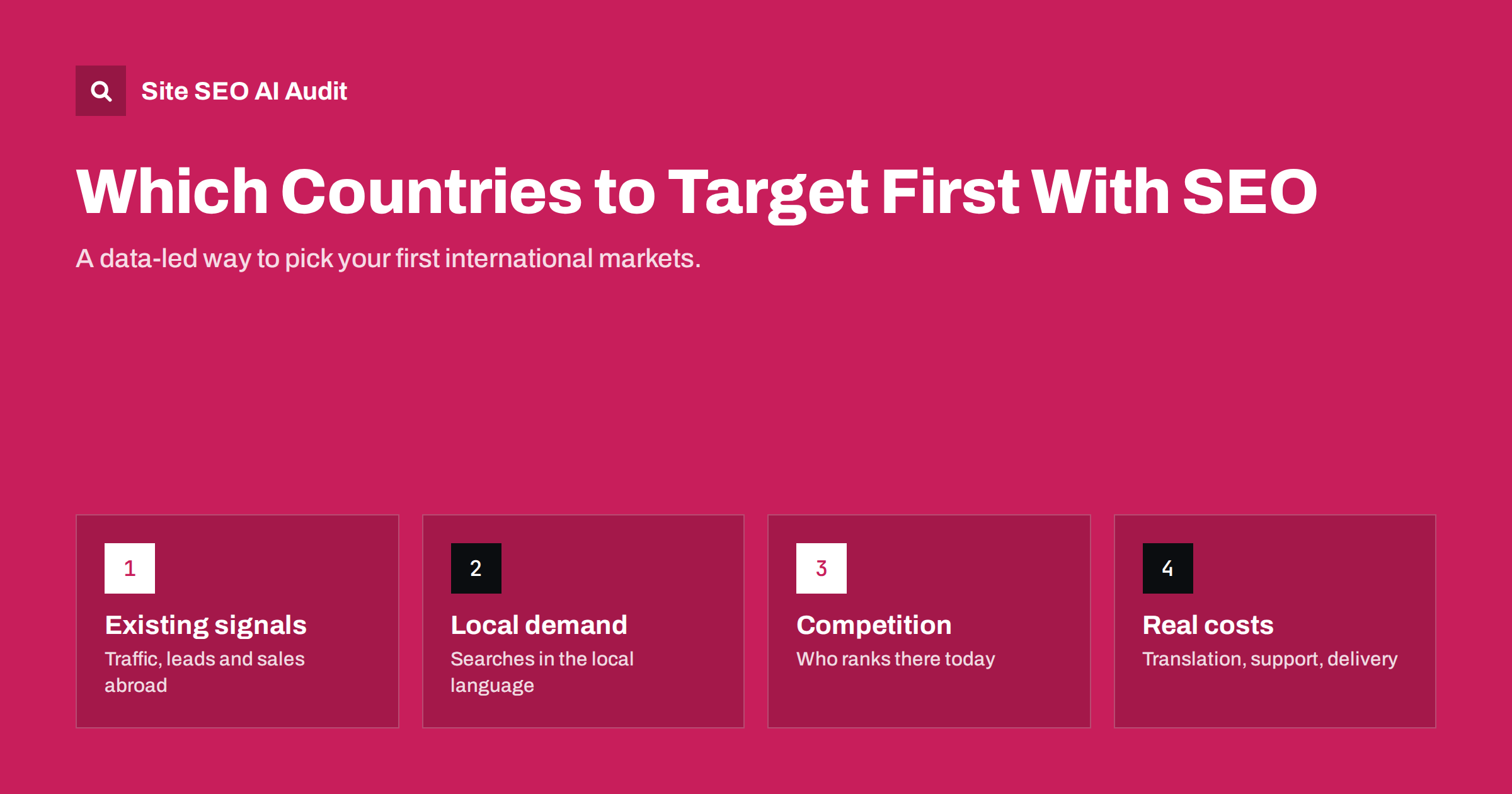
Short answer: Choose your first international markets by combining four things: signals you already have (visits, enquiries and sales from abroad), search demand in the local language, the strength of competitors in local results, and the real cost of serving that market, from translation and support to delivery and legal requirements. Score a shortlist of countries on these factors, start with one or two markets where you can win and serve customers well, and test with a small set of pages before translating the whole site.
Why the choice of market matters more than the setup
Most international SEO advice focuses on implementation: hreflang, URL structure, translation. Those matter, but they only pay off in the right market. A perfectly configured German version of a site that cannot deliver to Germany, or whose product has no local demand, is wasted effort.
Expanding into too many markets at once is the other common mistake. Each language or country version needs translated content, ongoing updates, local links and someone who can answer customer questions. Spreading a small team across ten markets usually produces ten weak versions instead of two strong ones. The guide to international SEO for small businesses covers when expansion pays off at all; this article assumes it does and focuses on where to begin.
Step 1: Look at the demand you already have
Your existing data often points to the first market before any research does.
- Search Console: in the Performance report, compare countries by impressions and clicks. Countries with many impressions but low clicks can mean people search for your topic there but your content is in the wrong language.
- Analytics: look at sessions, engagement and conversions by country and by browser language. A steady flow of visitors with a German browser language is a signal even if they arrive from several countries.
- Sales and enquiries: check where orders, quote requests and support tickets come from, and in which language customers write.
- Existing partners: distributors, resellers or clients in a country give you credibility and links in that market.
These signals show demand that exists despite the lack of localised content. That is usually the easiest demand to capture.
Read the numbers with some care. Visits from a country can come from expatriates, travellers or bots rather than local customers, and a single large client can make a market look bigger than it is. Look for patterns that repeat over several months and across more than one source. A country that appears in Search Console impressions, in analytics and in your enquiries is a much stronger candidate than one that shows up in only one report. It also helps to note which pages attract foreign visitors: if they land mainly on one product or topic, that tells you where to start the localisation.
Step 2: Estimate search demand in the local language
Search demand has to be measured in the local language, with local terminology. Translating your English keywords and checking their volume is not enough, because people in other markets often describe the same thing differently. The approach in multilingual keyword research applies here.
For each candidate market:
- Ask a native speaker how customers would search for your main products or services.
- Check those terms in a keyword tool set to the right country and language.
- Look at search suggestions and related searches in the local version of the search engine.
- Compare total demand for your core topics across markets, not individual keyword volumes.
Remember that not every market is dominated by Google. In some countries other search engines hold a significant share, which changes both the size of the opportunity and the work required. See search engines beyond Google for an overview.
Step 3: Check the competition in local results
Search your main terms in each market, using the local search engine and a local setting. Look at who ranks, not just how many results there are.
- Are the top results large marketplaces and national brands, or smaller specialists?
- Do competitors have well-localised pages, or machine-translated versions of foreign sites?
- Are there local directories, review sites or forums that dominate the results?
- Do AI answers and other result features take much of the space?
A market with moderate demand and weak local content can be a better first target than a larger market where every result is a strong, established local brand.
Take notes on what the best local pages do well: the depth of information, the proof they show, prices, delivery promises and the tone they use. This becomes the benchmark your localised pages have to meet, and it helps you estimate how much work a credible version would take.
Step 4: Count the real cost of serving the market
SEO brings visitors; the business has to serve them. Before choosing, list what each market would require beyond content:
- Translation and localisation of key pages, and ongoing updates when the original changes.
- Customer support in the local language, including e-mail, chat and phone if customers expect it.
- Delivery, returns and payments that local customers trust and expect.
- Legal and tax requirements, such as consumer rights, invoicing rules, cookie and privacy notices.
- Local proof: reviews, case studies, references and addresses that make the offer credible there.
Some of these costs are shared between markets that use the same language. Launching in Austria after Germany costs much less than launching in Germany from scratch.
Step 5: Score your shortlist
A simple scoring sheet makes the decision transparent and easy to revisit. Rate each factor from 1 to 5 for every candidate market and weight the factors that matter most for your business.
| Factor | What to look at | Suggested weight |
|---|---|---|
| Existing signals | Visits, impressions, leads and sales from the market | High |
| Local search demand | Total demand for core topics in the local language | High |
| Competition | Strength and quality of pages that rank today | Medium |
| Ability to serve | Support, delivery, payments, legal readiness | High |
| Cost to localise | Amount of content, availability of good translators | Medium |
| Shared language reuse | Other markets reachable with the same language | Low to medium |
The numbers are not scientific, but they force a conversation about trade-offs. Often one or two markets clearly stand out once all factors are on one page.
Language first or country first?
Your decision can be about a language rather than a country. If your offer works the same way everywhere, for example software or digital products, a Spanish version may serve Spain and much of Latin America at once. If the offer depends on the country, such as prices, delivery, regulations or local services, you may need country-specific versions even within one language.
This choice affects your structure. Language targeting usually means one version per language with hreflang language codes. Country targeting may mean country folders or domains, as explained in ccTLD vs subdomain vs subfolder. Decide this before launching, because changing the structure later requires redirects.
Step 6: Test before you commit
You do not have to translate the whole site to learn whether a market works. A pilot reduces risk:
- Localise a small set of pages: the home page, your main product or service pages, pricing and contact.
- Add the pages with correct hreflang, a language switcher and a sitemap entry.
- Translate a few articles with proven demand. Choosing which blog posts to translate explains how to pick them.
- Watch impressions, clicks and enquiries from the market for a few months. Search Console filters by country make this straightforward, as described in Search Console for international sites.
- Expand the version if the signals grow; pause or rethink if they do not.
How Site SEO AI Audit helps
Once you launch a new market, Site SEO AI Audit crawls all language versions of your site and checks the international setup: hreflang return links, broken language versions, x-default and lang attributes, along with titles, descriptions and links on every translated page. That lets a pilot run on a clean technical base, so the results reflect the market, not setup errors. Plans with regular re-audits keep checking as you add languages; details are on the pricing page.
Related reading
- International SEO for Beginners: How to Take a Site Global
- How to Launch a New Language Version Without SEO Problems
- International SEO Myths That Waste Time and Budget
The bottom line
Pick international markets with data, not intuition. Start from demand you already see, measure search demand in the local language, look at who ranks there, and be honest about what it costs to serve customers. Score a shortlist, choose one or two markets, test with a focused set of localised pages and expand only when the numbers justify it.
GYIK
How many countries should I target at first?
For most small and medium-sized businesses, one or two markets is a sensible start. It lets you localise properly, learn what works and build local credibility before spreading resources further.
How do I know if there is demand in a country?
Check Search Console and analytics for existing visits and impressions from the country, then research local-language search terms with a native speaker and a keyword tool set to that market.
Should I target a language or a country?
Target a language when your offer is the same for all speakers of it, and a country when prices, delivery, laws or services differ. Many sites combine both as they grow.
Can I test a new market without translating the whole site?
Yes. Localise your key commercial pages and a few high-demand articles, set up hreflang correctly and watch the results for a few months before expanding.
Is English enough for international SEO?
English can reach many markets, but people often search in their own language, especially for local services and purchases. In markets with strong local-language search, a localised version usually performs much better.