ENEnglish
 LTLietuviškai
 DEDeutsch
 FRFrançais
 RUРусский
 ESEspañol
 PLPolski
 ITItaliano
 UKУкраїнська
 CSČeština
 PTPortuguês
 JA日本語
 LVLatviešu valoda
 ETEesti
 HUMagyar
 IDBahasa Indonesia
 TRTürkçe
 HIहिन्दी
 ELΕλληνικά
 ARالعربية
 THไทย
 VITiếng Việt
 RORomână
 MSBahasa Melayu
 BNবাংলা
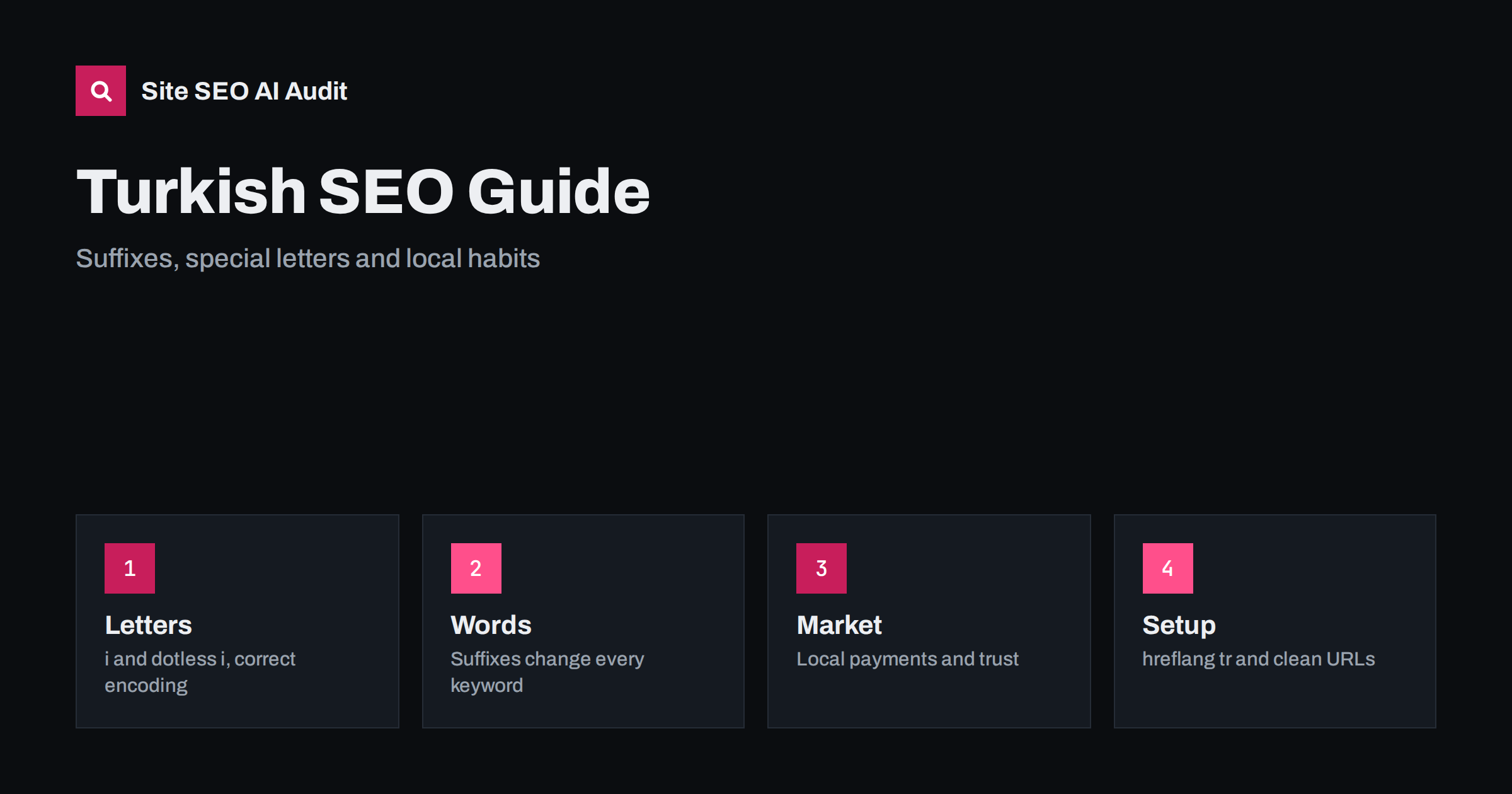
Short answer: Turkish SEO needs more care than a simple translation. Words take many suffixes, so keyword research must start from real Turkish queries. The letters with and without dots, such as i and ı, must be handled correctly in text, URLs and case conversion. Use UTF-8 everywhere, write natural Turkish with a consistent tone, add local payment, delivery and legal details, set hreflang to tr or tr-TR when the version is for Turkey and keep URLs readable and stable.
Turkish has a large online audience and a lively ecommerce market, and many international businesses want to reach it. The language, however, behaves differently from English and from most European languages. It builds words by adding suffixes, has vowel harmony and uses a few characters that cause real technical problems. A site that simply runs English text through a translation tool often ends up with awkward wording, broken letters and keywords that nobody searches for. This guide covers the language-specific points that matter for search, along with the market and technical choices that make a Turkish version work.
How Turkish works and why it matters for keywords
Turkish is an agglutinative language: a root word is extended with suffixes that express plural, possession, case, tense and more. One English phrase can correspond to several Turkish forms depending on the sentence. For example, the idea of “in Istanbul”, “from Istanbul” and “to Istanbul” is formed by adding different endings to the same base word. For searchers this means that people type different forms of the same word depending on what they want, and search engines are good at connecting many of them.
The practical consequence for a site owner is that you should not chase every inflected form with its own page. Choose the natural base term, use the most common forms in headings and body where they read naturally and write for meaning. One strong page that answers a topic is better than separate thin pages for variants, a principle covered in keyword mapping. Research should start from real queries, not from a dictionary translation; multilingual keyword research explains the process.
The dotted and dotless i problem
Turkish has two letters i: the dotted one, i and İ, and the dotless one, ı and I. This is not just a style point; it changes how upper and lower case conversion must work. In Turkish, the capital of i is İ and the lowercase of I is ı. Software that applies English rules can change a word into a different word or into a meaningless string. This can break search, sorting, URLs and templates that capitalise titles.
Check these places carefully:
- Headings and buttons styled with uppercase CSS or functions: test them with Turkish text, and set the page language correctly so that browsers apply Turkish case rules where supported.
- URL slugs generated automatically: make sure letters such as ı, İ, ş, ğ, ç, ö and ü are transliterated or kept consistently, and never produce two different slugs for the same title.
- Search on your site: a visitor who types a word without the special characters should still find the product. Support both forms.
- Database collation and exports: a wrong collation can merge or split entries incorrectly.
Set the HTML lang attribute to tr on Turkish pages, as explained in the HTML lang attribute guide.
Characters, encoding and URLs
Use UTF-8 for pages, databases, feeds and emails. Declare it in the response header and in the document, and verify that special letters display correctly in titles, meta descriptions, structured data and sitemaps. Problems often appear in places that are easy to overlook, such as an old plugin that exports a feed in another encoding or a payment page that uses its own template. The checks are described in character encoding and SEO.
Many Turkish searchers type without special characters, especially on mobile keyboards, so queries with and without them are both common. Search engines usually handle this well, but your internal search and your URLs should too. For URLs, many sites choose slugs in plain ASCII letters with consistent transliteration; others keep Turkish characters, which browsers encode as percent sequences. Either approach works if it is consistent, redirects are in place for old addresses and links use one version. See translating URL slugs for the trade-offs, and transliteration and SEO for searches in more than one script.
Write natural Turkish with a clear tone
Turkish has formal and informal ways to address people. The polite plural form, with the pronoun siz, is common in commercial writing, and a friendlier tone is used by youth and technology brands. Choose one tone and use it everywhere, in buttons, forms, emails and error messages. Machine translation often chooses inconsistently or produces unnatural word order, since the typical Turkish sentence places the verb at the end. Have a native speaker edit titles, calls to action and product descriptions, as recommended in machine translation and SEO.
Pay attention to length. Turkish words are often longer than English ones, so titles and buttons may need redesign. Check that titles still fit in search results and that important words come first. Write meta descriptions as an answer to a real question, not as a keyword list.
Understand the local market and trust signals
Search is only the first step. Turkish customers expect prices in Turkish lira, clear tax information, local payment options, installment choices where they are common, realistic delivery and a clear returns policy. Many shoppers compare offers on large local marketplaces and price comparison sites, so your pages must explain why your product or service is different. Add a Turkish phone number or support hours in the local time zone, an address if you have one and reviews written by Turkish customers. These steps echo the advice in local trust signals for country versions.
Legal and privacy pages should be written for the market. Rules for distance selling, consumer rights and personal data are specific to the country, so have a local professional check them rather than translating a policy written for another jurisdiction. Prices, currency and taxes in structured data must match what the page shows; see local currency and prices for SEO.
Search engines and platforms in Turkey
Google is the main search engine for most Turkish users, so standard Google SEO applies. Other search engines and platforms exist and some have local relevance; the overview in search engines beyond Google explains how to check which matter for your sector. For many businesses, marketplaces, maps, social platforms and video sites are just as important as organic search, so decide where your customers really look and keep your profiles and information consistent in each place.
Use Search Console for your Turkish version to monitor queries, pages and errors, and compare the queries with your keyword plan. Queries in Turkish often reveal wording you did not expect, and they are a good source for new pages and for improving titles.
Set up hreflang, structure and redirects
If you serve Turkish speakers in Turkey, use tr-TR on the version for that country, or tr if the page is for all Turkish speakers; the codes and syntax are in the hreflang reference. Every language version must link back to the others and to itself. A simple structure is a subfolder such as /tr/ on your main domain; a country domain can also work but requires more resources, as explained in ccTLD vs subdomain vs subfolder.
Avoid automatic redirects by browser language. They can block search engines from seeing all versions and frustrate visitors who want another language. Offer a visible switcher and, if you wish, a dismissible suggestion. If you plan the launch of a new version, the checklist in launching a new language version lists the steps that prevent common problems. Do not publish half-translated pages; hide or leave unpublished the pages you have not finished, as explained in untranslated pages on a multilingual site.
Audit the Turkish version regularly
Language versions break in small ways: a plugin update changes slugs, a template loses the lang attribute, a feed changes encoding or return links disappear. Check the Turkish version after each major change. Site SEO AI Audit crawls your pages, scores them across seven areas including languages and hreflang, and lists the fixes ranked by impact. The first audit of up to 200 pages is free, and the pricing page shows how to re-audit after each update.
Related reading
- Character Encoding and SEO: UTF-8 for Every Language
- Transliteration and SEO: Searches in Two Scripts
- Multilingual Keyword Research: Finding Real Local Search Terms
- What Is hreflang? A Plain-English Guide for Site Owners
The bottom line
Turkish SEO rewards care with details. Research real queries instead of translating keywords, handle the dotted and dotless letters correctly in text and URLs, use UTF-8 everywhere, write natural Turkish in a consistent tone, add local payments and trust signals and set up hreflang and structure cleanly. These steps make the version work for Turkish visitors and for search engines.
GYIK
Do I need separate pages for each Turkish word form?
No. Search engines connect many inflected forms. Choose a natural main term, use common forms where they read well and write one strong page for the topic.
Why is the Turkish i a technical problem?
Turkish distinguishes dotted and dotless letters, and case conversion differs from English rules. Wrong handling can change words in titles, slugs and search. Test it and set the page language.
Should URLs use Turkish characters?
Either approach works if you stay consistent. Many sites use ASCII slugs with fixed transliteration. Add redirects for old versions and link to only one form.
Which hreflang code should I use?
Use tr-TR for a version aimed at Turkey, or tr for Turkish in general. Each version must link back to the others and to itself.
Is Google the only search engine that matters in Turkey?
Google is the main one for most users, but marketplaces, maps and social platforms also matter in many sectors. Check where your own customers search.