ENEnglish
 LTLietuviškai
 DEDeutsch
 FRFrançais
 RUРусский
 ESEspañol
 PLPolski
 ITItaliano
 UKУкраїнська
 CSČeština
 PTPortuguês
 JA日本語
 LVLatviešu valoda
 ETEesti
 HUMagyar
 IDBahasa Indonesia
 TRTürkçe
 HIहिन्दी
 ELΕλληνικά
 ARالعربية
 THไทย
 VITiếng Việt
 RORomână
 MSBahasa Melayu
 BNবাংলা
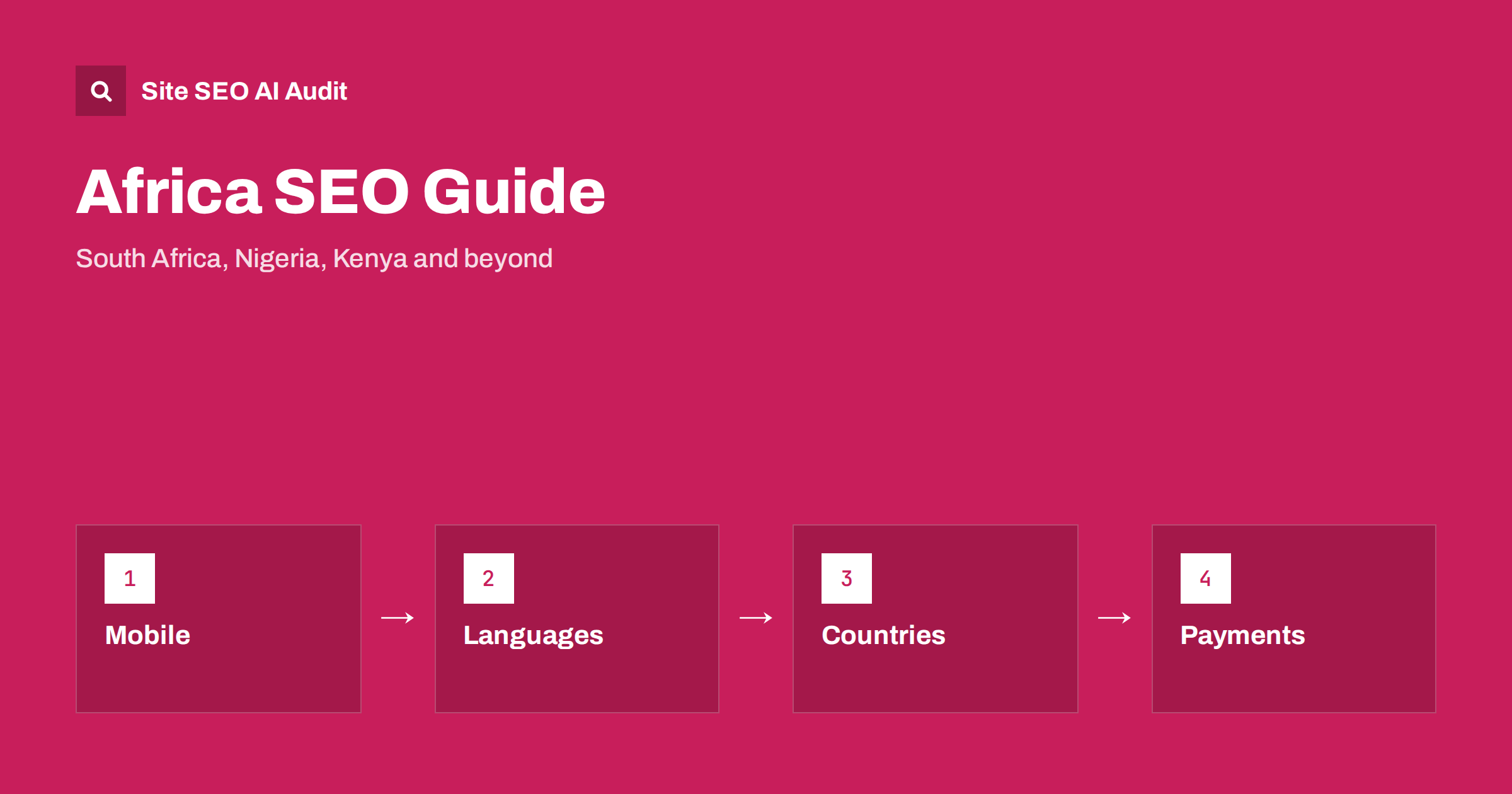
Short answer: Africa is fifty-four countries, not one market. The largest online audiences are in Nigeria, South Africa, Egypt, Kenya, Morocco and Ghana, and most of them reach the web through phones on mobile data, often with limited speed and expensive bandwidth. Google dominates search almost everywhere. English serves Nigeria, South Africa, Kenya and Ghana; French serves much of West and Central Africa; Arabic serves the north; Swahili, Hausa, Amharic and Afrikaans are important regional languages. The right approach is to pick target countries, build light and fast pages, localise language, prices, payments and trust signals per country, and set hreflang and country targeting for each version.
Companies that expand into African markets often make the same mistakes: they publish one “Africa” page in English, assume desktop-speed connections, price in dollars and ignore mobile money. The result is a site that technically exists but does not rank or convert. The opportunity is real: internet use is growing faster than in any other region, competition in local search is often light, and well-localised sites can rank quickly. This guide explains how to choose countries, which languages matter, how the mobile-first reality changes technical priorities and which local signals buyers expect. The country selection method in choosing target markets applies here first.
Choosing countries, not a continent
Start with where demand and the ability to serve customers meet. Nigeria has the largest population and online audience and a strong English-language web. South Africa has the most mature e-commerce market, with English as the business language alongside Afrikaans, Zulu, Xhosa and others. Kenya is the hub of East Africa, English and Swahili, and the home of mobile money. Egypt and Morocco are large Arabic-speaking markets with French widely used in Morocco. Ghana, Ethiopia, Tanzania, Uganda, Senegal and Ivory Coast are growing markets with their own languages and payment habits. Pick two or three countries where you can deliver, support and take payment, and build properly for them. A page for “Africa” ranks for almost nothing because nobody searches that way.
Languages and content
English content works in anglophone countries, but local English has its own vocabulary, spelling conventions and product terms, and search behaviour differs by country. French content serves West and Central Africa, with local vocabulary differences from France. Arabic serves North Africa with regional dialect considerations covered in the Arabic SEO guide. Swahili is read by tens of millions in East Africa and is underserved online, which makes it an opportunity for consumer sites in Kenya and Tanzania. In South Africa, Afrikaans content reaches a distinct audience. For many categories, English or French pages with local prices, examples and contact details are enough to start; add a regional language where your customers actually search in it. Decide which pages to localise using the method in which pages to translate, and research demand per country and language as in multilingual keyword research.
Mobile-first, data-conscious users
The technical priority that separates African markets from Europe is page weight. A large share of users is on mid-range or entry-level Android phones, on mobile data that is paid per megabyte, on networks that vary between fast 4G in cities and slow connections elsewhere. A three-megabyte page with web fonts, a hero video and several scripts is slow, costly and often abandoned. Aim for light pages: compressed images in modern formats, few fonts, deferred scripts, no autoplay video, and server-side rendering so that content appears before scripts load. Test on a slow network profile and on a cheap device, not only in a desktop browser. Hosting location matters as well: serve from a CDN with points of presence in Africa, since latency from European or American servers is high. The practical steps are in reducing page weight and hosting and CDN for international SEO.
Many users browse through data-saving browsers and lightweight app versions of social platforms. Make sure the pages work without JavaScript for the essentials and that forms are short and work on small screens. Mobile usability basics are covered in mobile usability.
Domains, hreflang and targeting
Country-code domains such as .ng, .co.za and .co.ke signal local presence, but registration rules vary and some require a local entity. Subfolders on one domain with hreflang and Search Console country targeting are the practical choice for most companies: /ng/, /za/, /ke/ with en-NG, en-ZA, en-KE, and fr-SN, fr-CI, ar-EG, ar-MA for French and Arabic markets. Use language-country pairs even when the language is shared, so that each page carries its own prices and details. Add x-default for visitors from other countries. Avoid a single English version targeted at “Africa” with IP-based redirects; redirects hide versions from crawlers and frustrate users on roaming connections. The setup is explained in the hreflang tags guide and the redirect problems in language redirects and SEO.
Payments, prices and trust
Show prices in local currency: naira, rand, shillings, Egyptian pounds, dirhams, CFA francs. Many visitors will not convert from dollars or euros and will not trust a site that expects them to. Mobile money is the dominant payment method in Kenya, Tanzania, Uganda and Ghana and widely used in Nigeria and francophone West Africa; card payment is more common in South Africa and Egypt; cash on delivery remains important for e-commerce in several countries. State the payment methods and the delivery coverage on the page, since they are decisive. Trust signals include a local phone number, a local address or partner, registration details, and reviews from local customers. Messaging apps are a primary customer service channel in many countries, so a visible chat contact increases conversions. The role of these signals is described in local trust signals for country sites.
Search engines, platforms and local competition
Google holds a dominant share across the continent, so the technical rules are the standard ones. Local marketplaces and classifieds sites are strong in Nigeria, Kenya and South Africa and often rank for product queries; a presence on them can complement your site. Social platforms and messaging apps are where many purchases start, and content shared there often sends more traffic than search in the early months. Local competitors are frequently small sites with weak technical SEO, which means that a fast, well-structured, localised site can rank quickly for commercial queries. Business profiles with correct local categories, hours and areas served are important for service businesses, as in any local market.
Content that works in African markets
Practical, local content outperforms generic marketing copy. Pages that explain how to buy, how delivery works in a specific city, how to pay with mobile money, what the warranty covers locally and how to reach support earn trust and rank for the questions people actually ask. Price guides and comparisons in local currency are among the most searched pages in many categories. For B2B companies, case studies with local clients and pages that address local regulations, import procedures and certification requirements bring qualified leads. Write for readers who may be on a small screen with limited time and data: short paragraphs, clear headings, the key facts near the top and no decorative media that adds nothing. Use local examples, cities and institutions, and avoid copying text between country versions with only the currency changed, since that produces near-duplicate pages that compete with each other. Refresh prices and delivery details regularly and show the update date, because currency movements make old figures misleading quickly.
Checklist and audit
- Two or three target countries with delivery, support and payment in place.
- Language versions per country with hreflang pairs, x-default and country targeting.
- Light pages: compressed images, few scripts, server-rendered content, CDN with African presence.
- Local currency, local payment methods including mobile money, delivery coverage stated.
- Local contact details, registration, reviews and a messaging contact.
- Keyword research and reporting per country, not per continent.
Site SEO AI Audit crawls each country version, flags heavy pages, hreflang errors, missing lang attributes and duplicate titles across versions, and ranks fixes by impact. The first audit of up to 200 pages is free; multi-country sites can see the pricing page.
Related reading
- Arabic SEO Guide: Dialects, RTL and Gulf Markets
- International SEO for Small Businesses
- Hosting and CDN for International SEO
- Reduce Page Weight: Compression and Smaller Pages
The bottom line
Treat African markets as individual countries with their own languages, currencies and payment habits, and build for phones on paid data. Pick the countries you can serve, create light and fast country versions with correct hreflang and targeting, price in local currency with local payment methods, and show local trust signals. Competition is often lighter than in Europe or North America, and a site built this way can rank quickly.
FAQ
Can one English site serve all of Africa?
No. Country versions with local prices, payments, contact details and hreflang pairs such as en-NG, en-ZA and en-KE perform far better, and French and Arabic markets need their own languages.
How important is page speed in African markets?
More than in most regions. Users are on mobile data paid per megabyte and on mid-range phones, so heavy pages are abandoned. Light, server-rendered pages served from a nearby CDN are essential.
Do I need Swahili or other regional languages?
Start with English or French where they are the business language, and add Swahili, Afrikaans or others when research shows customers search in them. Consumer categories in East Africa often justify Swahili.
Which payment methods should the site mention?
Local currency with mobile money in East and West Africa, cards in South Africa and Egypt, and cash on delivery where it is common. State them on the page, since they decide conversions.
Should I register local country domains?
Only if registration is practical for you. Subfolders with hreflang and Search Console targeting work well and are easier to manage across several countries.