ENEnglish
 LTLietuviškai
 DEDeutsch
 FRFrançais
 RUРусский
 ESEspañol
 PLPolski
 ITItaliano
 UKУкраїнська
 CSČeština
 PTPortuguês
 JA日本語
JA日本語 LVLatviešu valoda
 ETEesti
 HUMagyar
 IDBahasa Indonesia
 TRTürkçe
 HIहिन्दी
 ELΕλληνικά
 ARالعربية
 THไทย
THไทย VITiếng Việt
 RORomână
 MSBahasa Melayu
 BNবাংলা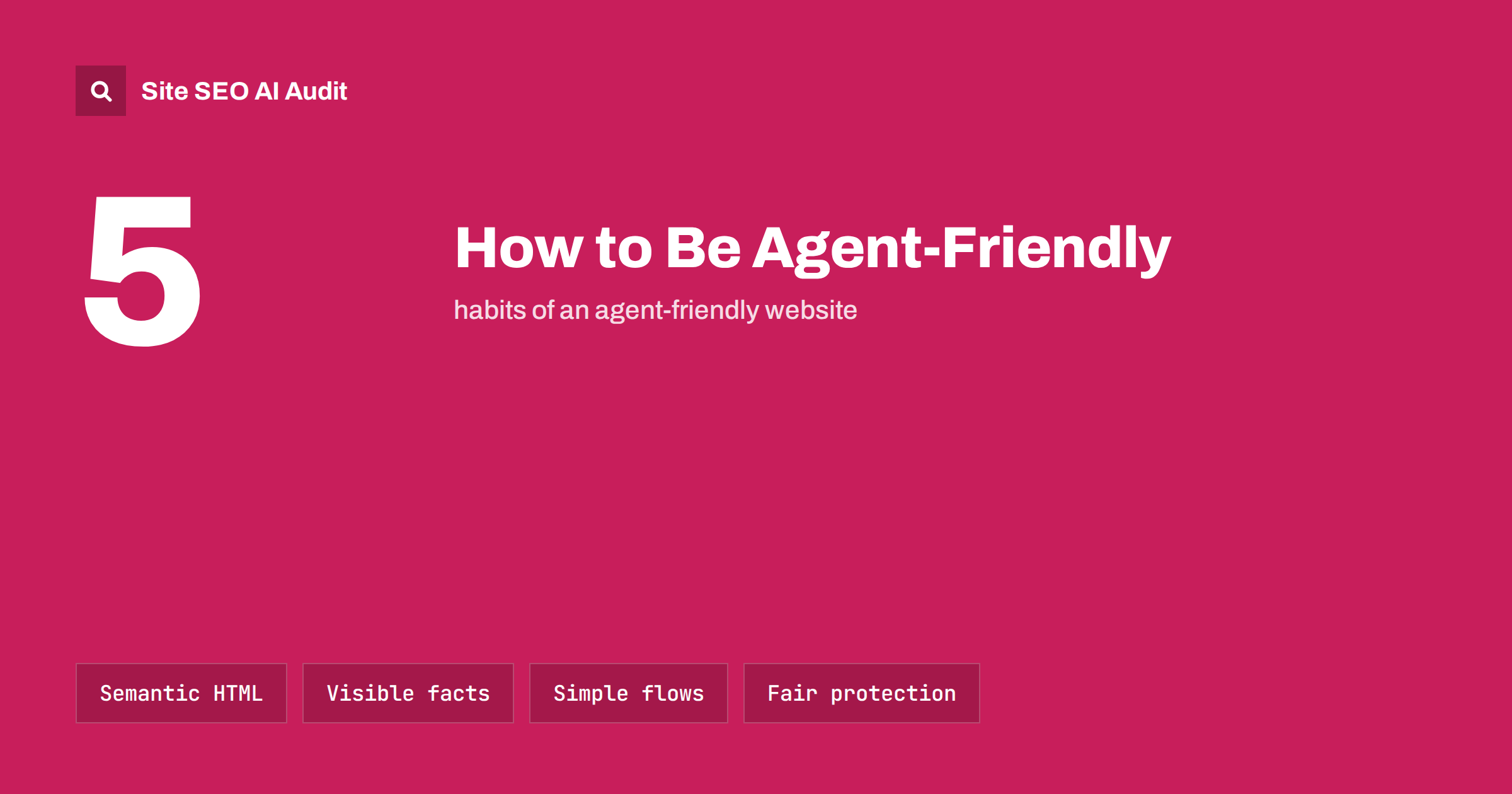
Short answer: AI agents are assistants that can browse websites and take actions for a user, such as comparing products, checking availability or filling in a booking form. They work best on sites that use clear, semantic HTML, show key facts such as prices and terms as text, have simple forms with proper labels, keep stable URLs and avoid unnecessary obstacles. Most of these qualities are the same ones that make a site accessible to people using assistive technology, so improving one usually improves the other.
What AI agents are
Search crawlers read pages to build an index. AI agents go further: they act on a user’s behalf. Several AI companies have released agent features that open a browser, navigate websites, read content, click buttons and fill in forms to complete a task the user described, such as “find a dentist near me with a free appointment on Friday morning” or “compare the three cheapest flights and show me the baggage rules”.
Agents are still early. They are slower than people for many tasks, make mistakes and usually ask for confirmation before doing anything important, such as paying. But their use is growing, and the way they interact with websites has practical consequences for businesses whose customers start delegating research and simple tasks.
From your site’s point of view, an agent is a visitor that reads the page structure carefully, relies on text and labels rather than visual design, and gives up quickly when something is confusing.
For businesses, the practical question is not whether to “optimise for agents” as a separate project, but whether a customer who delegates a task to an assistant can complete it on your site as easily as on a competitor’s. If an agent cannot find your prices or finish your booking form, it may simply suggest another business that it can handle, and the customer may never know why.
How agents see a website
Agents typically combine two kinds of input: the page’s underlying structure, such as the HTML and the accessibility tree that browsers build for assistive technology, and sometimes screenshots interpreted by a model. The structure tells the agent what elements exist, what they are called and what they do. Screenshots help with layout but are slower and less reliable.
This means that what matters most is not how the page looks but how it is built:
- Is the “Book now” control a real button with a clear label, or a styled div with a click handler?
- Does the price appear as text, or only inside an image?
- Do form fields have labels that say what they are for?
- Can the agent tell which step of a process it is on?
A useful mental model is a very literal new visitor who cannot see colours or layout well, reads every label exactly and does not guess. Anything that relies on visual cues alone, such as a red border to mark an error or an unlabelled arrow icon, is likely to confuse them.
Habit 1: use semantic, accessible HTML
The single most helpful thing is semantic HTML, the same foundation recommended for accessibility:
- Use real links for navigation and real buttons for actions.
- Give every form field a visible label connected to the input.
- Use headings in a logical order to structure content.
- Give icon-only buttons an accessible name, such as “Search” or “Add to cart”.
- Use native form controls, such as select elements and date inputs, where possible; heavily customised widgets are harder for both agents and screen readers.
The Web Content Accessibility Guidelines, published by the W3C, describe these practices in detail. A site that meets them is already largely agent-friendly.
Semantic HTML is also cheaper to maintain. Native elements come with keyboard support and accessibility built in, while custom components need extra work to reach the same quality and often break quietly after updates.
Habit 2: show key facts as text
Agents need facts to complete tasks: prices, availability, delivery times, opening hours, sizes, terms and conditions. When these appear only in images, in tooltips that open on hover, or after several clicks, agents struggle. Put important facts in plain text near the relevant product or service, and keep the same facts consistent across pages. Clear pricing pages, shipping pages and policy pages help agents and people alike.
Structured data can reinforce these facts. Product, Offer and LocalBusiness markup that matches the visible page gives any software reading it an unambiguous version of prices, availability and opening hours.
Habit 3: keep flows simple and predictable
- Short forms: ask only for what you need, and explain required formats, such as date or phone formats, next to the field.
- Clear errors: error messages should say what is wrong and how to fix it, in text near the field.
- Visible progress: multi-step processes should show which step the user is on.
- Stable URLs: product, service and booking pages should have their own addresses that can be opened directly.
- No surprise pop-ups: modals that appear during a task can derail an agent, just as they annoy people.
Habit 4: make content available without JavaScript tricks
Agents that run a full browser can handle JavaScript, unlike many crawlers, but heavy client-side behaviour still causes problems: content that loads only on scroll, controls that appear only on hover, and layouts that shift while loading. Server-rendered content with progressive enhancement is the most robust approach for crawlers, agents and people on slow connections.
If a task only works after a specific sequence of hovers and scrolls, it is fragile for everyone. Aim for pages where the important content and controls are present as soon as the page loads.
Habit 5: protect the site without blocking legitimate use
Businesses rightly protect their sites from abuse: scraping, fake sign-ups, card testing and spam. Agents raise a real question here, because they are automated but acting for a real customer. Some practical positions:
| Area | Reasonable approach |
|---|---|
| Viewing public pages | Allow; avoid challenges for simple browsing |
| Search and filtering | Allow with sensible rate limits |
| Account creation | Protect with standard anti-abuse measures |
| Payments | Keep strong verification; agents usually hand over to the user |
| Bulk data extraction | Limit or block, as with any scraper |
The web is still working out how agents should identify themselves. Some CDNs and AI companies are developing ways for agents to prove who operates them. Follow these developments through your CDN or hosting provider rather than building custom rules too early.
Testing your site with an agent’s eyes
You do not need special tools to get a sense of how agent-friendly your site is. A few simple tests reveal most problems:
- Use the keyboard only. Try to complete a key task, such as finding a product and adding it to the cart, using only the Tab and Enter keys. If you get stuck, an agent may too.
- Try a screen reader on your main task. Built-in screen readers on common operating systems are enough to hear whether buttons and fields have meaningful names.
- Inspect the accessibility tree in your browser’s developer tools and check that important controls have clear roles and names.
- Disable images and see whether prices, instructions and navigation still make sense.
- Try an agent yourself. If you have access to an assistant with browsing or agent features, ask it to complete a simple task on your site and watch where it hesitates or fails.
Record what goes wrong and fix the most important tasks first: the ones that lead to enquiries, bookings or sales. Every fix also helps customers who use assistive technology, older devices or slow connections.
How Site SEO AI Audit helps
Many agent-friendly qualities overlap with checks in a Site SEO AI Audit report: clear titles and heading structure, image alt texts, broken links, empty link anchors, stable status codes and content that does not depend on JavaScript to appear. The AI visibility area also shows which AI crawlers your robots.txt allows. You can run a free audit to find structural problems that confuse both agents and people.
Related reading
- Why AI Crawlers Miss JavaScript Content and How to Fix It
- Is Your CDN or Firewall Blocking AI Crawlers? How to Check
- Product Pages for AI Shopping Answers: What to Fix
The bottom line
AI agents read websites through their structure. Semantic HTML, facts in plain text, simple forms, stable URLs and sensible protection make your site usable when a customer sends software to do the browsing. These are the same qualities that make a site accessible and easy to use, so the work pays off for every visitor, human or not.
FAQ
What is an AI agent in the context of websites?
It is an assistant that can open websites, read them, click and fill in forms to complete a task for a user, such as comparing options or starting a booking. It usually asks the user before important actions.
Are AI agents the same as crawlers?
No. Crawlers fetch pages to build an index, while agents interact with pages on behalf of a specific user, often using a full browser.
Does accessibility help AI agents?
Yes. Agents rely on the same structure that assistive technologies use: semantic elements, labels and clear headings. Improving accessibility generally makes a site easier for agents too.
Should I block AI agents?
Blocking agents from simply viewing public pages can cost you customers who use them. Keep strong protection for account creation, payments and bulk extraction instead.
Can agents complete purchases on my site?
Some can prepare a purchase, but they typically hand over to the user for payment and confirmation. Clear, simple checkout flows make that handover smoother.