ENEnglish
 LTLietuviškai
 DEDeutsch
 FRFrançais
 RUРусский
 ESEspañol
 PLPolski
 ITItaliano
 UKУкраїнська
 CSČeština
 PTPortuguês
 JA日本語
 LVLatviešu valoda
 ETEesti
 HUMagyar
 IDBahasa Indonesia
 TRTürkçe
 HIहिन्दी
 ELΕλληνικά
 ARالعربية
 THไทย
 VITiếng Việt
 RORomână
 MSBahasa Melayu
 BNবাংলা
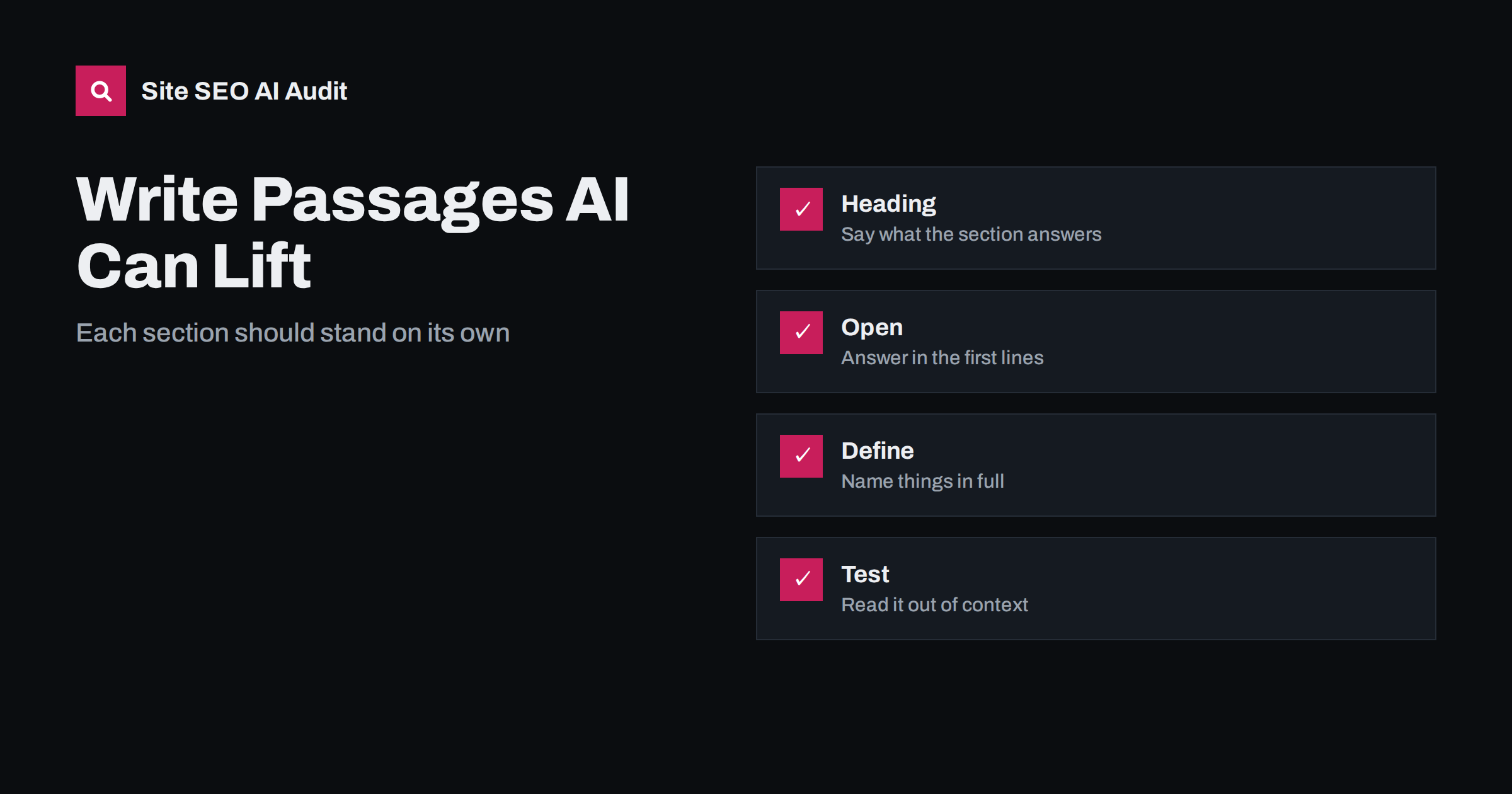
Short answer: Many search and AI systems do not read a page as one block. They split it into passages and pick the ones that best match a question. To be chosen, each section should answer one clear question, begin with a heading that says so, give the answer in its first sentences, name the subject in full instead of using vague references, and still make sense when read alone, away from the rest of the page.
Writers usually imagine a reader who starts at the top and reads to the end. Retrieval systems behave differently. They look for the passage that fits a question, take it out of its page and use it to build an answer or a result snippet. A passage that depends on the paragraph before it, with words such as this, that or as mentioned above, may be misunderstood or skipped. This guide explains how to write sections that work in both ways: as part of a flowing article and as stand-alone pieces. It builds on answer-first introductions and on how AI search engines work.
How passages get picked
The details differ between systems, and the companies do not publish all of them, but the general idea is the same. A page is divided into parts, often guided by headings, paragraphs and lists. The system compares a question with these parts and selects those that match best, sometimes after rewriting the question into several related searches. The chosen parts are then used as sources for an answer or shown as a highlighted passage. Because a matching part may come from anywhere on the page, every section of an article has a chance to be used, not only the introduction.
Write headings that carry meaning
A heading is the label of a passage. Vague headings such as overview or more details tell a machine nothing, while a heading that states the topic or the question tells it exactly what follows. Use plain words that match how people ask: what a thing is, how to do it, how much it costs, when to use it. Keep the order logical, with one main idea per heading, and avoid skipping levels. The guide to heading structure covers the technical side. A good test is to read only the headings and check whether they describe the whole article.
Answer first, explain after
Put the direct answer in the first one or two sentences of each section, then add reasons, examples and exceptions. A passage that starts with a story or a long lead-in may be cut before the answer appears. This does not mean that every section must be short. It means that the core statement comes first, in plain wording, so that if only the beginning is used, it still makes sense. Readers also appreciate this style because they can scan, find what they need and decide whether to read on.
Name things in full
When a passage is read alone, pronouns and references lose their meaning. Replace phrases such as it, this tool or the method above with the name of the thing at least once in each section. Spell out the first use of an abbreviation in the section where it matters. State units, years and places instead of relying on context from earlier paragraphs. This feels repetitive when you read the whole article, but a little repetition is a small price for a passage that can be understood alone. Aim for natural writing, not robotic repetition of keywords.
Keep one idea in each passage
A section that covers three ideas is harder to match with a question and harder to quote. Split long sections where the topic changes, and keep paragraphs short enough to read comfortably, usually three to five sentences. Lists work well for steps or options, and a small table can hold comparisons, as long as each has a short sentence before it that explains what it shows. Avoid hiding key facts in images, since text inside an image may not be read by crawlers. Where a figure matters, repeat its meaning in text.
Support claims with specifics
Passages with concrete details, such as numbers, dates, names, conditions and clear steps, are more useful than general statements. If you state a fact, say where it comes from or how you know it, and keep it current. Add the limit of a claim, for example for whom it is true and when it is not. This makes the passage more trustworthy for readers and for systems that try to avoid weak sources. The article on writing content that AI answers quote gives more examples of useful specifics.
Help the structure with markup
Use real headings, lists and tables in the page code, not styled text that only looks like them. Semantic markup shows where a passage starts and ends, and it helps assistive technology too. Keep important text in the main content area, not inside tabs that load later or widgets that need clicks, because content that needs interaction may not be seen, a topic discussed in the guide to semantic HTML for AI search. A table of contents with jump links can also help readers and, in some cases, search results link directly to a section.
Test your pages out of context
Choose a section at random, copy it into a blank document and read it. Does the topic come clear in the first sentence? Can a stranger tell what the section refers to? Are there missing words, such as the product or the place? Repeat for several sections and fix the weakest. You can also ask an AI assistant a question that your section should answer and see whether it uses your page and in which form. Treat this as a rough test, since results vary and no system gives a promise of inclusion.
Edit existing articles in the same way. Start with pages that already receive visits or impressions, and look for sections that begin with vague headings or that depend on earlier text. A small edit, such as renaming a heading and moving the answer to the first sentence, costs little and often improves the article for human readers as well.
Do not overdo it. Writing only for machines produces stiff text that readers leave quickly, and a flat structure of tiny sections can feel disjointed. The goal is clarity: a page that a person can read from start to finish with pleasure, and in which each part is also clear and complete when met alone. Good teaching material and good reference pages have always worked this way.
Consider an example. A section in an article about shipping policy begins with the words: As noted earlier, this usually takes five days. Read alone, the passage does not say what takes five days. Rewritten, it becomes: Standard delivery within the country usually takes five working days after the order is dispatched. The second version works as a complete answer in a search result, in a voice assistant and in an AI summary. It also reads better for a person who jumped to the section from a table of contents. The change adds a few words and removes all dependence on earlier text.
A second example concerns lists. A list of steps that starts with bullet points but never says what the steps achieve is hard to use out of context. Add one introductory sentence that names the task, such as: To change the language of your account, follow these steps. Then each step can stay short. The sentence gives the passage a subject, the steps give the detail, and the closing sentence can mention what the reader should see when it works. This small structure makes the passage useful as an answer to a how-to question.
Finally, remember mixed content. Many pages combine text, tables, images and video. Make sure that the text near a table or an image states the main point, so that the passage is understood even if the table is not read. Add captions that describe the meaning of a chart, not only its title, and give videos a short written summary or transcript. Each of these helps accessibility, and each helps retrieval systems that rely mostly on text.
Site SEO AI Audit crawls your site and checks headings, titles, descriptions, structured data, thin pages, broken links and AI crawler access, so you can see where the page structure is weak. It does not rewrite your text or predict which passages AI systems will use. The first audit of up to 200 pages is free; larger sites can see the pricing page.
Related reading
The bottom line
Write each section as a small, complete answer with a clear heading, the answer first, full names for things and specific support, then read it out of context to check that it stands alone.
FAQ
Do AI systems really split pages into passages?
Many retrieval systems work on parts of pages, although the exact method varies and is not always public.
How long should a passage be?
Long enough to answer one question fully, often one to three short paragraphs under a clear heading.
Will this hurt the reading flow?
Not if you write naturally. Slight repetition of names is a small price for clarity.
Should I add many more headings?
Add headings where the topic changes, not to break up text for its own sake.
Does this guarantee being quoted?
No. It improves the chance that your text is understood, but no writing method guarantees inclusion.