ENEnglish
 LTLietuviškai
 DEDeutsch
 FRFrançais
 RUРусский
 ESEspañol
 PLPolski
 ITItaliano
 UKУкраїнська
 CSČeština
 PTPortuguês
 JA日本語
JA日本語 LVLatviešu valoda
 ETEesti
 HUMagyar
 IDBahasa Indonesia
 TRTürkçe
 HIहिन्दी
 ELΕλληνικά
 ARالعربية
 THไทย
THไทย VITiếng Việt
 RORomână
 MSBahasa Melayu
 BNবাংলা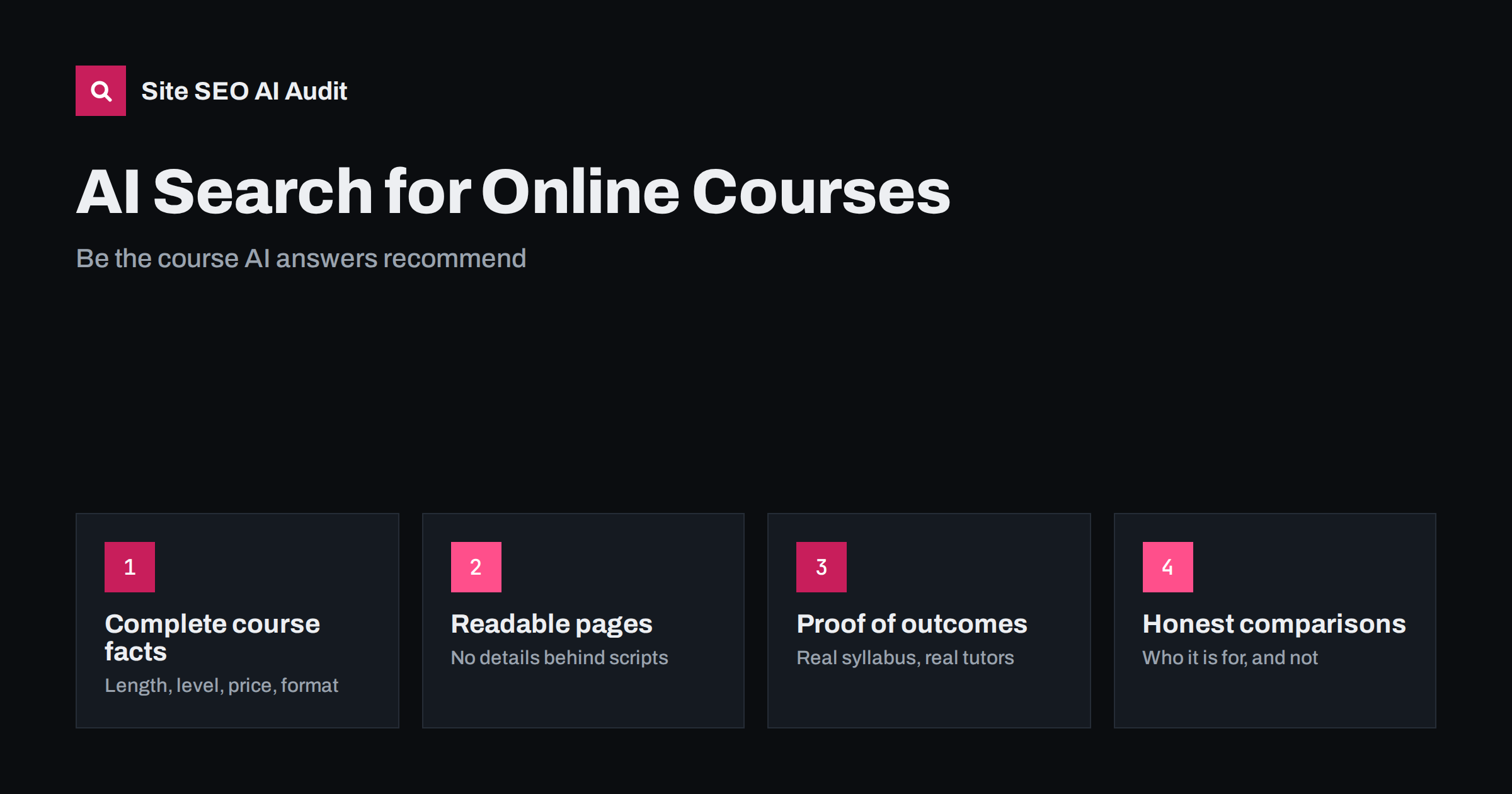
Short answer: When people ask an AI assistant which course to take, the answer is built from pages the system can read: course pages, provider profiles, reviews, comparison articles and forums. Online course providers, schools and training companies get recommended when each course page states the essential facts in plain text (topic, level, length, format, price or how to find it, prerequisites, certificate, tutor), when those pages can be read without JavaScript, when the provider is a clear and trusted entity, and when independent sources say good things about it. Vague marketing pages are rarely cited.
Choosing a course is a research-heavy decision, and much of that research now starts in AI assistants and AI search features. “What is the best beginner course for data analysis?”, “Is this certificate recognised by employers?”, “Which coding bootcamp is part-time and online?” are typical questions. The answer names a few providers and links to a few sources. This guide covers what education websites can do to be among them.
What learners ask AI assistants
Course questions tend to follow the decision process. Understanding the groups helps you decide which pages to build or improve:
- Discovery: “best online course for learning accounting basics”, “short courses in project management”.
- Fit: “is this course suitable for complete beginners”, “how many hours per week does it take”.
- Value: “is the certificate worth it”, “how does this compare with a university short course”.
- Logistics: “when does the next intake start”, “can I study from another country”, “is there a payment plan”.
- Outcomes: “what jobs can I get after this course”, “what will I be able to build”.
AI search systems often split such questions into several searches and combine the results, as our guide on query fan-out explains. A course page that answers fit, value and logistics questions directly can be retrieved for many of those sub-searches at once.
Put the essential facts on every course page
The most common problem on course websites is missing or hidden facts. The page has a hero image, a slogan and an enquiry form, but no clear statement of what the course actually is. AI systems cannot recommend what they cannot describe. Every course page should state, as visible text:
| Fact | Example of a clear statement |
|---|---|
| Topic and outcome | “Learn to build and analyse spreadsheets for small-business finance.” |
| Level and prerequisites | “For beginners; no previous accounting knowledge needed.” |
| Length and workload | “Eight weeks, about four hours per week.” |
| Format | “Online, self-paced videos with weekly live sessions.” |
| Price or how pricing works | The price, or a clear link to the page that lists it |
| Certificate and recognition | What the certificate is and who issues or accredits it, only if true |
| Tutor or instructor | Name, role and relevant experience |
| Dates and language | Next start date, or “start any time”, and teaching language |
Put a short summary of these facts near the top of the page and the full syllabus below. Our guide to answer-first introductions shows how to open a page so that the key facts can be quoted.
Publish the syllabus in readable HTML
A detailed syllabus is the best evidence of what a course covers, and it is often hidden: inside a PDF brochure, behind a “download curriculum” form, or inside accordions loaded by scripts. AI crawlers frequently read only the raw HTML, and our article on why AI crawlers miss JavaScript content explains the risk.
- List modules and lessons as headings and lists on the course page itself.
- Describe what learners will be able to do after each module, not only the module names.
- Accordions are fine for users if the text is present in the HTML when the page loads; see tabs and accordions.
- Keep a downloadable brochure if you need it for lead generation, but do not make it the only place where the content exists.
Make the provider a clear, trusted entity
For “which provider” questions, AI answers weigh who you are as much as what the page says. Make the institution easy to understand:
- An about page that says plainly what kind of provider you are, since when, where you are based, and whether you are accredited or partnered, with the names of the bodies involved.
- Instructor pages with real names, qualifications and professional experience. Our guide to author pages and bylines applies to tutors as well.
- Consistent naming across the website, course marketplaces, social profiles and directories.
- Organization markup that matches the visible facts, and Course markup where the course details are visible on the page. Markup supports understanding; it does not replace the text.
Profiles outside your site matter as much as the about page. Learners and AI systems both look at course marketplaces, business directories, professional associations and the websites of partner institutions. Check that each of these describes you the same way: the same name, the same type of provider, the same main subjects and, where relevant, the same accreditation. Outdated profiles that mention discontinued programmes or old addresses are a common source of wrong details in AI answers. Keep a simple list of every external profile, review it a few times a year and update anything that no longer matches the website.
Show outcomes honestly
Outcome questions are where many education sites overstate and lose trust. AI answers often combine your claims with what reviews and forums say. If the two disagree, the independent sources tend to win. Better approaches:
- show sample projects or work produced by learners, with permission;
- publish completion or employment figures only if you measure them and can explain how;
- link to genuine reviews on independent platforms instead of quoting only the best ones;
- say clearly who the course is not for, such as advanced practitioners or people who need a formal degree.
That last point helps both readers and AI systems match the course to the right learner. Our article on reviews and reputation in AI recommendations describes which signals tend to be used.
Content that earns citations beyond course pages
Course pages answer “which course” questions. Guides answer the questions that come earlier, when learners are still deciding what to study. Useful formats for education providers include:
- Career and skill guides: what a role involves, which skills it needs and how long it typically takes to learn them.
- Comparison guides: self-paced versus live courses, short courses versus degrees, certificates versus portfolios. Be fair, including where another option is better.
- Glossaries and explainers for the field you teach, which AI answers often quote for definitions; see glossary pages.
- Admissions and logistics FAQs: payment plans, refunds, study from abroad, time zones, language requirements.
Link each guide to the relevant course and each course back to its supporting guides, so that systems can see the relationship.
Technical basics for course catalogues
Large catalogues bring their own problems. Old intakes and archived courses remain indexed with outdated dates and prices. Filters create thousands of near-duplicate listing pages. The same course appears under several URLs for different start dates. Course marketplaces copy your descriptions word for word. A few rules help:
- keep one permanent URL per course and show the current dates on it, rather than a new URL per intake;
- redirect or clearly mark discontinued courses, pointing to the closest replacement;
- control filter and search URLs as explained in faceted navigation SEO;
- write a fuller description on your own site than on third-party marketplaces;
- check that robots.txt and bot protection do not block the AI search crawlers you want.
Check your course pages the way crawlers see them
Missing facts, scripts that hide the syllabus and duplicate course URLs are easy to miss when you look at the site in a browser. Site SEO AI Audit crawls your site like a search engine and checks every page for titles, thin and duplicate content, canonicals and structured data, plus an AI visibility area covering AI crawlers in robots.txt, llms.txt and content that needs JavaScript. The first audit of up to 200 pages is free; larger catalogues get a preliminary report of the first 200 pages, and paid plans crawl up to 10,000 pages.
Related reading
- How to write comparison pages that AI answers trust
- E-E-A-T and AI search
- AI search visibility checklist
The bottom line
AI assistants recommend courses they can describe and trust. State the essential facts on every course page, publish the syllabus in readable HTML, make the provider and tutors clear entities, show outcomes honestly and support course pages with guides that answer earlier questions. Keep the catalogue clean, with one URL per course and current details. These steps help learners as much as they help AI search.
FAQ
Do online course providers need Course structured data?
It helps search engines understand course pages and can support course features in search results where available. It does not create AI visibility on its own; the visible text on the page must contain the same facts.
Should course prices be shown publicly?
Where possible, yes. Price is one of the facts learners ask about most, and AI answers cannot cite what is hidden. If prices vary, explain how pricing works and link to a page with the details.
How can a small training provider compete with big platforms?
By being specific. Big platforms have many general courses; a small provider can describe a narrow audience, a clear outcome, named expert tutors and real learner work in more detail, which matches specific questions well.
Is it a problem if marketplaces copy my course descriptions?
It can be, because the marketplace may be cited instead of you. Write a fuller, more detailed description on your own site, add the syllabus and tutor details, and keep marketplace texts shorter where you control them.
What should happen to pages for courses that ended?
If a course runs again, keep its permanent URL and update the dates. If it is discontinued, redirect it to the closest current course or keep a clear archived page that points to alternatives, so outdated details are not quoted.