ENEnglish
 LTLietuviškai
 DEDeutsch
 FRFrançais
 RUРусский
 ESEspañol
 PLPolski
 ITItaliano
 UKУкраїнська
 CSČeština
 PTPortuguês
 JA日本語
 LVLatviešu valoda
 ETEesti
 HUMagyar
 IDBahasa Indonesia
 TRTürkçe
 HIहिन्दी
 ELΕλληνικά
 ARالعربية
 THไทย
 VITiếng Việt
 RORomână
 MSBahasa Melayu
 BNবাংলা
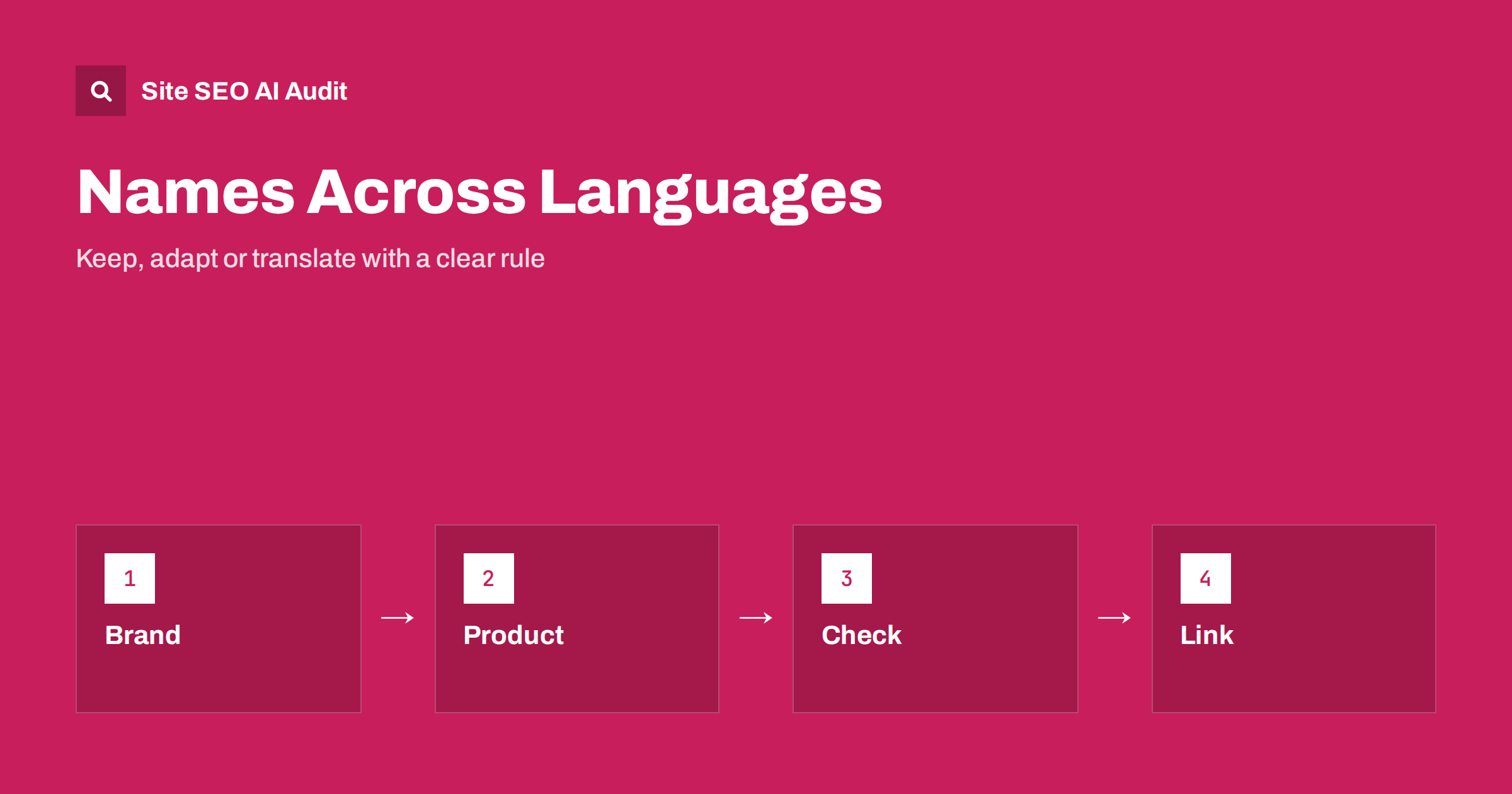
Short answer: Keep your brand name the same in every language unless there is a clear problem, such as an offensive or confusing meaning, a legal conflict or a script that your audience cannot read. For product names, keep the brand part and translate or localise the descriptive part. Always check meaning, pronunciation and trademark status in each market, add a transliteration where the script differs and use consistent names in titles, structured data and listings so that search engines recognise one entity.
When a company launches in a new language, someone soon asks whether the name should change. A product called “Quick Start Plan” may sound clumsy in German. A brand that works in English may mean something awkward in another market. A name written in Latin letters may be unreadable for customers who use another script. On the other hand, changing names everywhere makes you harder to find and weakens the recognition you have built. This guide gives a practical framework for choosing, and explains how to implement the decision in a way that helps search engines and customers.
Why naming decisions affect SEO
People search by name when they already know you, and by description when they do not. Branded searches are the most valuable, and they depend on the name being the same in every place a person meets it. If you use different names in different languages without links between them, search engines may treat them as separate things, and customers moving across borders will struggle to find you. Consistency also helps AI systems, which build a picture of a brand from many sources and need to recognise that they all describe the same entity; the background is in entity SEO.
At the same time, the descriptive words in a product name carry the meaning that non-branded searches use. They need to match local vocabulary. Treat the two parts differently: protect the brand, localise the description. The distinction between the two kinds of search is explained in branded vs non-branded search.
A rule of thumb: brand stays, descriptors adapt
A simple model works for most companies. The brand name is a proper noun and stays unchanged, apart from a transliteration where needed. The product line name, if it is made of ordinary words, is judged case by case. The descriptor, the part that says what the thing is, is written in the local language using the words customers use. For example, a brand name stays, the line name may stay if it is a coined word or is understandable, and the descriptor, such as “project management software”, is translated according to local keyword research.
Page titles then combine both: the local descriptor and the brand name. This approach follows the logic of translation vs localization: what readers must understand is adapted, and what identifies you is left intact.
When a name needs to change
Keeping the name is the default, but some situations call for a change or an adaptation.
- Unfortunate meaning or sound: the name means something offensive, ridiculous or negative in the local language, or sounds like a rude word. Ask several native speakers, not only one.
- Trademark conflict: another company already holds a similar mark for similar goods in that market. Legal advice is needed; do not rely on a quick search.
- Unreadable script: in markets with other scripts, a name in Latin letters may be hard to read, type or remember. A local form or a transliteration may be necessary.
- Descriptive names: if the name is made of ordinary English words that carry the meaning, such as “Fast Invoice”, customers who do not know English may not understand it. A local descriptor beside the brand solves this.
- Regulatory or cultural rules: some sectors and countries restrict certain words in names.
Make the decision with evidence: local keyword research, feedback from native speakers, customer interviews and legal checks. Do not decide on translation tools alone.
Transliteration and local scripts
In markets that use other writing systems, such as Cyrillic, Greek, Arabic, Hebrew, Chinese, Japanese, Korean or Thai, people may search for a brand in its original Latin spelling, in the local script or in both. Check the real queries. Where there is a local form, show it on the page, for example in the title or in the first paragraph, together with the Latin name, so that both searches lead to you. The approach is described in transliteration and SEO.
Choose one official local form and use it consistently. Several informal spellings confuse customers and search engines. For languages with several possible renderings, such as Chinese, consult local speakers; the issues for that market are covered in Chinese SEO guide. Add the local form to your official profiles, listings and structured data as an alternate name.
Product names, features and plan names
Inside the product, names of plans, features and modules appear in menus and on pricing pages. Decide a glossary for each language, so that every page, email, help article and screenshot uses the same words. A glossary also stops translators from translating the same feature in three different ways. Keep short notes for each term: keep, translate or adapt, with an example. The same glossary should be shared with agencies and tools.
For software and services, feature names often become search terms after launch. If a localised feature name does not match the words users type, add the common term in headings and descriptions, so that the page matches both. Pages that explain features should follow the approach in feature page SEO for software. For translating briefs and glossaries, see SEO briefs for translators.
URLs, titles and descriptions
The brand name in the title tag should be spelled the same way on every language version. Put the local descriptor first and the brand last, or follow the pattern you use in the main language, and keep it consistent. For descriptions, include the name once, naturally. For URLs, consider whether product slugs should keep the brand name or follow a translated descriptor; the pros and cons are discussed in translating URL slugs. If you already have URLs in place, do not change them just for tidiness. A change requires redirects and carries risk.
Check how social previews display names. The tags that control link previews should use the right local title and the correct name, as covered in og:locale and link previews on multilingual websites.
Structured data and entity signals
Help machines see that all language versions describe one organisation and one product. Use organisation markup with a consistent name, and add the alternate name for local forms. Link the official profiles with the same property across languages, and make sure the same logo and the same contact details appear. Translate descriptions, but keep identifiers stable. The principles are covered in organization schema for AI systems and, for multilingual sites, in structured data on multilingual sites.
Outside your site, make sure the main profiles, directories and press mentions use the correct names. Where several spellings of your name circulate, ask the owners of important pages to correct them, and mention the preferred spelling in your press materials. Unlinked mentions still help recognition, as discussed in unlinked brand mentions.
Test the names before launch
Before you fix a localised name, run a short test. Ask native speakers to say the name aloud, spell it, describe what it makes them think of and write how they would search for your product. Look at the search results for the name and for the descriptor in the local language, to see whether another company dominates them. Check domain names, social handles and marketplace listings. Search the trademark registers of the market with professional help. This costs little compared with renaming later.
After launch, monitor branded queries in Search Console for each language version, compare impressions and clicks and watch for typos and variants. If people use a spelling you did not expect, add it naturally to the pages.
Audit names and language versions
Inconsistent names often appear in titles, headings, structured data, hreflang titles and old pages. A crawl finds them quickly. Site SEO AI Audit crawls your pages, scores them across seven areas including languages and structured data and ranks the fixes by impact. The first audit of up to 200 pages is free, and the pricing page shows how to repeat it after you change naming or add a language.
Related reading
- Entity SEO: Helping AI Systems Understand Your Brand
- Transliteration and SEO: Searches in Two Scripts
- Translation vs Localization for SEO: What Actually Changes
- Branded vs Non-Branded Search: How to Read Both
The bottom line
Keep the brand name stable, localise the descriptive words and change a name only for a clear reason such as meaning, law or script. Check each market with native speakers and legal advice, use one glossary, keep titles and structured data consistent and show local forms where people search for them. That protects recognition while still speaking the customer’s language.
FAQ
Should I translate my brand name?
Usually not. Keep it unchanged unless it has a problematic meaning, a legal conflict or an unreadable script. Add a local descriptor beside it.
How do I handle a brand in a different script?
Check how people search. If they use a local form, show it with the Latin name on the page and in profiles, and use one official form consistently.
Do product names need translating?
Keep the brand part and the coined line name if they are understandable. Translate the descriptive part using words customers search for.
Can I use different names for the same product in different countries?
You can, but link them with consistent profiles, structured data and glossary rules so that systems and customers see one product. Avoid unplanned variation.
Who should check a new local name?
Native speakers for meaning and sound, and a trademark professional for legal conflicts. Do not rely only on a translation tool or a quick search.