ENEnglish
 LTLietuviškai
 DEDeutsch
 FRFrançais
 RUРусский
 ESEspañol
 PLPolski
 ITItaliano
 UKУкраїнська
 CSČeština
 PTPortuguês
 JA日本語
JA日本語 LVLatviešu valoda
 ETEesti
 HUMagyar
 IDBahasa Indonesia
 TRTürkçe
 HIहिन्दी
 ELΕλληνικά
 ARالعربية
 THไทย
THไทย VITiếng Việt
 RORomână
 MSBahasa Melayu
 BNবাংলা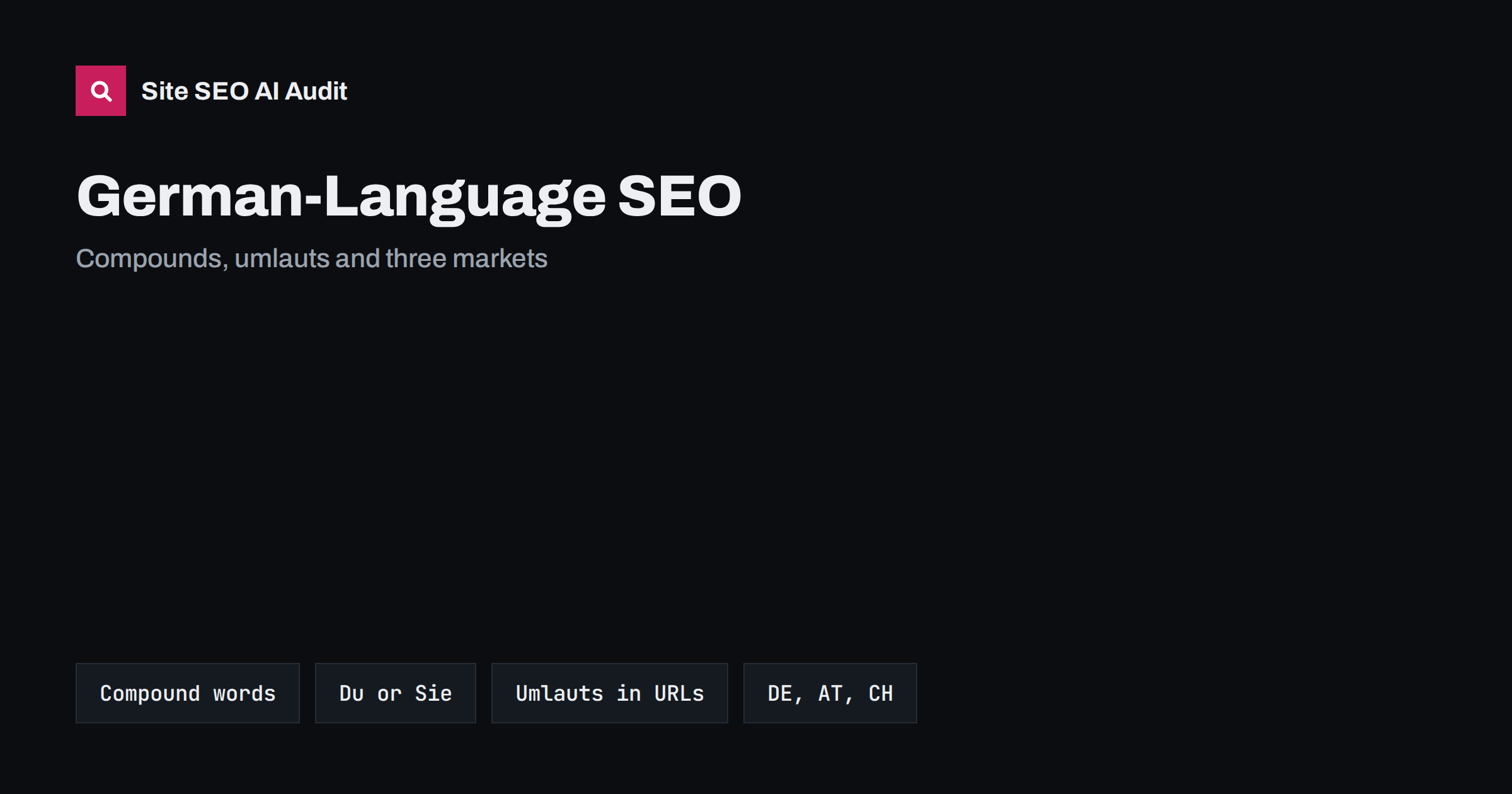
Short answer: German-language SEO differs from English in a few practical ways. Germans join words into long compounds, so keyword research must check both joined and separate forms. You have to choose between formal Sie and informal du and use it consistently. Umlauts and ß need a decision for URLs. And German is used in three main markets, Germany, Austria and Switzerland, with differences in vocabulary, spelling, currency and legal requirements. Translate with native speakers, research keywords per market and use de-DE, de-AT and de-CH in hreflang only when the versions really differ.
The German-speaking market is large, wealthy and demanding. Visitors expect precise, complete information, clear prices and proper legal pages. Many companies enter it by translating their English site and adding hreflang. That works up to a point, but German has features that change how people search and how pages should be written. This guide covers the ones that affect SEO most.
Compound words and keyword research
German builds new nouns by joining words: Kinder and Fahrrad become Kinderfahrrad (children’s bike), Rasen and Mäher become Rasenmäher (lawn mower). Searchers do not always use the compound. The same need can be typed as:
- a compound: Kinderfahrrad;
- a phrase: Fahrrad für Kinder;
- a hyphenated form: Kinder-Fahrrad;
- a split form, which is grammatically wrong but common in searches: Kinder Fahrrad.
Search engines understand many of these variations, but search volumes and results can still differ between forms. In keyword research:
- Check the compound and the main phrase forms separately, using German-language settings for the right country.
- Use the most common form in the title and H1, and the alternative naturally in the text, for example in an introduction or a subheading.
- Do not write wrong split forms into your content just because people search for them; correct German reads better and search engines connect the variants.
- Watch for very long compounds that few people search. A product called Edelstahl-Gartenschlauchverbindungsstück may need a simpler phrase in the title.
Our guide to multilingual keyword research explains how to research each market without relying on translated English keywords.
Du or Sie: choosing a form of address
German has a formal “you” (Sie) and an informal one (du). Neither is right or wrong for SEO, but the choice shapes the whole site:
- Sie is the traditional choice for B2B, finance, law, healthcare, public sector and many established brands.
- Du is common in consumer e-commerce, fashion, sport, apps and start-ups, and among brands targeting younger audiences.
What matters is consistency. A page that switches between Sie in the text and du on buttons or in e-mails looks careless, and German readers notice immediately. Write it into your translation brief, apply it to the interface, forms, error messages and transactional e-mails as well as the content, and keep it the same across Germany, Austria and Switzerland unless you have a good reason to differ.
Umlauts and ß in URLs and text
German uses the umlauts ä, ö and ü and the sharp s, ß. In normal text, always use the correct characters: Größe, not Groesse. For URL slugs, there are two common approaches:
- Transliterate: ä becomes ae, ö becomes oe, ü becomes ue and ß becomes ss, as in
/groesse-tabelle/. This is the most common choice and avoids encoding problems when URLs are copied and shared. - Keep the characters:
/größe-tabelle/works technically, but appears percent-encoded in many places, such as%C3%B6, which looks messy when pasted.
Pick one approach for the whole site and stick to it, because changing it later means redirecting every URL. Search engines usually connect transliterated and original forms, but not always perfectly. Our guides to translating URL slugs and transliteration and SEO cover the details. Serving pages as UTF-8 ensures the characters display correctly in titles and text.
Germany, Austria and Switzerland
German is the main language in Germany and Austria and one of the official languages of Switzerland, where it is spoken by the majority. The written language is largely shared, but there are differences that matter for content and search:
| Aspect | Germany | Austria | Switzerland |
|---|---|---|---|
| Currency | Euro | Euro | Swiss franc |
| Sharp s (ß) | Used | Used | Not used; written as ss |
| Example vocabulary | Januar, Tomate | Jänner, Paradeiser | Velo for bicycle |
| hreflang code | de-DE | de-AT | de-CH |
For most businesses, one German version marked hreflang="de" is the right start. Add an Austrian or Swiss version when prices, currency, shipping, legal information or product ranges differ, or when you see that a market uses different words for your products. A Swiss version also has to fit a multilingual country, where French and Italian speakers may need their own versions; see SEO for multilingual countries. Our article on same-language country targeting explains how to separate versions properly.
Text length, titles and layout
German text is often noticeably longer than the English original, because of compounds and grammar. This affects SEO and design:
- Title tags may be truncated sooner. Put the most important words first and shorten the brand part if needed. Our guide to translating title tags and descriptions has more tips.
- Navigation and buttons designed for short English labels may break or wrap awkwardly.
- Headings with long compounds may need hyphenation rules in CSS to display well on mobile.
Check the German version on real devices before launch, not only in the translation tool.
Trust, legal pages and local details
German-speaking users tend to look closely at who is behind a website. Several elements are expected, and some are legally required:
- Impressum: most commercial websites in Germany and Austria are legally required to publish an imprint with the provider’s name, address and contact details. Get legal advice on the exact content for your business.
- Privacy information in German, matching what the site actually does.
- Clear prices including VAT for consumers, with delivery costs stated.
- Familiar payment methods and local contact options.
- Correct formats: 1.234,56 € in Germany and Austria, dates as 13.10.2026, and Swiss formats for Swiss prices.
Our guides to local trust signals and dates, numbers and units go deeper into these points.
Search habits in German-speaking markets
Google is the dominant search engine in Germany, Austria and Switzerland, so most of the work above is aimed at it. Bing also has a share of users, particularly on Windows devices and in workplaces, and smaller engines such as Ecosia, based in Berlin, have a loyal audience. Content that is well structured and correctly marked up works for all of them; our article on search engines beyond Google gives the wider picture.
A few habits are worth keeping in mind when planning content:
- Detailed research before buying: German-speaking users often compare specifications, test reports and reviews before deciding, so thorough product and comparison content is valued.
- Local terms over English loanwords: some English terms are widely used in German, others are not. Check whether people search for the English word or the German one, for example in software and marketing topics.
- Regional searches: city and region names are common in local searches, and Austrian and Swiss users often add their country or city when they want a local provider.
Translation quality and review
German readers are quick to spot machine translation: wrong compounds, English word order, inconsistent forms of address, or terms that are technically correct but nobody uses. For important pages:
- Work with native German translators who know your industry.
- Give them the target keywords per market, the chosen form of address and a glossary of product terms.
- Translate titles, meta descriptions, alt texts, structured data and interface text as well as the main content.
- Ask someone from Austria or Switzerland to review pages aimed at those markets.
Once German versions are live, hreflang and language settings must stay consistent on every page. Site SEO AI Audit crawls your site like a search engine and checks hreflang return links, broken language versions, x-default and lang attributes, along with titles, descriptions and duplicate content, then ranks the fixes by how many points each adds. The first audit of up to 200 pages is free.
Related reading
- Translation vs localization for SEO
- hreflang language and region codes
- Launching a new language version
The bottom line
German-language SEO rewards precision. Research compound and phrase forms of your keywords per market, choose Sie or du and use it everywhere, decide once how to handle umlauts and ß in URLs, and start with one German version before adding Austrian or Swiss versions where prices, rules or vocabulary truly differ. Then add what German-speaking users expect: an Impressum, clear prices, correct formats and text written by native speakers.
FAQ
Should I use umlauts in German URLs?
Either approach works, but most German sites transliterate them, writing ae, oe, ue and ss. That avoids percent-encoded characters when URLs are shared. Choose one method for the whole site and keep it.
Is du or Sie better for SEO?
Neither has an SEO advantage. Choose the form that suits your brand and audience, Sie for most B2B and traditional sectors and du for many consumer brands, and use it consistently across the site and e-mails.
Do I need separate pages for Germany, Austria and Switzerland?
Not at first. One German version marked hreflang de is enough for many businesses. Add country versions when currency, prices, shipping, legal information or vocabulary genuinely differ.
Does Google understand German compound words?
Largely, yes. Google connects many compound and phrase forms, but search volumes and results can differ between them. Research both forms and use the most common one in titles and headings.
Why does Swiss German text not use ß?
Standard German as written in Switzerland replaced ß with ss decades ago. A Swiss version should follow that convention, which is one of the small details that makes a page feel local.