ENEnglish
 LTLietuviškai
 DEDeutsch
 FRFrançais
 RUРусский
 ESEspañol
 PLPolski
 ITItaliano
 UKУкраїнська
 CSČeština
 PTPortuguês
 JA日本語
JA日本語 LVLatviešu valoda
 ETEesti
 HUMagyar
 IDBahasa Indonesia
 TRTürkçe
 HIहिन्दी
 ELΕλληνικά
 ARالعربية
 THไทย
THไทย VITiếng Việt
 RORomână
 MSBahasa Melayu
 BNবাংলা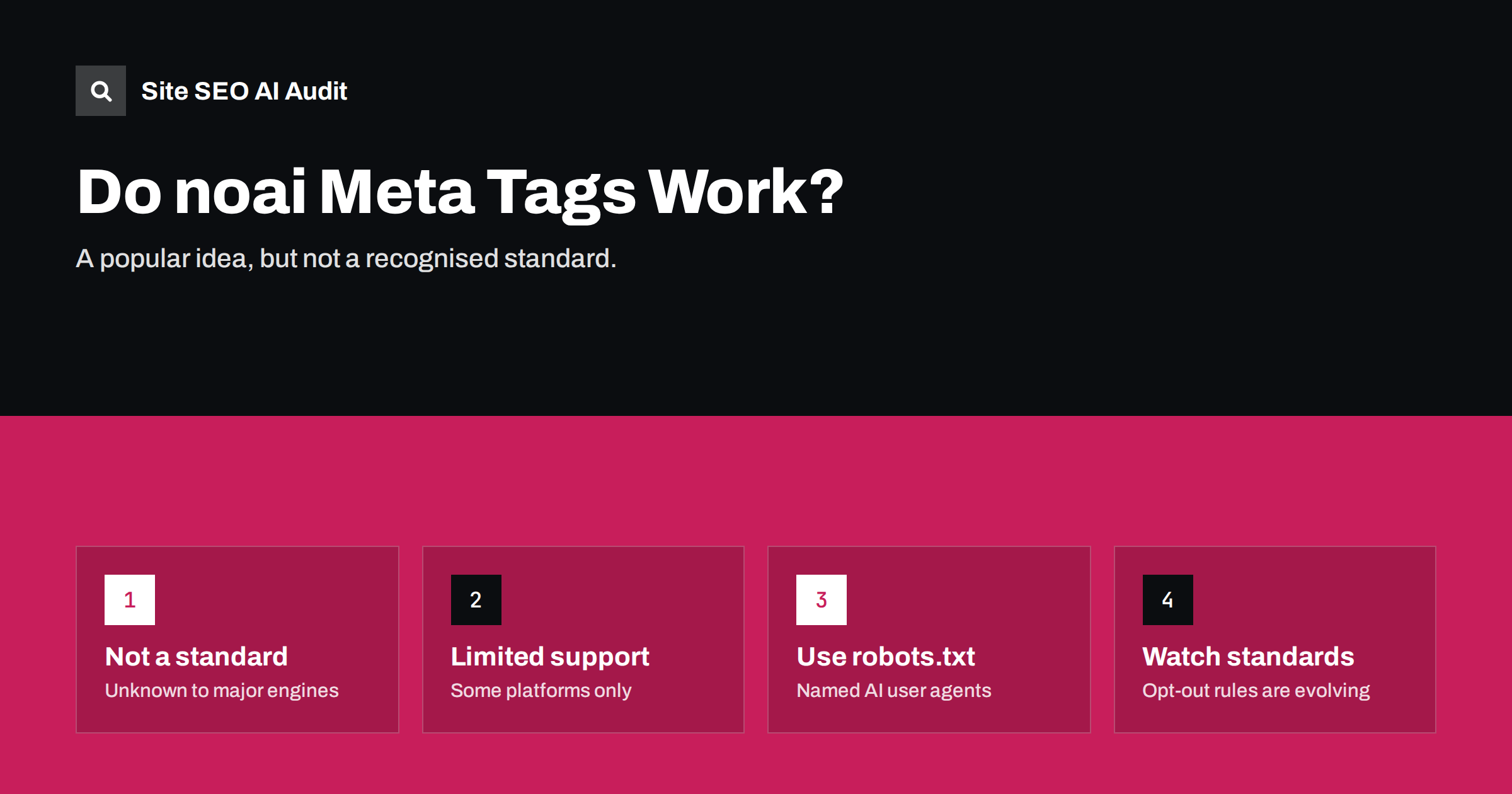
Short answer: The noai and noimageai meta tags are informal directives, first popularised by an art platform in 2022, that ask AI systems not to use a page’s text or images for training. They are not part of any web standard and are not listed among the directives Google or Bing support, so major crawlers cannot be relied on to respect them. To control AI use of your content today, use robots.txt rules for named AI crawlers and tokens, snippet controls for search features and server-level blocking where enforcement matters, while watching emerging opt-out standards.
What noai and noimageai are
The tags look like ordinary robots directives: <meta name="robots" content="noai, noimageai">. The idea is simple: “noai” asks that the page’s content not be used to train AI systems, and “noimageai” asks the same for images. They were introduced by DeviantArt in 2022 as a way for artists to signal that they did not want their work used for AI training, and the idea spread to other platforms, plugins and website builders.
Their appeal is obvious. They are easy to add, they sit next to familiar directives such as noindex, and they express a clear wish. The problem is that a directive only works if the systems reading the page agree to honour it.
It is worth separating two questions that often get mixed up: whether you should express a preference about AI training, which is a business and sometimes ethical decision, and whether a particular mechanism will enforce that preference, which is a technical question. The tags answer the first but not the second.
Who respects them
Support is limited and uneven:
- Google documents the robots meta values it supports, including noindex, nofollow, nosnippet, max-snippet and others. noai and noimageai are not among them.
- Bing likewise documents its supported directives, and noai is not one of them.
- Major AI companies generally document control through robots.txt user agents rather than meta tags.
- Some platforms and dataset tools have stated that they respect these tags, and some artist-focused services use them.
In practice, adding noai to a page is a statement of preference that some parties may honour, not a reliable control. It does no harm, but it should not be your only measure if AI use matters to you.
What actually controls AI use today
| Control | What it does | Reliability |
|---|---|---|
| robots.txt rules for AI user agents | Asks named crawlers such as GPTBot, ClaudeBot or CCBot not to fetch paths | Respected by major operators that document these agents |
| Product tokens in robots.txt | Controls use for specific purposes, such as Google-Extended for Gemini | Documented by the operators |
| Snippet controls | nosnippet, max-snippet and data-nosnippet limit text in search features, including Google’s AI features | Documented by Google and Bing for search |
| Server or CDN blocking | Refuses requests from specific user agents or IP ranges | Enforced, not voluntary |
| Authentication | Keeps content behind a login | Strongest; crawlers cannot access it |
| noai and noimageai meta tags | Expresses a preference against AI training | Limited, platform-dependent |
The table also shows why layering matters. Voluntary signals, such as robots.txt and meta tags, work with operators that choose to respect them. Enforced measures, such as server blocks and authentication, work regardless. A sensible policy uses voluntary signals to state your wishes clearly and enforced measures where the stakes justify the extra effort.
Emerging standards for AI preferences
The lack of a common standard has not gone unnoticed. Several efforts aim to give publishers a clearer, machine-readable way to state preferences about AI use:
- Text and data mining opt-outs in the EU. The EU’s copyright rules allow rights holders to reserve their works from text and data mining by machine-readable means. That has driven interest in formats such as the TDM Reservation Protocol developed in a W3C community group.
- IETF work on AI preferences. The Internet Engineering Task Force has set up work on a vocabulary for expressing preferences about AI use, which could be used in robots.txt and HTTP headers.
- CDN-level signals. Some CDNs offer managed settings that add AI-related rules to robots.txt or state content-use preferences on your behalf.
These efforts are still developing, and it is not yet clear which will become widely supported. If AI use of your content is important to your business, follow them through your CDN, hosting provider or industry association, and adopt a standard once major operators commit to it.
In the meantime, the safest course is to express your preferences through the mechanisms operators already document, and to keep a record of what you have stated and when.
Choosing a practical approach
Most sites fall into one of three positions:
- Visibility first. You want to be found and cited in AI answers. Allow AI search crawlers, decide on training crawlers deliberately, and skip noai tags, which add nothing useful for you.
- Visible but not trained on. You want to appear in AI search but not contribute to model training. Allow AI search crawlers and user-triggered fetchers, disallow training crawlers and relevant product tokens in robots.txt, and optionally add noai as an extra signal.
- Minimal AI use. Your content is your product and you want to limit AI use as far as possible. Disallow AI crawlers and tokens in robots.txt, consider snippet controls for search, enforce blocks at the server or CDN, keep premium content behind authentication and add noai tags as a stated preference.
Write your choice down and apply it consistently across robots.txt, CDN settings and any meta tags, so that the signals do not contradict each other.
A note for photographers, artists and image-heavy sites
noimageai was created with visual work in mind, and image creators have the strongest reasons to care about AI training. Unfortunately, images are also the hardest content to control. They are copied, shared, embedded and hotlinked, and they often live on image hosts, social platforms and marketplaces with their own terms.
A realistic approach combines several measures:
- Read the terms of every platform where you publish, since many grant themselves or partners broad rights.
- Use robots.txt on your own site to disallow training crawlers from image folders as well as pages.
- Consider publishing lower-resolution previews publicly and keeping full-resolution files for clients.
- Add clear copyright and licensing information on your site and in image metadata.
- Use noimageai where platforms support it, as a stated preference.
None of this makes images impossible to use without permission, but together these measures make your terms clear and reduce casual collection.
How to check what your site currently signals
Many sites send AI-related signals nobody remembers adding. A quick review takes a few minutes:
- Open yourdomain.com/robots.txt and list every AI-related user agent and token, with its rules.
- View the source of a few page templates and search for
noai,noimageai,nosnippetandnoindex. - Check HTTP response headers for
X-Robots-Tag, which some servers and CDNs add. - Look at your CDN and security plugin for AI bot settings.
- Compare everything against your written policy, and remove signals that contradict it.
Common misunderstandings
- “noai removes my content from AI search.” It does not; AI search features follow crawler rules and, for Google, Search and snippet controls.
- “noai protects my images from being copied.” Meta tags cannot prevent anyone from downloading an image. At most, they express a licensing preference.
- “noindex stops AI training.” noindex removes pages from search indexes, but it does not by itself instruct AI training crawlers, which have their own user agents.
- “Adding every tag is safest.” Stacking restrictive directives can remove your pages from search or strip your snippets, which is rarely the intention.
How Site SEO AI Audit helps
Site SEO AI Audit reports which AI crawlers your robots.txt allows and blocks in its AI visibility area, and its crawl checks noindex, canonicals and other directives on every page. That makes it easy to see whether your signals are consistent, and to catch restrictive directives that affect search visibility more than you intended. You can run a free audit to review your current settings.
Related reading
- How to Allow or Block AI Crawlers in robots.txt
- Google-Extended Explained: What Blocking It Does and Doesn’t
- nosnippet, max-snippet and AI: Controlling What Gets Quoted
The bottom line
noai and noimageai are well-intentioned but informal. Major search engines do not list them as supported directives, and major AI operators rely on robots.txt instead. Use robots.txt rules for named AI crawlers and tokens, snippet controls for search features, server-level blocking and authentication where enforcement matters, and treat noai tags as an optional extra signal while opt-out standards mature.
FAQ
Does Google respect the noai meta tag?
Google does not list noai or noimageai among its supported robots meta directives. To control Gemini use, Google documents the Google-Extended token in robots.txt.
Will noai keep my site out of ChatGPT?
You should not rely on it. OpenAI documents control through robots.txt user agents such as GPTBot and OAI-SearchBot, so use those rules for the behaviour you want.
Is there any harm in adding noai tags?
Generally no. They do not affect search rankings. Just make sure they are not combined with other directives, such as noindex or nosnippet, that you did not intend.
What is the most reliable way to prevent AI training on my content?
Disallow training crawlers and relevant tokens in robots.txt, enforce blocks at the server or CDN for crawlers that ignore rules, and keep valuable content behind authentication.
Will there be a standard for AI opt-outs?
Several efforts are underway, including work at the IETF and a W3C community group, driven partly by EU rules on text and data mining. It is not yet clear which will be widely adopted.