ENEnglish
 LTLietuviškai
 DEDeutsch
 FRFrançais
 RUРусский
 ESEspañol
 PLPolski
 ITItaliano
 UKУкраїнська
 CSČeština
 PTPortuguês
 JA日本語
JA日本語 LVLatviešu valoda
 ETEesti
 HUMagyar
 IDBahasa Indonesia
 TRTürkçe
 HIहिन्दी
 ELΕλληνικά
 ARالعربية
 THไทย
THไทย VITiếng Việt
 RORomână
 MSBahasa Melayu
 BNবাংলা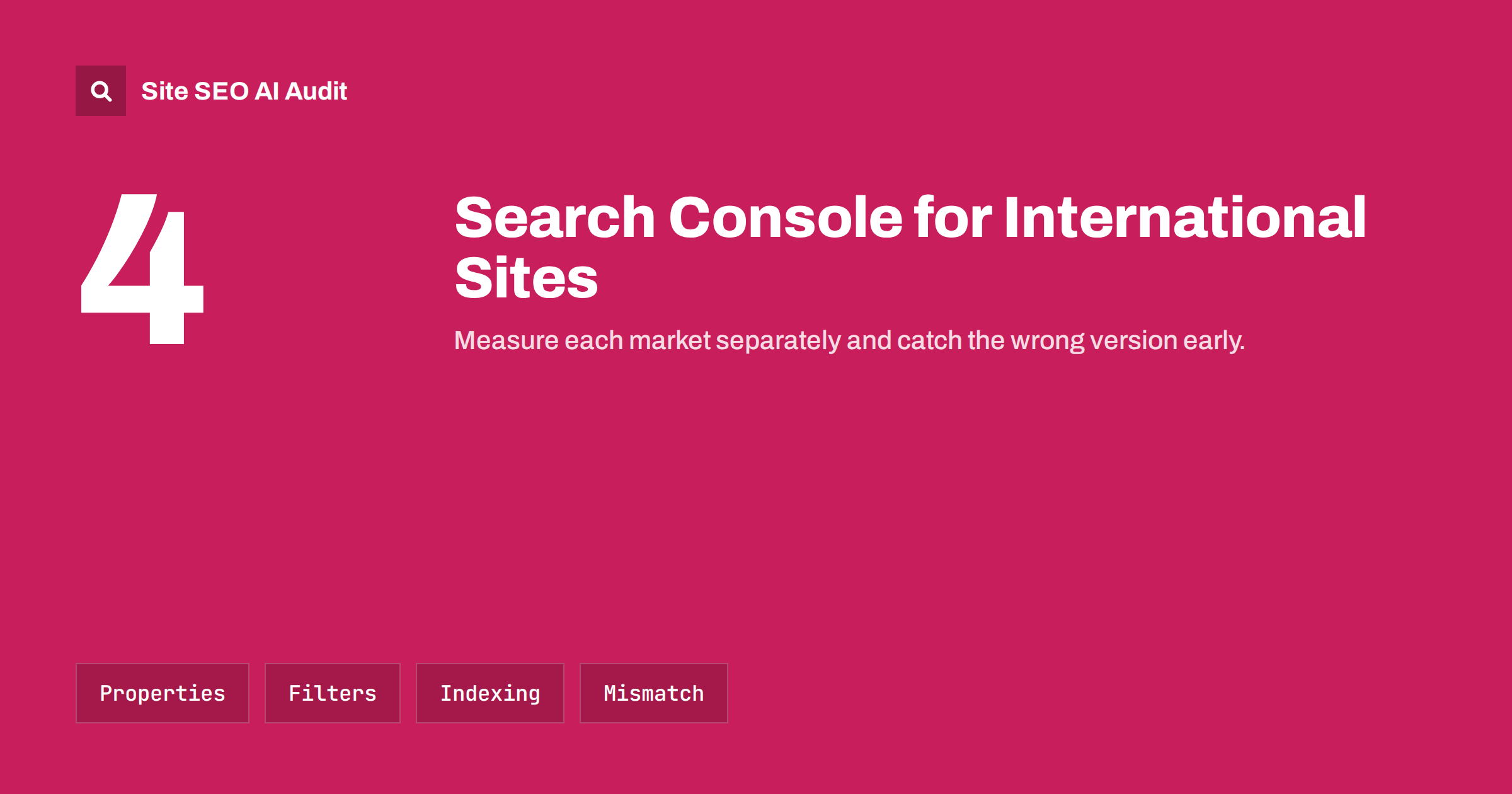
Short answer: Search Console does not have a dedicated international report any more, but it can still measure each market well. Set up properties that let you see each language or country version on its own, filter the performance report by country and by page folder together, compare indexing between languages, and watch for the wrong version appearing in a market. Those views show whether your international set-up works and where it breaks.
What changed, and what is still there
Search Console used to include an International Targeting report with hreflang error listings and a country targeting setting. Google retired it in 2022. Since then, there is no single place in Search Console that shows hreflang problems or lets you set a target country.
What remains is still very useful for international sites: the performance report with country, page, query and device filters; the page indexing report; URL inspection with the Google-selected canonical and rendered HTML; sitemap reporting; and regular properties for domains, subdomains and URL prefixes. The trick is to use them per market rather than for the site as a whole.
hreflang errors themselves need to be found with a crawler. Search Console tells you about the consequences: which version is shown where, and which pages are or are not indexed.
Set up properties that match your structure
A domain property covers all subdomains and protocols of a domain, for example everything under example.com. A URL-prefix property covers only URLs starting with a given prefix, such as https://example.com/de/.
- Subfolders: keep a domain property for the whole site, and add URL-prefix properties for important language folders, such as /de/ and /fr/. Each prefix property gives you reports, indexing data and sitemap status for that language alone.
- Subdomains: the domain property covers them all; add a property per subdomain for separate reporting.
- Country domains: each domain needs its own property. A domain property for example.de, another for example.fr, and so on.
Separate properties also make it easier to give access to local teams and to submit a sitemap per language version.
Create any new property before a launch or migration rather than after it, so you have a clean baseline from the first day. It is also worth writing down which property covers which version, so that colleagues do not compare numbers from overlapping properties by mistake.
Filter performance by country and folder together
The most useful view for international SEO combines two filters in the performance report:
- Country, for example Austria.
- Page, with “URLs containing” set to the folder of the version you expect there, for example /de-at/.
Then compare it with the same country and the other versions: /de-de/, /de/ or /en/. In a healthy set-up, most Austrian impressions go to the Austrian version. If the German-for-Germany version dominates Austrian results instead, Google is not choosing your Austrian pages, and hreflang, canonicals or differentiation need attention.
Repeat this for each market. A simple table with markets as rows and versions as columns, filled with impressions or clicks, quickly shows where versions are swapped.
Look at trends as well as totals. A market where the correct version’s share of impressions slowly falls over several months often points to a gradual problem: new pages published without hreflang, translations that stopped being updated, or a template change that altered canonicals. Sudden swaps usually follow a release or migration and are easier to trace.
Read queries per language
Queries show whether each language version is found for the right words. Filter by page folder and look at the top queries:
- Are queries mostly in the page’s language? English queries driving impressions to the /de/ folder may mean some German pages are partly untranslated, or that English-language searches in Germany find them.
- Do queries match the local terms you researched? If the German version receives impressions mainly for English product names, local terms may not be used enough in titles and headings.
- Are there high-impression, low-click queries? Poor click-through in one language often points to untranslated or badly localized titles and descriptions.
Queries also reveal content opportunities. Questions that appear only in one language, with few clicks because no page answers them well, are good candidates for local content that does not exist in your original language at all. International SEO is not only about translating what you have; it is also about answering what each market asks.
Compare indexing between languages
The page indexing report shows how many pages are indexed and why others are not. Use it per language property or filter by sitemap:
- Compare the number of indexed pages with the number of pages you published in each language. A much lower ratio in one language is a warning sign.
- Look at reasons such as “Duplicate, Google chose different canonical than user” in a country folder. It often means Google treats country versions as duplicates of another version.
- Watch “Crawled, currently not indexed” and “Discovered, currently not indexed” in translated sections, which can indicate thin or low-value translations or weak internal linking.
- Check “Excluded by noindex” for leftovers from staging or from plugin settings that affect only some languages.
Indexing differences between languages are normal to some degree. A new language version needs time to be crawled and evaluated, and a small translated section with few internal links will usually be indexed more slowly than the established original. What matters is the trend: the share of indexed pages in a new language should rise over the first months. If it stays flat or falls, look at content quality, internal links and technical signals before publishing more pages in that language.
Use URL inspection on sample pages
For each language version, inspect a few representative URLs: the language home page, a main category or service page and an article or product. URL inspection shows:
- The Google-selected canonical. If it differs from your declared canonical and points to another language or country version, Google considers the pages duplicates.
- The rendered HTML, which lets you confirm that hreflang, the lang attribute and translated content are present in what Google processed.
- Crawl information, including whether the page was fetched successfully and whether it is allowed by robots.txt.
Submit and monitor sitemaps per version
Submit the sitemap or sitemap index for each property. If you split sitemaps by language, the sitemap report shows discovered and indexed URLs per language, which is an easy way to spot a language that is not being indexed as expected. If you publish hreflang in sitemaps, keep them updated whenever URLs change.
When a language’s sitemap shows many submitted URLs but few indexed ones, compare it with the page indexing report for that property. The reasons listed there, such as duplicates, redirects or pages not yet crawled, usually explain the gap and tell you whether the problem is technical or about content quality.
A monthly international check in Search Console
- For each market, compare impressions and clicks per version with the country filter.
- Note any market where the wrong version gets most of the impressions.
- Review top queries per language folder for mismatched languages or missing local terms.
- Compare indexed versus published pages per language.
- Inspect two or three URLs per language for the selected canonical.
- Check sitemap status for each property.
This takes little time once the properties and filters are set up, and it catches most international problems before they grow.
Share the results with whoever owns each market. A short monthly note per country, listing impressions and clicks for the correct version, any version swaps and any indexing changes, keeps local teams involved and makes it much more likely that problems are reported and fixed quickly. Over a year, these notes also become a useful history of how each market developed and which changes helped.
Combining Search Console with a crawl
Search Console shows symptoms; a crawl shows causes. When a market shows the wrong version, a crawl can reveal missing return links, redirected hreflang targets, cross-language canonicals or wrong lang attributes. Site SEO AI Audit crawls a site like a search engine and checks these in its Languages and crawl areas on every page, weighted by how many pages each issue affects. Paid plans add regular re-audits and comparisons over time, which fit well with a monthly Search Console review; see the plans.
Related reading
- How to target a specific country in Google Search today
- Same language, different countries: how to target en-US and en-GB
- Discovered – currently not indexed: why and how to fix it
The bottom line
Search Console can measure an international site well if you use it per market. Create properties that match your structure, combine country and folder filters, read queries per language, compare indexing between languages, inspect sample URLs for the selected canonical and monitor sitemaps per version. Then use a crawl to find the causes of what the reports reveal.
FAQ
Does Search Console still report hreflang errors?
No. The International Targeting report that listed hreflang errors was retired in 2022. Use a crawler to find hreflang problems and Search Console to see their effects.
Should I create a property for each language folder?
It is optional but useful. URL-prefix properties for folders such as /de/ give separate performance, indexing and sitemap data for each language.
How can I tell if the wrong version shows in a country?
Filter the performance report by that country and compare impressions for each version’s folder. If another version gets most impressions, Google is not choosing your intended pages there.
What does “Google chose different canonical” mean on a country page?
Google considers the page a duplicate of another URL, often another country version with nearly identical content. Check hreflang, canonicals and how much the versions really differ.
Can I set a target country in Search Console?
No. The country targeting setting was removed. Country relevance now comes from your domain, hreflang, local content and local links.