ENEnglish
 LTLietuviškai
 DEDeutsch
 FRFrançais
 RUРусский
 ESEspañol
 PLPolski
 ITItaliano
 UKУкраїнська
 CSČeština
 PTPortuguês
 JA日本語
JA日本語 LVLatviešu valoda
 ETEesti
 HUMagyar
 IDBahasa Indonesia
 TRTürkçe
 HIहिन्दी
 ELΕλληνικά
 ARالعربية
 THไทย
THไทย VITiếng Việt
 RORomână
 MSBahasa Melayu
 BNবাংলা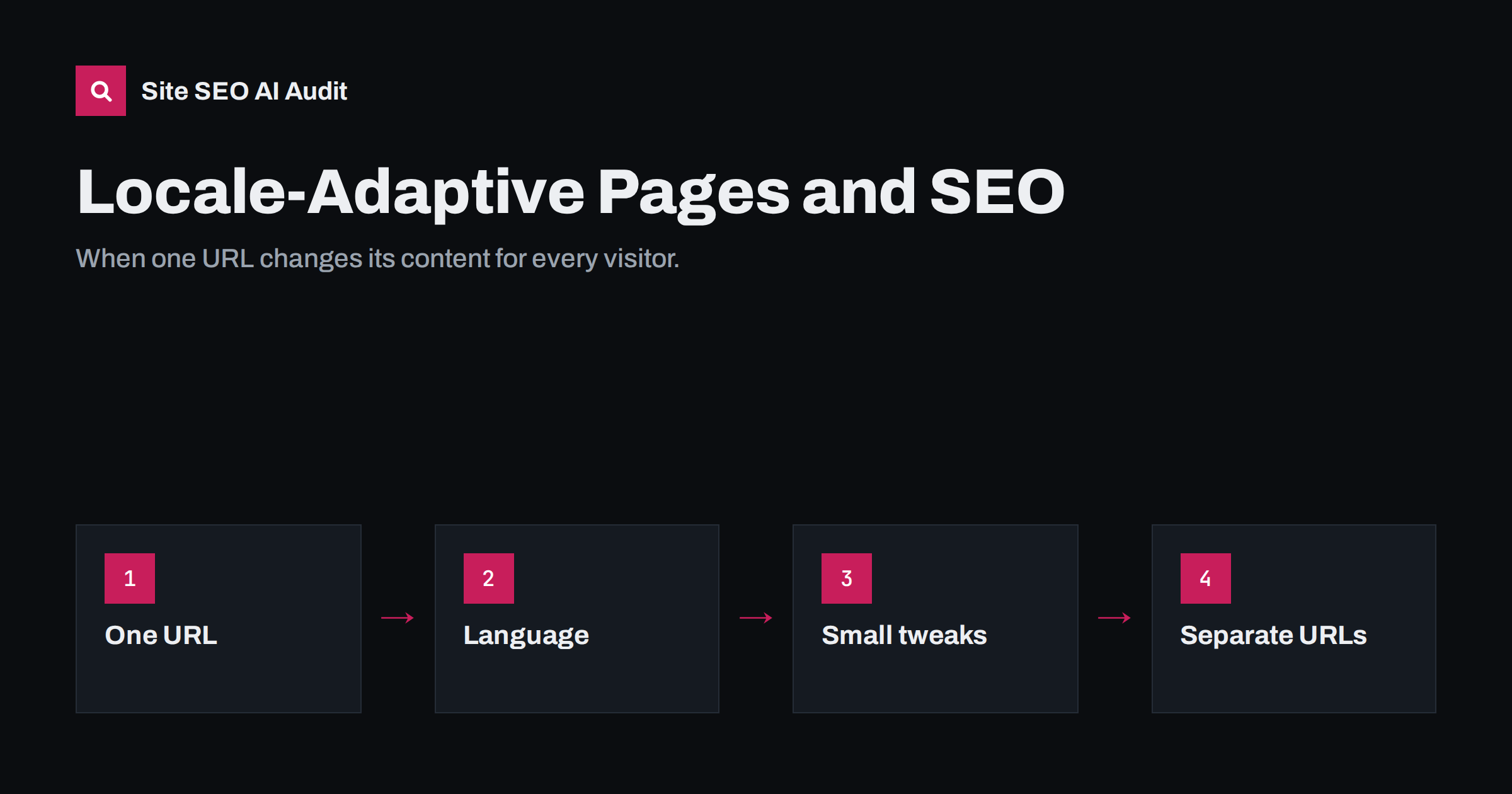
Short answer: A locale-adaptive page serves different content on the same URL depending on the visitor’s location or browser language. Search engines usually crawl from a limited set of locations without a language preference, so they typically see and index only one version. Small adaptations, such as displaying a local currency or a nearby store, are usually harmless. But if language or the main content changes, each version needs its own URL connected with hreflang.
What locale-adaptive pages are
A locale-adaptive page decides what to show after it receives a request. The server, or JavaScript in the browser, looks at signals such as the IP address or the Accept-Language header and then adjusts the page: German text for German browsers, prices in yen for visitors from Japan, a different hero banner for visitors from the United States.
The URL stays the same for everyone. example.com/pricing/ shows English and dollars to one visitor and German and euros to another. For visitors this can feel convenient, and for developers it can feel elegant: one URL, one template, many markets.
For search engines, it creates a basic problem. A URL is the unit that search engines crawl, index and rank. If one URL can hold many different versions, the search engine has to pick one, and it usually picks whatever it happens to be served.
Why search engines struggle with them
Google has documented how it handles locale-adaptive pages. Its crawler mostly uses IP addresses based in the United States and typically does not send an Accept-Language header. It may crawl from other locations as well, but you cannot rely on it seeing every variant, and Google recommends separate locale URLs annotated with hreflang instead.
The practical consequences:
- Only one version gets indexed. Usually the one served to a US request without language preference, often English.
- Other languages cannot rank. The German version has no URL of its own, so it cannot appear for German searches as German content.
- hreflang cannot help. hreflang connects different URLs; with one URL, there is nothing to connect.
- Other crawlers see something else. Different search engines and AI crawlers may come from different places, so they may each index a different variant of the same URL, which makes results unpredictable.
There is also a user-facing cost. People share URLs constantly, in emails, chats and social posts. With a locale-adaptive page, the person who receives a link may see something different from what the sender saw: another language, another price or another offer. That leads to confusion and support questions, and it makes it hard for anyone to refer to “the page” with certainty.
What kind of adaptation is fine
Not every adaptation is a problem. The question is whether the main content, especially its language, changes. Adaptations that leave the page essentially the same are generally fine:
- Currency display converted from a base price, with the product and text unchanged.
- A “nearest store” or local contact block within an otherwise identical page.
- Date, time and number formats adjusted to the visitor’s locale.
- A banner suggesting another language version, with links to separate URLs.
- Legal notices such as cookie consent banners that vary by region, while the page content stays the same.
In all of these cases, what search engines index is still an accurate description of the page. The risk begins when language, main text, product range or prices that are central to the page change based on who is asking.
What should get separate URLs
Give each variant its own URL when any of the following differ:
| Difference | Why it needs its own URL |
|---|---|
| Language of the content | Each language must be indexable to rank for searches in that language |
| Product range by country | Search engines should see what is actually available in each market |
| Prices and terms that define the offer | Structured data and snippets must match the market’s page |
| Legal content by country | Visitors and search engines need the version that applies to them |
| Substantially different marketing content | Each version should be evaluated on its own merits |
Once variants have their own URLs, connect them with hreflang, give each a self-referencing canonical and link between them with a language or country switcher.
Moving from adaptive pages to separate URLs
If your site currently adapts content on one URL, a transition typically looks like this:
- List the variants. Which languages and markets does the adaptive logic currently serve?
- Choose a URL pattern, usually folders such as /de/ or /de-at/, and create URLs for each variant.
- Keep the original URL meaningful. It can become the default version (for example English), or a language and country selector that serves as x-default.
- Replace automatic switching with suggestions. Detection can still power a banner offering the local version, but the URL should decide the content.
- Add hreflang, canonicals and sitemaps for all new URLs.
- Update internal links so each version links within its own language.
- Monitor indexing per language in Search Console as the new URLs are discovered.
Caching and performance side effects
Locale-adaptive pages cause problems beyond search engines. Caching layers and content delivery networks store pages by URL. When one URL can produce many versions, the cache must either be told to store a separate copy for each variant, usually through the Vary header or custom cache keys, or it will serve the wrong variant to some visitors.
Both options have costs:
- Varying the cache by Accept-Language or country multiplies the number of cached copies and lowers the cache hit rate, which can slow pages down for everyone.
- Not varying the cache leads to visitors, and crawlers, receiving a version that was generated for someone else, such as German text for a British visitor. These errors are intermittent and hard to reproduce.
Separate URLs avoid the whole problem. Each language URL is cached once, served quickly from the edge and always returns the same content, which is better for speed, for visitors and for search engines. It also makes debugging simpler: when someone reports a problem, the URL tells you exactly which version they saw.
When a single adaptive URL can be acceptable
There are situations where a single URL with light adaptation is a reasonable choice:
- Single-language sites with international customers, where only the currency display or shipping estimate changes.
- Logged-in areas and checkouts, which are not meant to be indexed anyway.
- Personalised recommendations within an otherwise stable page, such as “popular in your country” blocks below the main content.
- Temporary regional notices, for example delivery delays in one country.
In these cases, make sure the default version that crawlers receive is complete and accurate, that structured data matches it and that no essential content is shown only to some locations.
Cookies and stored preferences
Some sites store the visitor’s chosen language in a cookie and then serve that language on every URL. This creates the same problem as IP-based adaptation: crawlers usually do not keep cookies, so they always see the default.
Stored preferences are useful, but they should influence navigation, not content. If a visitor who chose German lands on an English URL, suggest the German equivalent or redirect them once, clearly, to the German URL. Do not silently rewrite the English URL’s content into German.
Testing what crawlers see
- Request your URLs with a command-line tool, without cookies and without an Accept-Language header. That approximates a typical crawler request.
- Request them again with different Accept-Language headers and, if possible, from other countries. If the content or language changes, the page is locale-adaptive.
- Use URL inspection in Search Console to see which version Google fetched and rendered.
- Check the indexed snippet in different countries’ search results, which shows which variant was indexed.
Site SEO AI Audit crawls a site like a search engine, following robots.txt, and checks the Languages area on every page it reads: hreflang return links, broken language versions, x-default and lang attributes. On a locale-adaptive site, a crawl that finds only one language with no alternates is a quick sign that other versions are invisible. You can run a free audit to check.
Related reading
- Automatic language redirects: why they hurt international SEO
- hreflang on JavaScript and headless sites: what can go wrong
- Multilingual vs multi-regional sites: what is the difference?
The bottom line
Serving different languages or markets on one URL means search engines usually index only one of them. Keep small, cosmetic adaptations such as currency display if they help visitors, but give every language and every materially different market its own URL, connect them with hreflang, let the URL decide the content and use detection only to suggest the right version.
FAQ
Can Google index different languages on the same URL?
Not reliably. Google usually crawls from the United States without a language preference, so it typically indexes the default version only. Separate URLs with hreflang are the recommended approach.
Is showing local currency on one URL a problem?
Usually not, if the product and text stay the same. If prices and offers differ materially by country, separate country URLs are clearer.
Does Googlebot send an Accept-Language header?
Google has said its crawler typically sends requests without an Accept-Language header. Pages that depend on that header to choose a language will usually show their default to Googlebot.
Can cookies store a visitor’s language choice?
Yes, but use the stored choice to suggest or navigate to the right URL, not to change the content of the URL the visitor requested.
What should the original URL show after moving to separate URLs?
Either a default version, such as English, or a language and country selector. Either can serve as the x-default in the hreflang cluster.