ENEnglish
 LTLietuviškai
 DEDeutsch
 FRFrançais
 RUРусский
 ESEspañol
 PLPolski
 ITItaliano
 UKУкраїнська
 CSČeština
 PTPortuguês
 JA日本語
 LVLatviešu valoda
 ETEesti
 HUMagyar
 IDBahasa Indonesia
 TRTürkçe
 HIहिन्दी
 ELΕλληνικά
 ARالعربية
 THไทย
 VITiếng Việt
 RORomână
 MSBahasa Melayu
 BNবাংলা
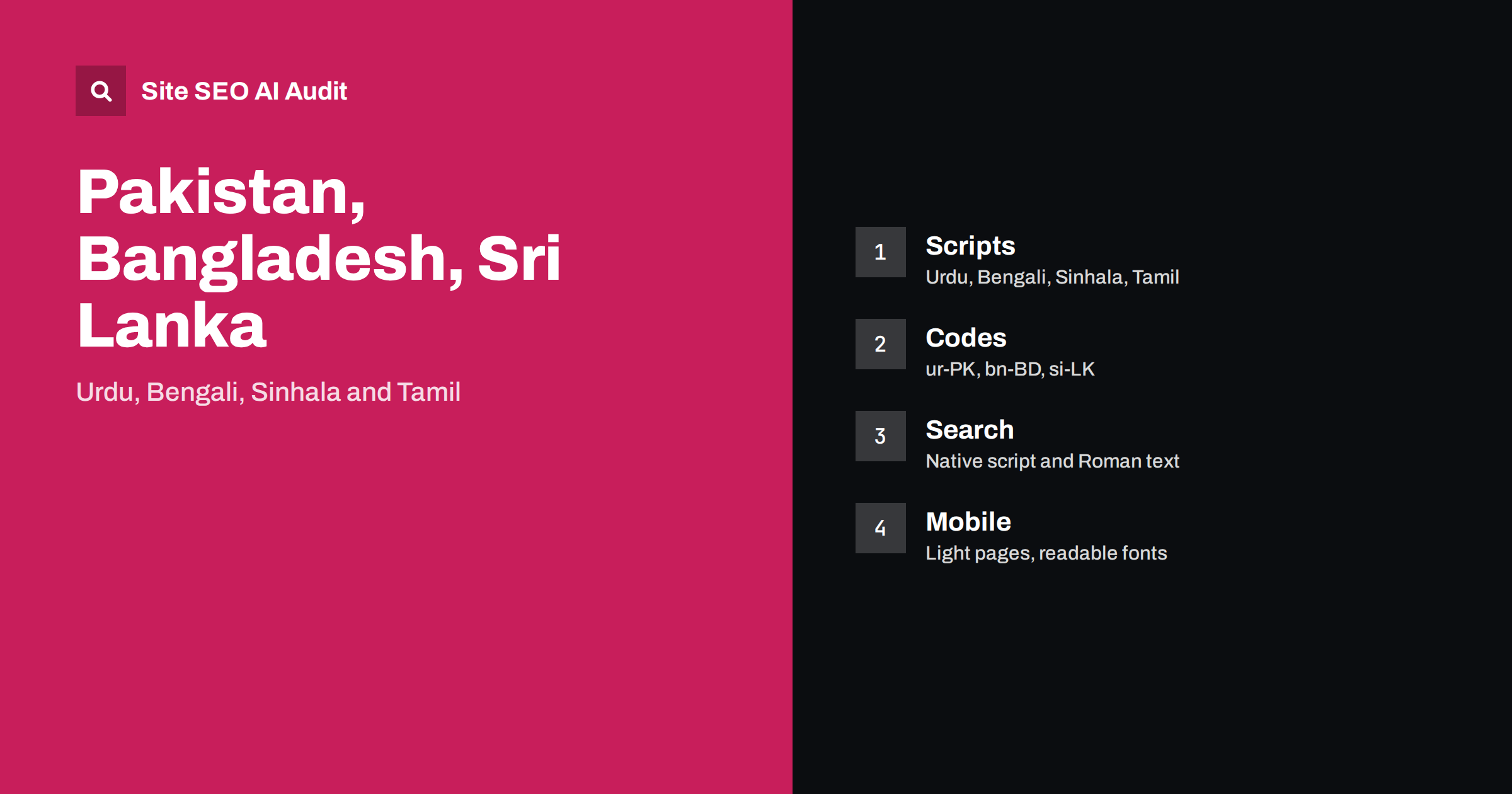
Short answer: To rank in Pakistan, Bangladesh and Sri Lanka, treat each country as its own market with its own languages and habits. Pakistan uses Urdu, written right to left, alongside English; Bangladesh uses Bengali; Sri Lanka uses Sinhala and Tamil with English widely understood. Publish separate URLs for each language and country, mark them with hreflang codes such as ur-PK, bn-BD, si-LK, ta-LK and en-PK, set the HTML lang and direction attributes, use UTF-8 and web fonts that display the scripts correctly, and research real queries, including searches typed in Latin letters. Many users browse on phones with limited data, so keep pages light and readable. Localize prices, payment methods, delivery and support, show local trust signals and monitor Search Console by country. Start with the language that best serves your customers and expand only when you can maintain it.
South Asian markets beyond India are large, young and increasingly online, yet they are often handled as an afterthought: a single English page or a machine translation without review. The result is poor visibility in local searches and low trust. Each country has distinct languages and scripts, and each script brings technical requirements: right-to-left layout for Urdu, complex shaping for Bengali and Sinhala, and font choices that affect speed. This guide explains how to choose languages, set up the technical foundation, research keywords, localize content and measure results. It builds on the India SEO guide, which covers Hindi, and on SEO for right-to-left languages.
Choose countries and languages with care
Begin with the customers you can serve. Pakistan, Bangladesh and Sri Lanka differ in regulations, payment systems, logistics and language use, so a single regional page rarely works. English is common in business, education and technology and can be a sensible first version for professional audiences, software and B2B. For consumer services, retail, education and local offers, content in Urdu, Bengali, Sinhala or Tamil often reaches many more people and faces less competition. Decide which language versions you can keep accurate, and avoid launching more than you can maintain. The reasoning in choosing which countries to target first applies directly.
Set up hreflang, lang and direction
Give every language and country combination its own address, and annotate them with hreflang: ur-PK for Urdu in Pakistan, en-PK for English in Pakistan, bn-BD for Bengali in Bangladesh, en-BD for English in Bangladesh, si-LK for Sinhala in Sri Lanka, ta-LK for Tamil in Sri Lanka and en-LK for English there. All versions must link to each other, and you should add an x-default for pages where no version fits. In the HTML, set the lang attribute to the page language and use dir=”rtl” for Urdu pages so that punctuation, numbers and layout behave properly. Do not choose the language automatically from browser settings or location, and offer a visible language switcher made of normal links. See hreflang language and region codes and the HTML lang attribute.
Handle scripts, encoding and fonts
Serve all pages in UTF-8 so that every character is stored and displayed correctly, and check that databases, templates and feeds preserve it; see character encoding and SEO. Urdu is often displayed in a calligraphic style that needs suitable fonts, and some of those fonts are large. Bengali, Sinhala and Tamil also need fonts with full coverage of conjunct characters. Choose fonts carefully, subset them where possible, load them efficiently and define sensible fallbacks, so that text stays readable and pages stay fast, as explained in web fonts and page speed. Test headings, buttons, tables and forms with real text in each script, because longer or taller characters can break layouts that look fine in English.
Research keywords in native script and Latin letters
Search behaviour is mixed. Many people search in the native script, others type their language in Latin letters, often called romanized text, and many mix English words into queries. Roman Urdu, for instance, is widely used in informal writing, and similar habits exist for Bengali and Sinhala. Do not assume that a direct translation of an English keyword matches what people type. Use autocomplete, Search Console queries by country, local forums and social platforms, customer questions and the results pages themselves, then decide which form to target on which page. You can often include both forms naturally, for example the native-script term in the heading and the romanized variant in a related phrase. The methods are in multilingual keyword research and transliteration and SEO.
Localize content, prices and trust
Show prices in the local currency (Pakistani rupees, Bangladeshi taka or Sri Lankan rupees), use local units, dates and address formats, and state delivery areas and times that apply. Describe the payment methods your customers use, which in these markets may include cash on delivery, mobile wallets, local bank transfers and cards, depending on what you actually support. Add local phone numbers, addresses, business registration details where applicable and support hours in local time. Use examples and imagery that reflect local customers. Make return and refund terms clear. These details are part of the trust signals discussed in local trust signals for country versions, and they affect conversions as much as rankings.
Quality control is especially important for these languages. Machine translation can produce stiff or incorrect text, and mistakes in product names, legal terms or health and finance topics damage trust. Ask a native speaker from the target country to review key pages, because vocabulary and tone differ between countries even for the same language. Keep a glossary of approved terms for products, features and brand names, and decide in advance which names stay in English. Keep translations in step with the original when prices, policies or features change, using the process in keeping translations in sync.
Build for mobile and slower connections
Many users in these markets browse on mid-range phones and variable connections, and data costs matter. Keep pages light: compress and resize images, avoid heavy scripts, limit third-party tags, and use caching and a content delivery network. Make sure the layout works on small screens, text is large enough in each script, buttons are easy to tap and forms are short. Measure with field data and test on realistic devices instead of only on a fast office connection. The checks are described in mobile usability: viewport, tap targets and font size and page weight and compression.
Choose a domain structure and hosting
You can use country domains such as .pk, .bd and .lk, subfolders on one domain, or subdomains. Country domains give a strong local signal and can be needed for some regulated sectors or local credibility, but they require separate authority building and administration. Subfolders on one domain are usually easier for small teams. Whichever you choose, keep a consistent structure, avoid redirecting users by location and make sure each version has a self-referencing canonical tag. Hosting near your audience can help speed, although a content delivery network often provides the same benefit. See ccTLD, subdomain or subfolder for the trade-offs.
Also think about discovery beyond search results. Messaging apps and social platforms play a large part in how people find and share links in these markets, so make sure pages produce good link previews with a correct title, description and image in the right language. Set Open Graph tags per language version and test a shared link on a phone. A preview in the wrong language or with a broken image reduces clicks from every channel. The setup is explained in Open Graph tags for link previews.
Measure and improve by country
Verify your site in Search Console and filter performance by country, language and device. Compare impressions and clicks per market with your goals, check that the right language version ranks, and look for pages that are crawled but not indexed. Review the results pages for your main queries to see which languages and formats dominate, and adapt your pages. Collect local feedback from customers or native speakers about wording and tone. Use a recurring review, such as the international SEO audit checklist, and track indicators from international SEO reporting KPIs.
Checklist and audit
- Selected countries and languages that you can maintain.
- Separate URLs with reciprocal hreflang, lang and dir attributes.
- UTF-8, suitable fonts and tested layouts in each script.
- Keyword research in native script and romanized forms.
- Local currency, payments, delivery, contact details and support.
- Light, mobile-friendly pages and country-level reporting.
Site SEO AI Audit crawls each language version, checks hreflang return links, lang attributes, duplicate titles, speed and AI crawler rules, and ranks the fixes by the points they add. The first audit of up to 200 pages is free; multilingual sites can see the pricing page.
Related reading
- India SEO: Hindi and Multilingual
- SEO for Right-to-Left Languages
- Arabic SEO Guide
- Transliteration and SEO
The bottom line
Pakistan, Bangladesh and Sri Lanka reward sites that respect local languages, scripts and habits. Choose the markets and languages you can serve, mark versions correctly, support each script technically, research both native and romanized queries, localize payments and trust, keep pages light and measure by country. Do a few things well before expanding.
FAQ
Which language should I start with in Pakistan?
Start with the language your customers use to search and buy. English suits professional audiences, while Urdu reaches a much wider consumer audience.
Do I need dir=”rtl” for Urdu pages?
Yes. Set the direction so that layout, punctuation and numbers display correctly, and test the pages with real Urdu text.
Should I target romanized Urdu or Bengali?
Many people search that way, so check your data. Include common romanized forms naturally on relevant pages, alongside the native script.
Can one page serve all three countries?
Rarely. Languages, currencies, laws and delivery differ, so separate country versions work better, although shared English content can be reused where it applies.
How do I check which version ranks in each country?
Filter Search Console by country, review the landing pages and queries, and compare them with the versions you intended to rank.