ENEnglish
 LTLietuviškai
 DEDeutsch
 FRFrançais
 RUРусский
 ESEspañol
 PLPolski
 ITItaliano
 UKУкраїнська
 CSČeština
 PTPortuguês
 JA日本語
JA日本語 LVLatviešu valoda
 ETEesti
 HUMagyar
 IDBahasa Indonesia
 TRTürkçe
 HIहिन्दी
 ELΕλληνικά
 ARالعربية
 THไทย
THไทย VITiếng Việt
 RORomână
 MSBahasa Melayu
 BNবাংলা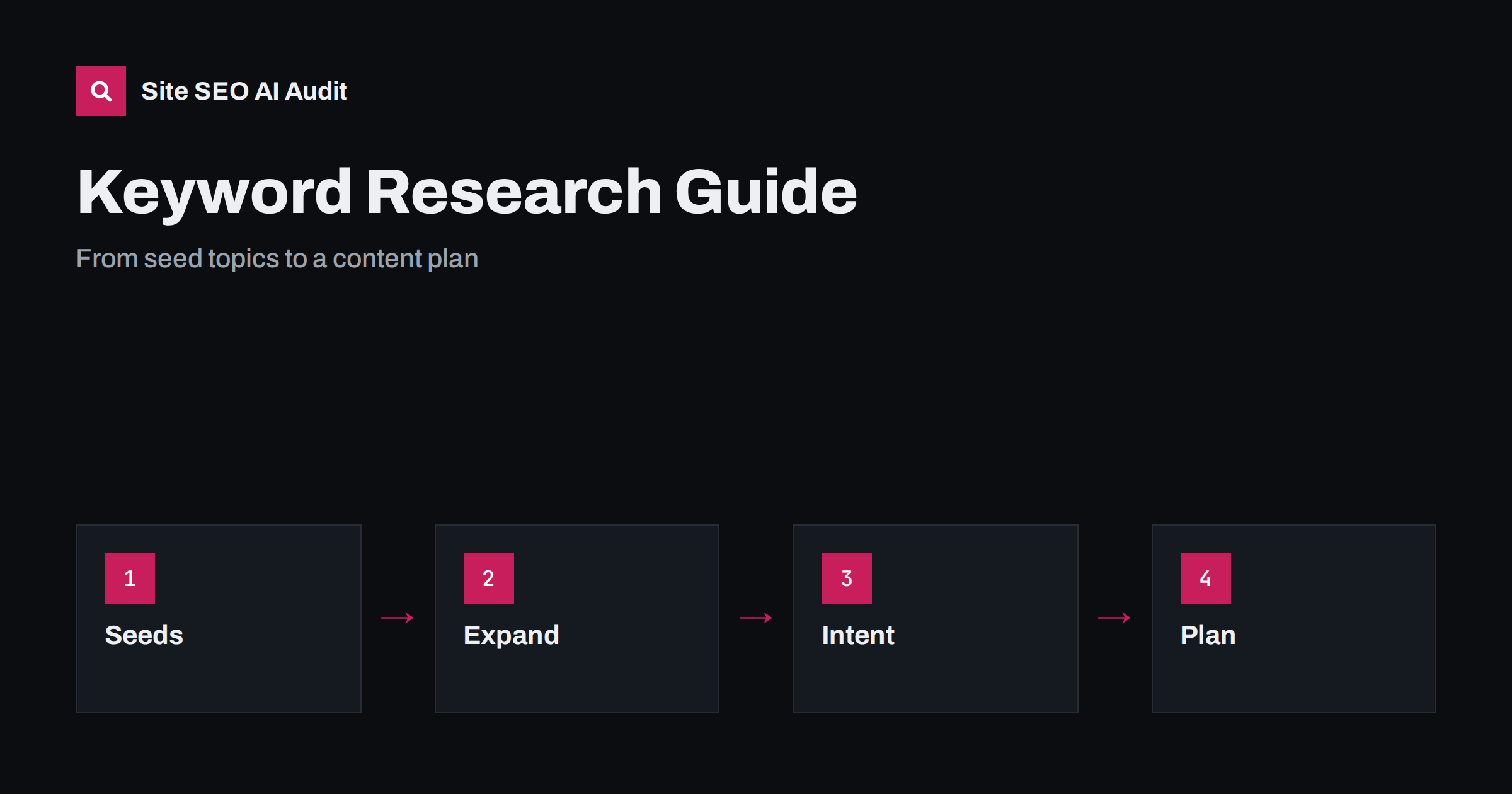
Short answer: Keyword research is the process of finding the words people use when they look for what you offer, then deciding which page should answer each one. List your core topics, expand them with search suggestions, customer questions and competitor pages, group the results by intent, choose one main page per group, and rank the plan by value and effort. Repeat it every few months, because language and demand change.
Many beginners treat keyword research as a hunt for a magic phrase with high volume and low competition. In practice it is closer to listening. You learn how your customers describe their problems, which words they use for your products and what kind of page they expect to find. Tools help, but the value comes from the decisions you make: which topics to cover, which pages to create, which ones to merge and which words to put in titles and headings. This guide gives a repeatable process that works for a small business site as well as a large one.
Start with seed topics, not tools
Before you open any tool, write down what your site is about in plain words. Ask four questions: what do we sell or explain, whom do we help, which problems do we solve, and what do customers ask before they buy? The answers are your seed topics. A garden centre might list “raised beds”, “lawn care”, “tree planting” and “garden tools”. A software company might list its features, the jobs they do and the tasks that come before and after.
Collect real wording from places where customers speak freely: emails, chat logs, call notes, reviews, forum threads and the questions your sales team hears. These phrases are often better than anything a tool suggests, because they show the exact vocabulary of your audience, including mistakes and slang. Keep them in a spreadsheet with a column for the source.
Expand the list with suggestions and questions
Next, grow each seed into many related searches. Useful sources are:
- Autocomplete suggestions and related searches in the search engine itself.
- The “people also ask” style questions that appear for your topics.
- The queries your site already receives in Search Console, which show what people use to find you today; see Search Console setup.
- Your internal site search, if you have one, because it shows what visitors cannot find.
- Competitor sites that rank for your topics: their titles, headings and category names.
- Keyword tools, which add volume estimates and related terms.
Volume numbers from tools are estimates, so use them to compare ideas, not as exact forecasts. A phrase with a small volume can still bring valuable visitors if it matches a purchase need. Look also at long phrases that describe a specific need; see long-tail keywords.
Understand search intent
Intent is the reason behind a search. Four broad types cover most queries:
- Informational: the person wants to learn something, for example “how to choose a standing desk”.
- Navigational: the person wants a specific site or page, such as a brand name.
- Commercial: the person is comparing options, for example “best standing desks for small rooms”.
- Transactional: the person is ready to act, for example “buy standing desk” or “book a service”.
To check intent, search for the phrase and look at what ranks. If the results are all guides, a product page will struggle. If they are all product listings, a long article may not fit. Match the format that people already see, and then make your page more useful than the others. See the search intent guide.
Group keywords into topics
A common beginner mistake is to create one page for every phrase. Many phrases mean the same thing, and search engines understand that. Instead, group phrases that share an intent and can be answered by the same page. For example, “how to clean a laptop screen”, “clean laptop screen safely” and “what to use to clean a laptop display” belong on one page. Choose a main phrase for the title and heading, and use the others naturally in sections, questions and image descriptions.
When two groups have different intent, they need different pages. “Laptop screen cleaner” with product intent is not the same as “how to clean a laptop screen” with informational intent. Keep a map that lists each group, its main phrase, its intent and the page assigned to it. See keyword mapping. This map also prevents two of your own pages from competing for the same searches; see fixing keyword cannibalization.
Judge difficulty and value
Not every keyword deserves effort. Judge each group by three questions:
- Relevance: does this topic lead to something your business offers or a reader you want?
- Value: would a visitor from this search be likely to buy, subscribe, call or return?
- Difficulty: who ranks now, and could your page be better, fresher or more specific than theirs?
Difficulty scores from tools are rough guides based on links and competitor strength. Look at the actual results: if they are dominated by large brands and official sources, a new site may need a narrower angle. If they contain thin or outdated pages, you have an opening. Newer sites usually progress faster with specific topics, where they can show real experience, than with broad head terms.
Check what AI answers show
People increasingly ask full questions to assistants and AI features in search. This changes keyword research in two ways. First, queries are longer and more conversational, so write down the full question, not only a short phrase. Second, the answer may quote a few sources, so your page needs a direct, accurate answer near the top, followed by detail. Test your main topics by asking an assistant and noting which sources it uses and what it leaves out. See prompt research for AI search and query fan-out in AI search.
Build a content plan
Now turn the groups into work. For each one, decide whether you will create a new page, improve an existing page, merge pages or skip it. Prioritize with a simple score: value, chance of ranking and effort. Pages that support products or services come first, followed by guides that answer questions customers ask before buying. Organize related pages into clusters with one main page and several supporting pages that link to it; see topic clusters and pillar pages.
For every planned page, write a short brief: main phrase, related phrases and questions, intent, audience, what the reader should be able to do afterwards, facts to include, and internal links. Briefs make writing faster and keep the result focused. If several writers work on the site, share a template; see SEO content briefs for writers. When the plan is large, look for gaps against competitors with a content gap analysis.
Place keywords where they belong
After the plan, write for people first. Put the main phrase, or a close natural variant, in the title tag, the main heading, the first paragraph, the address and at least one subheading. Use related phrases where they fit the sentence. Do not repeat a phrase mechanically, because it makes the text hard to read and does not help. Add the language real customers use, and explain technical terms. See keyword placement on the page and title tag writing.
Review and repeat
Keyword research is never finished. Every quarter, compare the plan with Search Console: which pages gained impressions, which queries bring clicks, and which pages rank but get few visits because the title is weak. Refresh the pages that are close to a good position, and add new pages for questions that appear in your data. A site audit helps you see the technical and on-page state of the pages you wrote. Site SEO AI Audit checks titles, headings, duplicates and more, and the first audit of up to 200 pages is free.
A few mistakes appear again and again, and they are easy to avoid once you know them:
- Chasing volume only. A phrase that many people type but that does not fit your offer brings visitors who leave at once.
- Ignoring the results page. If you never look at what ranks, you cannot know which format the searcher expects.
- Creating a page for every variation. Near-identical pages split links and confuse search engines about which one to show.
- Forgetting existing pages. Often the fastest win is to improve a page that already ranks on the second page of results.
- Never checking the outcome. Without a review, you cannot learn which kinds of topics work for your site.
Keep the spreadsheet simple and share it with everyone who writes for the site, so that the plan stays a working document and not a one-time exercise.
Related reading
The bottom line
Good keyword research is a process of listening, grouping and deciding. Start with your audience’s words, expand them with real data, match the intent, give each topic one strong page, and review the results every few months. The best keyword list is the one that turns into pages people find useful.
FAQ
How many keywords should one page target?
One main topic with its close variants. A page can rank for many related phrases if it answers the same question well.
Do I need a paid keyword tool?
Not to begin. Search suggestions, Search Console, customer questions and competitor pages give a strong starting list. Paid tools add estimates and convenience.
Is keyword volume the most important number?
No. Relevance and intent matter more. A low-volume phrase that matches a buying need can be worth more than a broad term with many casual searches.
How often should I redo keyword research?
Review it every quarter and whenever you launch a product, enter a market or see a change in your traffic. Language and demand shift over time.
Should I research keywords in every language I publish?
Yes. Translated keywords often do not match what local searchers type, so research each language with native speakers or local data.