ENEnglish
 LTLietuviškai
 DEDeutsch
 FRFrançais
 RUРусский
 ESEspañol
 PLPolski
 ITItaliano
 UKУкраїнська
 CSČeština
 PTPortuguês
 JA日本語
JA日本語 LVLatviešu valoda
 ETEesti
 HUMagyar
 IDBahasa Indonesia
 TRTürkçe
 HIहिन्दी
 ELΕλληνικά
 ARالعربية
 THไทย
THไทย VITiếng Việt
 RORomână
 MSBahasa Melayu
 BNবাংলা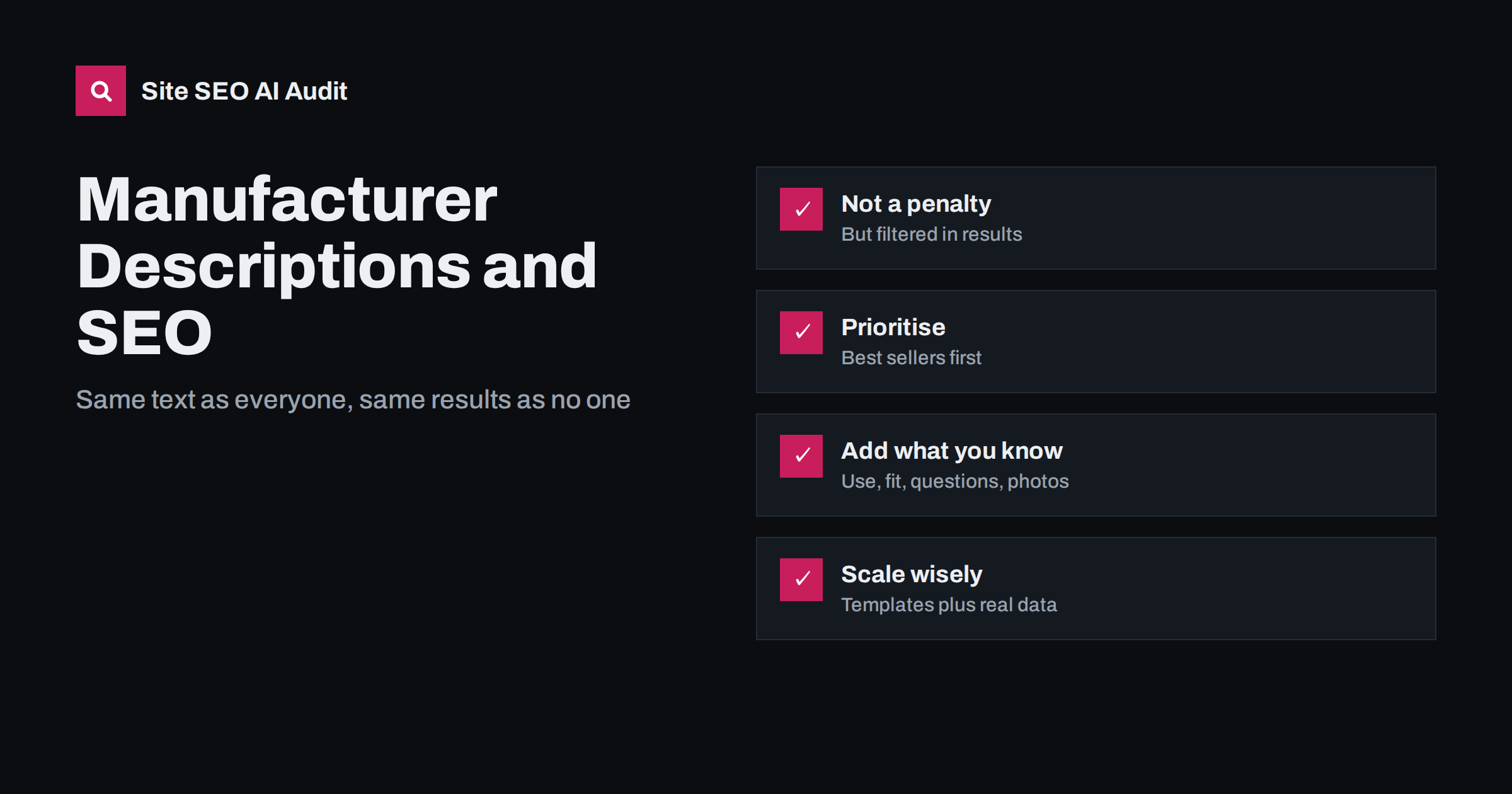
Short answer: Using the manufacturer’s product description does not cause a penalty, but it gives search engines no reason to show your page instead of the many other shops with identical text. Usually one or a few versions rank and the rest are filtered out of results for that text. You do not need to rewrite every product. Start with the products that matter most, add information only you can provide, such as real photos, sizing advice, use cases, comparisons, questions and reviews, and use structured templates with accurate product data for the long tail.
Most online shops start with supplier data: a product feed with titles, specifications and a description written by the manufacturer. It is the fastest way to fill a catalogue, and every other retailer of the same products does exactly the same. The result is thousands of pages across the web with identical text, competing for the same searches. This guide explains how search engines handle that and what to do about it with limited time.
How search engines treat identical product text
When many pages contain the same text, search engines try to show only one version for a query that matches it, so that results are not full of duplicates. Which version they choose depends on many signals: the authority of the site, how well the rest of the page matches the query, the user’s location and other factors. The other versions are not removed from the index and not penalised; they are simply less likely to appear for searches that the shared text answers.
For a large, well-known retailer, that may be fine, because it often wins the choice. For a smaller shop, it usually means that its product pages are invisible for the product name unless something else on the page makes them stand out. Our guide to thin content explains why pages with nothing of their own struggle in general.
Why it matters more than it seems
- Product searches are high intent. People searching for a specific model are often ready to buy. Those clicks are worth more than most informational traffic.
- Shopping and AI answers draw on product pages. When a system summarises what a product is good for, it prefers pages that say something specific and different; our guide to product pages for AI shopping answers covers this.
- Manufacturer text is written for the manufacturer. It describes features, not the questions your customers ask, and it often includes claims or marketing language that do not help buyers decide.
- Your own duplicates add up. Variants, colour pages and filtered category pages with the same description repeat the problem inside your own site.
Decide where rewriting pays off
Rewriting thousands of descriptions by hand is rarely realistic, and not necessary. Prioritise:
- Best sellers and high-margin products, where better visibility has the biggest effect on revenue.
- Products with search demand, which you can see in Search Console queries and impressions for product pages.
- Products where you have real expertise, such as items your staff use, test or advise on.
- Products you sell exclusively or in unusual combinations, where you can genuinely be the best source.
For the rest of the catalogue, a better template with accurate data is often enough. Our guide to prioritising SEO fixes describes a simple way to rank work by impact.
What to add instead of just rewording
Rewording the manufacturer’s text in different sentences makes it technically unique but no more useful. Search engines and shoppers both respond to new information. The most effective additions:
| Addition | Why it helps | Effort |
|---|---|---|
| Your own photos and video | Shows real size, texture and use; unique images | Medium |
| Fit, sizing and compatibility advice | Answers the most common pre-purchase questions | Low to medium |
| Who it is for and who should choose something else | Helps buyers decide; rarely in supplier text | Low |
| Comparison with similar products you sell | Captures “X vs Y” searches, links products | Medium |
| Questions and answers from customers | Adds real wording and long-tail detail | Low once set up |
| Genuine customer reviews | Unique text, trust, possible review rich results | Low once set up |
| Care, setup or usage instructions | Useful after purchase, earns links and returns | Medium |
A short paragraph of genuine advice from someone who knows the product is often worth more than a long rewritten description. Our guide to product page SEO covers the rest of the page.
Better templates for the long tail
For thousands of products, a well-designed template can make each page more useful without manual writing:
- Structured specifications shown in a clear table, from accurate data, rather than buried in a paragraph.
- Generated summaries from real attributes, such as “A 2-person, 3-season tent weighing 1.6 kg, suitable for backpacking,” built from the actual data fields.
- Category-level advice blocks that are relevant to the product type, written once and kept short so they do not dominate every page.
- Related and alternative products chosen by real attributes, which also improves internal linking.
- Delivery, returns and stock information specific to your shop.
Be careful with automatically generated descriptions at scale. Text produced only to look unique, without adding information, does not help users and can fall under scaled content abuse in Google’s spam policies. If you use writing tools to help, base the text on real product data, check it for accuracy and add genuine expertise. Our article on publishing AI-assisted content responsibly explains the line.
Fix duplicates inside your own shop
Before competing with other shops, make sure you are not competing with yourself:
- Variants: colours and sizes of the same product usually belong on one page with a selector, or on separate pages with canonical tags to a main version when they have no distinct search demand.
- Products in several categories: keep one product URL, regardless of the category path the visitor came from.
- Filter and sort URLs: control them as described in faceted navigation SEO.
- Discontinued products: handle them deliberately, as explained in out-of-stock and discontinued product pages.
Use canonical tags correctly for duplicates you keep; our guide to canonical tags explains the setup.
Titles, data and feeds
Supplier feeds also bring identical product titles, and titles matter more than descriptions in search results. Make them specific and consistent: brand, model, key attribute such as size or colour, and product type, in an order your customers search. Make sure the structured data on each product page, including price, availability and identifiers such as GTIN where you have them, matches what the page shows. Accurate identifiers help search engines understand that your page is about the same product as others, and then the rest of your page decides whether yours is the one worth showing.
How to measure whether it worked
Improving product pages takes effort, so measure the effect on a sample before rolling it out across the catalogue. A simple approach:
- Choose two comparable groups of products, for example 30 products in the same category with similar sales and impressions.
- Improve the pages in one group and leave the other unchanged as a comparison.
- Record impressions, clicks and average position in Search Console for both groups for several weeks before the change.
- After Google has recrawled the improved pages, compare the same metrics for at least four to eight weeks, along with sales or add-to-cart rates from analytics.
- Look at the queries the improved pages now appear for. New long-tail queries, such as sizing or comparison searches, are an early sign that added content is working.
Seasonal products and price changes can distort the results, so compare groups over the same period rather than one group before and after. If the improved group performs clearly better, extend the approach to the next set of products.
Find duplicate and thin product pages
In a large catalogue, duplicate titles, thin descriptions and variant duplicates are hard to see one page at a time. Site SEO AI Audit crawls your shop like a search engine and checks every page for duplicate titles and descriptions, thin and duplicate content, canonicals, image alt texts and structured data, then ranks the fixes by how many pages each issue affects. The free audit covers up to 200 pages, and larger shops get a preliminary report of the first 200 pages; paid plans crawl up to 10,000 pages.
Related reading
The bottom line
Manufacturer descriptions are not penalised, but they rarely help a page rank, because many shops publish the same text. Prioritise the products that matter most, add information only you can provide, improve templates with accurate data for the long tail, avoid empty automated rewrites and clean up duplicates inside your own shop first.
FAQ
Will using manufacturer descriptions get my shop penalised?
No. Duplicate product text is not a penalty in itself. Search engines usually show one or a few versions for queries that match the shared text and filter the others, so your page is simply less likely to appear.
Do I need to rewrite every product description?
No. Rewrite or extend the products that matter most, such as best sellers and products with search demand, and improve the template with accurate data for the rest of the catalogue.
Is rewording the manufacturer’s text enough?
Rarely. Different wording without new information does not make the page more useful. Add your own photos, advice, comparisons, questions and reviews, which give search engines and shoppers a reason to choose your page.
Can I use writing tools to create unique descriptions?
Only with care. Text generated at scale just to look unique can fall under scaled content abuse. Base any assisted text on real product data, check it for accuracy and add genuine expertise before publishing.
How should I handle product variants with the same description?
Usually keep them on one page with a selector, or use canonical tags from variant pages to a main version when variants have no separate search demand. Give variants their own indexable pages only when people search for them specifically.