ENEnglish
 LTLietuviškai
 DEDeutsch
 FRFrançais
 RUРусский
 ESEspañol
 PLPolski
 ITItaliano
 UKУкраїнська
 CSČeština
 PTPortuguês
 JA日本語
 LVLatviešu valoda
 ETEesti
 HUMagyar
 IDBahasa Indonesia
 TRTürkçe
 HIहिन्दी
 ELΕλληνικά
 ARالعربية
 THไทย
 VITiếng Việt
 RORomână
 MSBahasa Melayu
 BNবাংলা
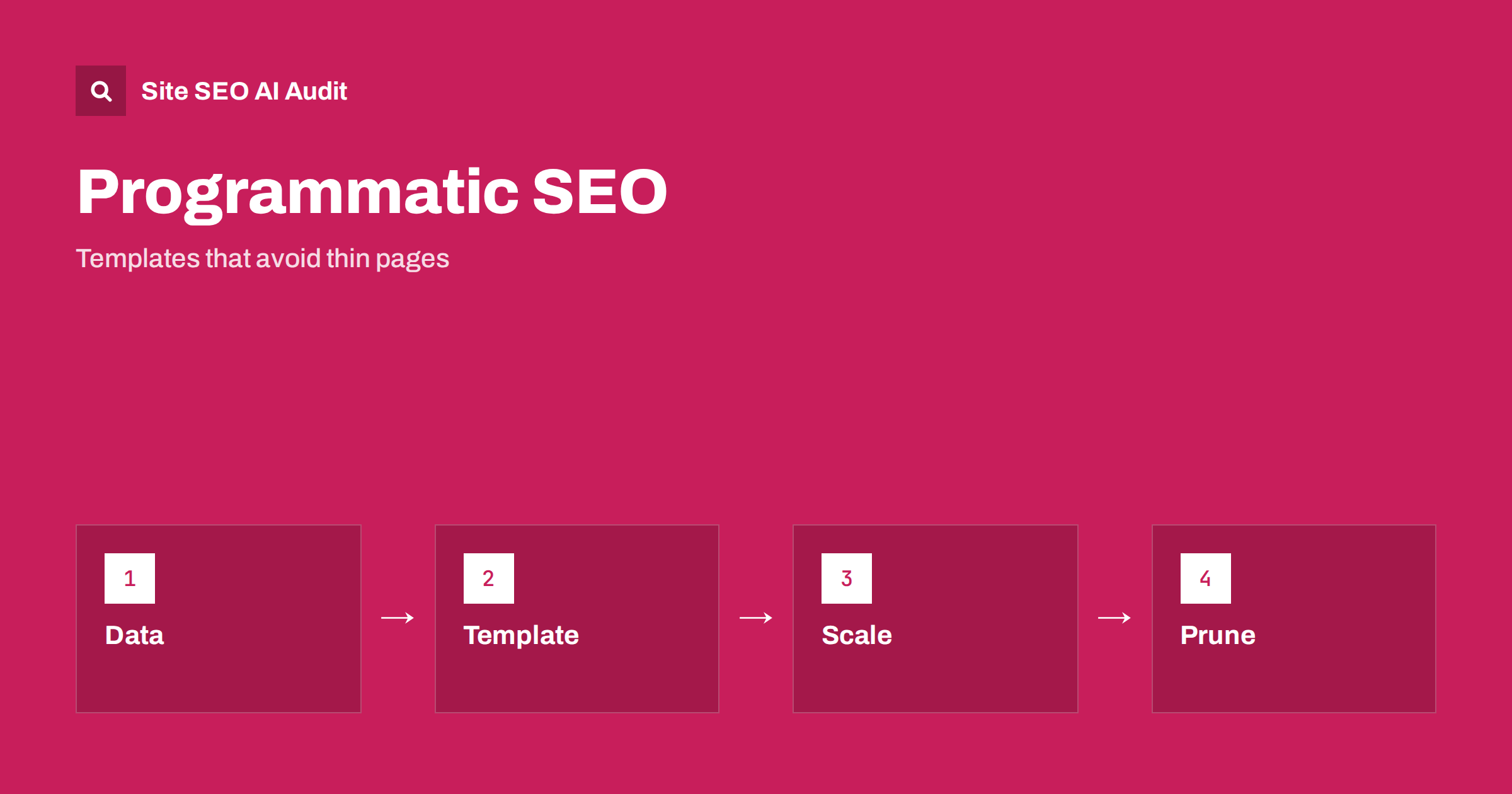
Short answer: Programmatic SEO creates many pages from one template and a data set, such as a page per city, product or comparison. It works when every page offers something useful and different, based on real data. It fails when pages are the same text with a few words swapped. Start with a small batch, make sure each page answers a real query, link them sensibly and remove pages that attract no impressions or add no value.
Large sites have always generated pages from databases: a travel site with a page per destination, a marketplace with a page per category, a software directory with a page per tool. The same approach is attractive to smaller teams, because a good template and a spreadsheet can produce hundreds of pages that match long-tail searches. It is also easy to do badly. Search engines have long targeted pages made at scale with little value, and quality systems judge pages against the needs of searchers, not the effort behind them. This guide explains when the method makes sense, how to design templates that produce useful pages, how to launch safely and how to clean up what does not work.
What programmatic SEO is
The idea is simple: identify a pattern of searches, build one page design that can answer them and fill it with data. Examples include “[tool] alternatives”, “[city] opening hours”, “[currency] to [currency] converter”, “[product type] size guide” and “[job] salary by country”. Each page targets a specific query, which is why the approach can bring traffic from long-tail searches that are too numerous to write by hand; see long-tail keywords.
It is not the same as spam, and it is not automatically good. The difference lies in whether each page gives a visitor something they could not get from a generic page, which is where the data comes in.
When it is a good idea
Programmatic pages suit situations where you have structured information with real value and many people search for variations of the same question. Good signs include:
- You own or can legitimately use a data set that is not trivial to copy: your own inventory, user-generated content, measurements, prices, availability or reviews.
- The queries share a clear pattern and each variant has a distinct answer.
- Search results for the variants show specific, practical pages, not only long guides.
- You can keep the data current.
It is a poor idea when you only have a list of locations and a paragraph of generic text, when the data is public and identical on a thousand other sites, or when you cannot say what each page offers that the others do not. In those cases, a smaller number of strong pages usually beats a large number of weak ones.
The data decides the quality
The page is only as good as its data. Ask what unique fact each page can show. For a city page it might be real opening hours, a map, local prices or tested recommendations. For a product comparison it might be specifications, measured results or your own ratings. For a calculator it might be a working tool. If the only difference between two pages is a name, the pages are near duplicates and will be treated as such.
Prefer first-party data where you can. Original numbers, tests and observations are also more likely to be cited by others and by AI systems, as discussed in original research and AI citations. Copied data from other sites adds nothing and carries legal and quality risks, so check the licence and add your own value.
Design the template for usefulness
A template is not a text with blanks. Design it from the visitor’s needs.
- Lead with the answer. Put the key fact or tool at the top of the page, not behind a block of introduction.
- Vary the structure with the data. If a page has no data for a section, hide the section instead of showing an empty or generic one.
- Add conditional content. Include extra blocks only when the data supports them, for example a warning when a value is unusual, or a comparison with the nearest alternatives.
- Write helpful text, not filler. Short, specific sentences generated from data are fine. Long paragraphs that repeat the same claims on every page are not. Review the output on real samples, not the template alone.
- Provide navigation. Link to related pages, parent categories and the next logical step.
- Set unique titles, headings and descriptions that reflect each page’s data.
Boilerplate is not forbidden, but too much of it is a signal of low value; the guide to boilerplate text and SEO explains how much is reasonable. A useful check is to read ten random pages and ask whether any of them could be swapped with another without the reader noticing.
Check demand before you build
Do not generate pages for every combination of data. Check whether people actually search for the variants. Look at search volume, at Search Console impressions for similar queries and at what the results show. Group the variants by intent and map each group to a page type, as in the keyword mapping guide. If a variant has no demand, skip it. Combinations that are possible but pointless, such as a page for every pair of cities that nobody travels between, inflate your site without bringing visitors.
Also check that the same intent is not already covered by another page of yours, because multiple pages for one query compete with each other; see keyword cannibalisation.
Launch in batches and learn
Publish a small set first, perhaps a few dozen pages that you review by hand. Watch how they are crawled, indexed and shown. Check the pages in Search Console to see whether they are indexed, and read the reasons for pages that are not, as explained in crawled but not indexed and discovered but not indexed. A large share of pages left out of the index is a signal that the template or data is too weak. Improve it before you add more.
When the first batch behaves well, scale gradually. A sudden jump from a few hundred pages to many thousands can overload crawling and attract scrutiny. Make sure your sitemap lists only canonical, indexable pages, as described in XML sitemap best practices.
Internal links and crawl paths
Generated pages need a way in. Orphan pages are rarely crawled or valued; the guide to orphan pages shows how to find them. Build hub pages that list the variants in a useful order, and link from related pages. Keep important pages within a few clicks of the home page, as explained in click depth and site architecture. Use descriptive anchor text and avoid linking every page to every other page, which creates noise. A thoughtful structure also helps with crawl budget on larger sites; see crawl budget explained.
Risks: thin, duplicate and AI-generated pages
Three risks deserve attention. First, thin pages: pages with little content or value, which may stay unindexed or drag down the perceived quality of the site. The fixes for them are covered in thin content: how to find and fix it. Second, near duplicates: the same text with a changed place name, which is the typical weakness of location pages; see location pages and duplicate city pages. Third, mass-produced text from AI tools. Using AI to help is not forbidden, but producing many pages without oversight, accuracy checks or added value is risky, as explained in AI-written content and SEO. Search engines evaluate the usefulness of the result, not the tool used to write it. Review facts, avoid invented details and make sure every page has something real to say.
Maintain, measure and prune
Programmatic pages need upkeep. Data changes, so schedule updates and show dates where freshness matters. Track the performance of each template: indexed share, impressions, clicks and conversions. Compare cohorts of pages to see which data types and templates work. When a group of pages gets no impressions after a reasonable period, improve it, merge it into a stronger page or remove it with the right status code; the options are covered in content pruning and index bloat cleanup.
A crawl helps you keep control of scale. It shows duplicate titles, thin pages, orphan pages and indexing problems across thousands of URLs at once. Site SEO AI Audit checks these across your site and ranks fixes by impact. The first audit of up to 200 pages is free, and the pricing page shows how to re-check after each batch.
Related reading
- Thin Content: How to Find and Fix It
- Location Pages: How to Avoid Duplicate City Pages
- Index Bloat: How to Clean Up Low-Value Pages
- Keyword Mapping: Assign One Topic to Each Page
The bottom line
Programmatic SEO is a way to serve many specific searches with real data and a well-designed template. It succeeds when each page is useful and distinct, demand is checked first, launches are gradual, pages are well linked and weak pages are pruned. It fails when scale is the only goal, so measure value before volume.
DUK
Is programmatic SEO against search engine guidelines?
No, but pages made at scale with little value can be treated as spam. What matters is whether each page helps a visitor.
How many pages should I launch first?
Start with a small batch you can review by hand, then scale when the pages are being indexed and shown.
Can I use AI to write the page text?
You can use it as a tool, but review facts and make sure each page has real, specific value. Unchecked mass output is risky.
What if many generated pages are not indexed?
It usually means the pages look too similar or too thin. Improve the data and template, link the pages better and prune the weakest ones.
Do I need unique text on every page?
You need unique value. That can be data, a tool or tailored text, but not only a swapped place name.