ENEnglish
 LTLietuviškai
 DEDeutsch
 FRFrançais
 RUРусский
 ESEspañol
 PLPolski
 ITItaliano
 UKУкраїнська
 CSČeština
 PTPortuguês
 JA日本語
 LVLatviešu valoda
 ETEesti
 HUMagyar
 IDBahasa Indonesia
 TRTürkçe
 HIहिन्दी
 ELΕλληνικά
 ARالعربية
 THไทย
 VITiếng Việt
 RORomână
 MSBahasa Melayu
 BNবাংলা
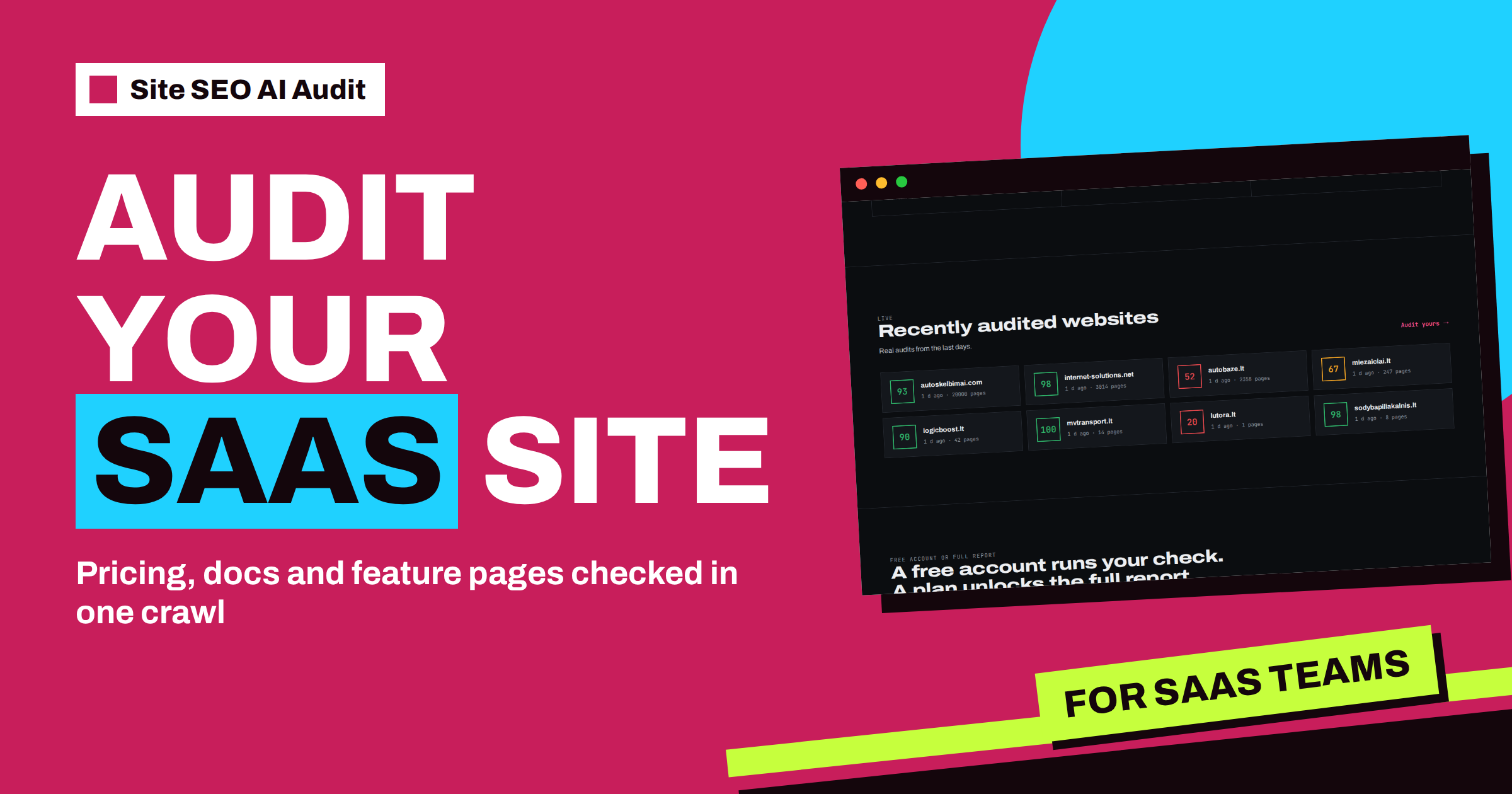
Short answer: A software company’s marketing site changes often and is built with modern tools, which is exactly where technical SEO problems hide. Site SEO AI Audit crawls the whole site, scores seven areas and ranks fixes by points. For a SaaS site, the findings that matter most are pages that need JavaScript to show text, wrong or missing canonicals, thin feature pages, leftover noindex rules, redirect chains after address changes, missing share images, slow mobile speed and AI visibility. Run a check before each release and after each redesign.
A SaaS marketing site is not a blog and not a shop. It has a home page, feature pages, a pricing page, documentation, a changelog, integration pages and often a blog. It is edited by marketers and built by developers, usually with a framework that renders pages in the browser, and it is redeployed many times a month. Each deployment can change something that nobody meant to change: a canonical, a robots rule, a template. Visitors do not see the damage, but search engines and AI assistants do. This article shows how the audit fits into the workflow of a software team and which findings deserve attention first.
What makes a SaaS site different
- Frequent releases. Small changes ship every week, and each one can touch templates that affect every page.
- Modern front ends. Single-page applications and client-side rendering are common, which makes JavaScript-only content a real risk.
- Several environments. Staging and preview sites exist next to production, and their rules sometimes travel to the live site.
- Many small pages. Integration pages, feature pages and help articles are short by nature, and may look thin to a crawler.
- Technical buyers. The audience researches with search engines and, more and more, with AI assistants.
The audit looks at all of these in one pass. It does not need any code on your site: you enter the address, and the crawler SEOAuditBot reads your pages and your sitemap like a search engine, following robots.txt.
First: can crawlers read your pages at all?
The finding to check first is “Content needs JavaScript to appear” in the AI visibility area. It flags pages with fewer than 50 words in the HTML and at least three scripts, which is the fingerprint of an application shell. If your feature and pricing pages are rendered in the browser, many AI crawlers will see an empty page, and your carefully written copy cannot be cited. The usual fix is server-side rendering or static generation for marketing pages, while the application itself stays as it is. The article on the content needs JavaScript warning gives a test you can run in two minutes, and the guide to JavaScript SEO basics explains how search engines treat such pages.
Next: environment leftovers and release accidents
Two critical findings deserve a look after every release. “robots.txt blocks the whole website” appears when a staging rule reaches production, and the score is then capped at 20. “Pages are hidden from search (noindex)” lists pages that carry a noindex instruction, which is fine for a login page and harmful for a feature page. Checking these two takes seconds when you read the top of the report, and finding them early can save weeks of lost traffic. A line in your release checklist, “run a check and read the critical findings”, is the cheapest insurance a software team can buy.
Address changes are the third kind of accident. When you rename a product, restructure the docs or change the folder of the blog, old addresses should redirect once to the new ones. The report shows redirect chains, links that point to redirects and canonicals that point to redirected pages. The article on running an SEO check before launch and after a redesign describes the sequence for a larger change.
Pricing, features and integrations: the thin page question
Many SaaS pages are short on purpose. A pricing page is a table, an integration page is a logo and a paragraph. The audit flags pages with fewer than 200 words as thin content, and duplicate content when several pages repeat the same text. That is not always a reason to panic, but it is a reason to look. For feature and integration pages, the question is whether each page says something specific: what the feature does, who needs it, how it works and what the result is. Name pages after the job they do, as the guide to feature page SEO for software suggests, and give each page its own title and description.
For structured data, software companies have a natural fit in the SoftwareApplication type, which the article on SoftwareApplication schema for apps and SaaS pages explains. The audit checks that structured data exists, that it is valid and that pages have it, and the Structured data area carries ten percent of the score.
Share images, speed and the details buyers notice
SaaS links travel through social networks, chat tools and newsletters. A page without Open Graph tags and a share image shows a bare link, and a bare link gets fewer clicks. The audit includes two notices, missing Open Graph tags and no share image, and the advice is to set a 1200 by 630 pixel image for each page. Speed matters too: the Speed and Core Web Vitals area uses Google PageSpeed for mobile, plus server response, compression and page weight on every page, and it carries 15 percent of the score. Marketing sites often grow heavy with scripts for analytics, chat and testing tools, so a mobile score below 50 is common and worth fixing.
AI visibility for a software company
Buyers of software ask assistants for comparisons and recommendations. The AI visibility area checks whether AI crawlers are allowed in robots.txt, whether an llms.txt file exists, whether content works without JavaScript, and whether long pages have subheadings and articles have dates. For a software company, the most important items are the first and the third: if crawlers are blocked or see empty pages, nothing else counts. The guide to allowing or blocking AI crawlers in robots.txt helps you decide what to allow, and the area is described in the article on AI visibility checks in Site SEO AI Audit.
A workflow for a software team
- Baseline check. Run a check on the live site and save the report as the starting point.
- Triage with the fix list. Sort by impact. Mark which findings are template changes and which are content edits.
- Give developers a clear list. Share the report link or, on Pro, the PDF, and add the affected pages for each task.
- Fix in sprints. Group template fixes into one release, and content fixes into the marketing backlog.
- Check after each release. Run a new check and compare it with the previous one.
- Use alerts as a safety net. On Pro, e-mail alerts tell you when a check shows a score drop or new critical issues.
Note that checks run only when you start them. There are no automatic scheduled audits, so make the check a step in your release routine rather than something you expect to happen by itself. The article on sharing your SEO report as a link, a PDF and developer tasks shows how to hand findings to the engineers.
Which plan fits a software team
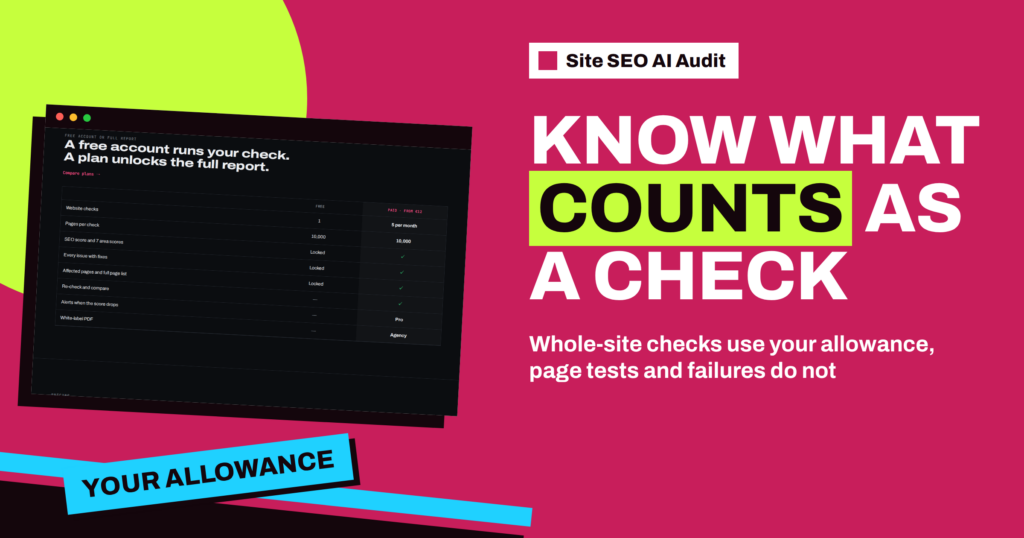
A free account runs one check and shows the report locked. A team that releases weekly needs repeated checks and full reports, so Starter, with five checks a month, is the minimum, and Pro, with twenty checks, alerts, comparison between audits and PDF reports, fits a product team. Agencies that look after several SaaS clients can use Agency with a hundred checks and white-label reports. The pricing page has the details, and every plan covers up to 10,000 pages per check.
Documentation and changelog pages
Software sites often hold their most useful content in documentation, help articles and release notes. These pages answer the exact questions that people type into search engines and ask assistants, which makes them valuable for visibility. They also produce typical audit findings. Documentation trees grow deep, so pages end up more than three clicks from the home page. Old versions of articles stay online, which creates duplicate content. Moved articles leave broken internal links and redirect chains. And long reference pages are often written as one block, without H2 subheadings that an assistant could quote.
Use the report to keep the documentation healthy: link important help articles from the home page or the product pages, redirect old addresses once to the current version, choose one canonical version for pages that exist in several releases, and give long pages a clear outline. The same page list that shows click depth and the number of internal links in for each page will tell you which help articles are buried. A tidy documentation section lifts the whole site, because it is the part that readers and assistants return to most often.
The same goes for the changelog. A page that lists every release in one very long list is hard to read and hard to cite, while a page per release, or a clear structure with dates, is easy to quote. Dates matter especially here, since a changelog is a record of time. Make sure the publish dates are visible and declared in the markup, so that the freshness of the information is clear to every reader.
Related reading
- Run an SEO Check Before Launch and After a Redesign
- Feature Page SEO for Software: Name Pages After the Job
- Content Needs JavaScript: The AI Visibility Warning
The bottom line
A SaaS marketing site changes often, so it needs a check that runs as often as the releases do. Make sure crawlers can read your pages, watch for staging leftovers, give every page a clear purpose, set share images and keep AI crawlers welcome, then compare each new report with the last one.
DUK
Do I need to install anything on my site?
No. You enter the address, and the crawler reads your pages and sitemap from the outside, following robots.txt.
Which finding is most dangerous after a release?
“robots.txt blocks the whole website” and unexpected noindex rules, because they can hide the whole site. The first also caps the score at 20.
Are short feature pages a problem?
Pages under 200 words are flagged as thin content, but a short page can be fine if it is specific and useful. Review the list and decide page by page.
Can the audit check documentation and the blog too?
Yes. The crawler follows internal links and reads the sitemap, so every reachable page of the site is included, up to the limit of 10,000 pages per check.
Will alerts run by themselves?
Checks run only when you start them. On Pro, alerts are sent when a check shows that the score dropped or that new critical issues appeared.