ENEnglish
 LTLietuviškai
 DEDeutsch
 FRFrançais
 RUРусский
 ESEspañol
 PLPolski
 ITItaliano
 UKУкраїнська
 CSČeština
 PTPortuguês
 JA日本語
 LVLatviešu valoda
 ETEesti
 HUMagyar
 IDBahasa Indonesia
 TRTürkçe
 HIहिन्दी
 ELΕλληνικά
 ARالعربية
 THไทย
 VITiếng Việt
 RORomână
 MSBahasa Melayu
 BNবাংলা
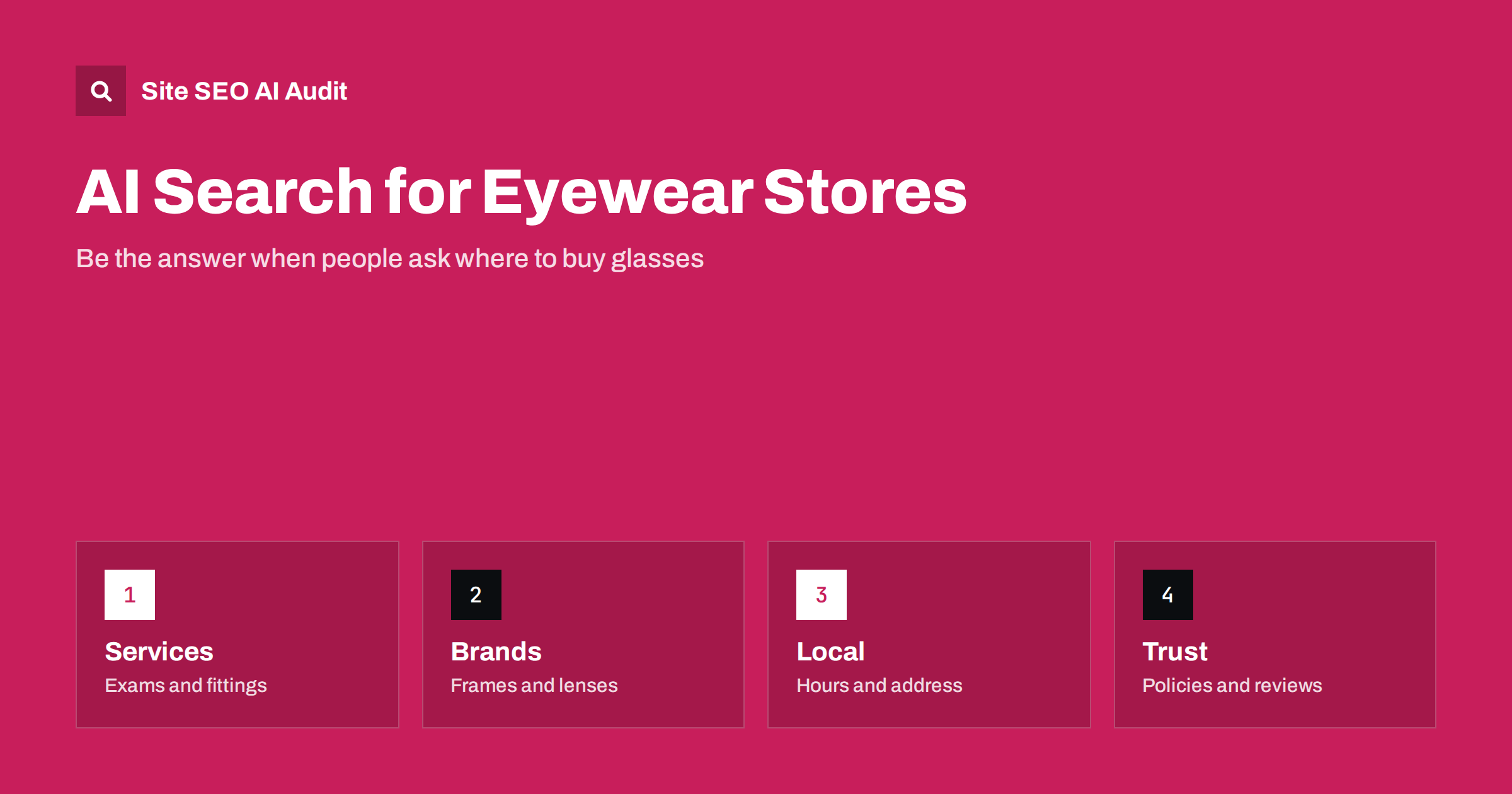
Short answer: AI assistants answer eyewear questions by combining local information, product details and trust signals. To be included, an optical business needs clear pages for each service, frame brand and lens type, accurate opening hours and addresses, plain explanations of prescriptions, returns and warranties, and consistent information across its site and public profiles. Do not give medical advice beyond your role; explain what you offer and who performs it, and keep claims modest and verifiable.
People now ask assistants questions such as “where can I get progressive lenses near me”, “are blue light glasses worth it” or “which shop can fit children’s frames on Saturday”. The answers draw on pages that state facts plainly. Optical stores have a natural advantage because their work is concrete: eye exams, fittings, repairs, frames and lenses. The challenge is that many sites show only a gallery of frames and a phone number. This guide explains what to publish so that assistants and search engines can understand and recommend your business. For the wider approach, see the AI search visibility checklist.
What people ask about glasses
Questions fall into a few groups. Local questions ask who is nearby, who is open, who accepts a certain insurance or voucher and who can see a patient quickly. Service questions ask about eye exams, contact lens fittings, children’s glasses, repairs and adjustments. Product questions compare lens coatings, frame materials, sizes and brands. Decision questions ask about price ranges, how long lenses take to make and what to do if the glasses do not feel right.
List the real questions your staff answer every day. Each one that can be answered in a short paragraph deserves a place on a page. The questions customers repeat at the counter are the same ones assistants receive.
Build a page for every service
A single “Services” page with a bulleted list is hard to cite. Give each major service its own page with a clear title and a direct opening answer: what it is, who it is for, how long it takes, what it costs or how the price is set, and how to book. Typical pages include eye examinations, contact lens fittings, children’s eyewear, sports and safety glasses, computer glasses, repairs and adjustments, and sunglasses with prescription lenses.
State who performs each service and their qualifications as they are shown in your country. If a service requires a prescription from an eye doctor, say so. Never promise results or imply that glasses cure a condition. A calm, factual page is more trustworthy and more likely to be quoted than a promotional one. The same on-page basics apply as for any page, as covered in the on-page SEO checklist.
Explain lenses and coatings in plain words
Lens choices confuse buyers, so clear explanations attract both visitors and citations. Create a guide that explains single vision, bifocal and progressive lenses, thickness and high-index options, anti-reflective and scratch-resistant coatings, photochromic lenses and filters for screens. For each, describe what it does, who may benefit and the trade-offs, including cost and adaptation time for progressive lenses.
Use short definitions and a comparison table, but only one table per page. Avoid exaggerated claims about eye health. If research is mixed, such as for blue light filtering, say that the evidence is limited and explain what a lens can reasonably do, such as reducing glare. Honest answers build trust and stand out from marketing copy.
Make frames and brands easy to understand
For stores that sell frames, structure the catalogue so that each brand and collection has its own page with an introduction, the styles offered, size guidance and the lens options available. Describe materials such as acetate, titanium and stainless steel, weight, flexibility and nose pad adjustments. Explain how to measure a frame size and how to read the numbers printed inside the temple.
Product pages should include a clear name, brand, model, colour, size, price, availability and delivery information. Add Product structured data with accurate values, following the practices in the product schema guide. For online-only shops, add a page that explains how a prescription is entered, how the pupillary distance is measured and what happens if the first pair does not fit.
Get the local details exactly right
For physical stores, assistants rely on consistent local facts: name, address, phone number, opening hours, holiday hours, parking, accessibility and which services are available at which branch. Keep these identical on your site and your business profiles. If the Saturday hours change, update every place on the same day.
Create a page for each branch with its own address, map link, photo of the entrance, staff introductions where appropriate and a list of services available there. Mark it up with local business data as described in the LocalBusiness schema guide. Mention insurance partners, vouchers or public health schemes you accept, but only where it is true and current. Outdated information is the most common reason for wrong answers about local shops.
Policies that reduce doubt
Buyers worry about whether glasses will fit, whether the prescription will be right and what happens if not. Publish clear policies for adaptation periods, remakes, returns, repairs, warranties and delivery times. Use plain statements with conditions, such as how many days you allow for a remake and what is excluded. Keep the policy page linked from product pages and the footer.
If you give guarantees, describe them exactly. Do not write that customers are always satisfied. Say what you do when a problem occurs. Assistants and people both favour specific commitments over vague reassurance.
Reviews and reputation
Reviews influence local recommendations. Ask customers for feedback after a fitting or pickup, and respond politely to criticism. Do not offer rewards in exchange for positive reviews and do not publish reviews you cannot verify. Display genuine testimonials on the relevant service pages and make sure the markup matches the visible content. The wider effects of reputation are explained in the guide to reviews and AI recommendations.
Pages for children, contact lenses and special cases
Some of the most specific questions come from parents and from people with unusual needs. Parents ask how often a child should have an eye test, how durable children’s frames are, how long a repair takes and whether lenses can be replaced when the prescription changes. A dedicated children’s page that answers these questions, shows the frame ranges and explains the process of choosing a pair is far more useful than a general product list.
Contact lenses deserve the same treatment. Explain the types you supply, how a fitting appointment works, what follow-up checks are needed, how orders and repeat purchases are handled and what hygiene guidance you give. Keep the advice general and refer to the practitioner for personal decisions. Add a page for people who need strong prescriptions, sports glasses or safety eyewear for work, because those searches are specific and the competition is smaller.
Finally, think about accessibility and language. If your staff speak several languages or your store is accessible for wheelchair users, say so. If you serve tourists or expatriates, a short page in their language with the essentials, such as how to get a replacement pair or repair quickly, can win questions that large chains ignore. Each of these pages should link to related ones so that visitors and crawlers can move naturally between services, using the approach in the internal linking strategy guide.
Measure what changes
Track visits to service and brand pages, calls and direction requests, online bookings and the questions customers mention when they arrive. Test a set of ten typical questions in several assistants every month and note whether your business appears, whether the details are correct and which sources are cited. When an answer is wrong, correct the source page first. Keep a log so that you can see whether improvements to your pages lead to better answers over several months.
Also review the pages that bring in the most visits each quarter. If a frame collection is discontinued, redirect or update its page rather than leaving an empty listing, and refresh seasonal content such as sunglasses guides before summer. A small, regular maintenance routine keeps the information accurate, which matters more to assistants than the volume of pages.
Site SEO AI Audit crawls your website and checks status codes, titles, descriptions, headings, image alt text, broken links, structured data, page speed and AI visibility settings, which helps you find weak or duplicated service and product pages. It does not review medical claims or prescriptions. The first audit of up to 200 pages is free, and larger sites can see the pricing page.
Related reading
The bottom line
Publish a clear page for every service, lens and brand, keep local details exact and state your policies plainly.
BUJ
Should an optician publish prices online?
Where possible, yes, at least ranges or starting prices with the conditions. Clear pricing answers a common question and builds trust.
Can I explain eye conditions on my site?
You can give general information within your professional role and refer readers to a qualified eye doctor for diagnosis. Avoid medical claims you cannot support.
Do online glasses shops need local pages?
Only if you have a physical location. Online shops should focus on product, prescription, delivery and returns pages instead.
How often should opening hours be reviewed?
Check them monthly and before every holiday, and update all places at once so that the information stays consistent.
Which structured data is useful for an eyewear store?
LocalBusiness for each branch, Product for frames and sunglasses, FAQPage for visible questions and Organization for the brand.