ENEnglish
 LTLietuviškai
 DEDeutsch
 FRFrançais
 RUРусский
 ESEspañol
 PLPolski
 ITItaliano
 UKУкраїнська
 CSČeština
 PTPortuguês
 JA日本語
JA日本語 LVLatviešu valoda
 ETEesti
 HUMagyar
 IDBahasa Indonesia
 TRTürkçe
 HIहिन्दी
 ELΕλληνικά
 ARالعربية
 THไทย
THไทย VITiếng Việt
 RORomână
 MSBahasa Melayu
 BNবাংলা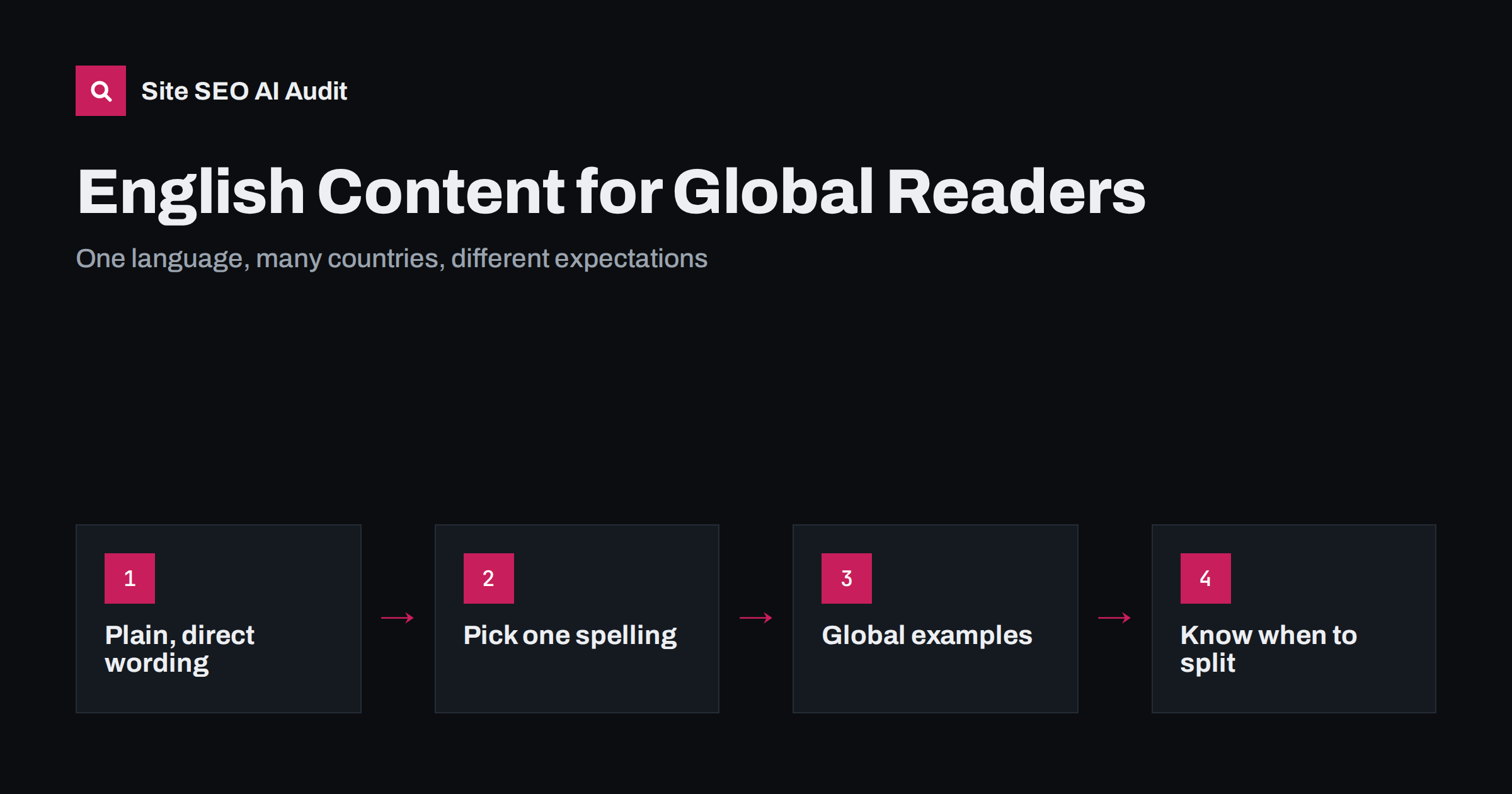
Short answer: Many English-language sites are read mostly by people outside the US and UK, often by non-native speakers. Write in plain, direct English without idioms, choose one spelling standard and use it consistently, avoid examples, formats and terms that only make sense in one country, and research keywords in the markets you target, because people in different countries search with different words. Split into country versions such as en-US and en-GB only when prices, laws, products or vocabulary genuinely differ.
English is the default language of the web for business, software and many technical fields. For a small company that sells internationally, a single English site is usually the first step into other markets. That site will be read by customers in India, Germany, Nigeria, Australia and Brazil, by people using browser translation, and by search and AI systems that compare it with local alternatives. How you write affects whether all of them understand it, trust it and find it.
Who actually reads your English pages
Before changing how you write, look at your analytics. Check the country report and the browser language report for your English pages. Many site owners are surprised to find that their largest English-speaking audience is not where they assumed. Typical patterns:
- software and B2B sites with a large share of visitors from countries where English is a second language;
- e-commerce sites shipping across Europe whose English pages are read by Germans, Dutch or Scandinavians;
- service businesses whose visitors come from the US, UK, Canada, Australia and India in very different proportions.
Search Console’s country filter shows the same for search traffic: which countries see your pages, and for which queries. Use that data to decide which English you write and which examples you choose.
Write plain English that travels
Plain writing helps native speakers too, but for international readers it decides whether the page is understood at all. It also survives browser translation and machine translation far better.
- Prefer short sentences with one idea each, and put the main point first.
- Avoid idioms and sports metaphors such as “hit it out of the park”, “ballpark figure” or “on the same page”. Say what you mean.
- Avoid phrasal verbs where a simple verb works. “Set up” and “sign in” are fine because they are standard, but “figure out” can be “find” and “put off” can be “delay”.
- Use the same term for the same thing. Do not alternate between “account”, “profile” and “workspace” for one concept.
- Expand abbreviations the first time, unless they are universal, such as URL or PDF.
- Be careful with humour and cultural references. They are easy to misread and rarely translate.
None of this means writing like a manual. Clear, friendly and specific is the goal. Our guide to readability and SEO writing covers sentence and paragraph structure in more depth.
Choose one spelling and stick to it
American and British spelling differ in many common words: optimize and optimise, color and colour, center and centre, license and licence. For a single global site there is no universally right choice, but there is a wrong one: mixing both.
- Pick the standard that matches your main market or your company’s home. Many global software sites use American spelling; many European companies use British spelling.
- Write it down in a short style guide, together with your choices for dates, numbers and currencies.
- Configure the spell checker of every writer to that standard.
- Do not worry about ranking for the other spelling. Search engines generally understand that “optimise” and “optimize” mean the same thing.
Vocabulary matters more than spelling. Some words differ completely between countries: mobile phone and cell phone, postcode and ZIP code, VAT and sales tax, flat and apartment. Where a word is country-specific, either pick the most widely understood one or mention both once.
Remove one-country defaults
Content written in one country carries hidden assumptions that confuse readers elsewhere. Look for these:
- Dates, numbers and units. 04/05 means April 5 in the US and 4 May in most other countries. Write months as words, and give metric units, with imperial ones where your audience expects them. Our guide to dates, numbers and units covers this in detail.
- Prices and currencies. “$49” is ambiguous; write “USD 49” or “US$49” if several dollar currencies are possible.
- Seasons and holidays. “This summer” or “before Thanksgiving” means nothing, or something different, in half the world.
- Laws and institutions. Mentioning one country’s tax rules, regulator or legal requirements without saying which country applies them misleads readers elsewhere.
- Phone numbers and addresses without country codes.
- Examples that only use one country’s cities, names or brands. Vary them, or choose neutral ones.
Research keywords in each target market
People in different English-speaking countries do not search with the same words, and non-native speakers often use simpler or more literal queries. A few practical steps:
- Check search volumes and suggestions per country in your keyword tool, not only for the US.
- Look at the actual search results in each market. If the top results in India use different terms or formats than in the UK, that tells you how people search there.
- Read the Search Console queries per country. Non-native searchers often use full questions or translated phrases from their own language.
- Include the common alternative term once in the text where it fits naturally, rather than creating separate pages for each synonym.
Our guide to multilingual keyword research describes the same method for other languages; it works for English variants too.
When to split into en-US, en-GB and other variants
A single global English version is the right default for most small sites. Separate English versions make sense only when the content truly differs between countries:
| Situation | One global English version | Separate country versions |
|---|---|---|
| Same product, price and terms everywhere | Usually enough | Not needed |
| Different prices, currencies or shipping per country | Possible with clear notes | Often better |
| Different laws, contracts or regulations | Risky | Recommended |
| Strongly different vocabulary or product names | Mention both terms | Worth considering |
| Small team, limited capacity to maintain pages | Recommended | Hard to keep in sync |
If you do split, the versions must actually differ, use hreflang with language and country codes such as en-us and en-gb, and include an x-default for everyone else. Near-identical versions are often folded together by search engines anyway. See targeting countries that share a language for the setup.
Global English and AI search
AI answer engines often serve users in many countries from the same pool of English sources, sometimes translating the answer into the user’s language. Pages written in clear, unambiguous English, with explicit units, currencies and country context, are easier to quote correctly. A sentence such as “In the UK, VAT registration is required above a turnover threshold set by HMRC” can be safely quoted to anyone; “you need to register once you pass the threshold” cannot. Stating the country, the unit and the condition in each key sentence makes your content more reusable for people and for machines.
A one-page style guide for global English
Consistency is easier when the rules are written down. A short style guide that every writer, translator and freelancer receives prevents most problems. It can fit on one page:
- spelling standard (American or British) and the spell checker setting;
- date format, with the month written as a word, and the time format;
- number format, units and how to show currencies;
- preferred terms for your product’s main concepts, and words to avoid;
- how to refer to countries, laws and regions when the content applies only to some of them;
- a reminder to avoid idioms, slang and one-country examples.
Review it once a year, and update older pages when the rules change, starting with the pages that get the most international traffic.
Check your international setup
Writing is only part of reaching global readers. The technical side must support it: correct lang attributes, hreflang return links and x-default if you have country versions, and no automatic redirects that trap visitors in the wrong version. Site SEO AI Audit has a Languages area that checks hreflang return links, broken language versions, x-default and lang attributes, alongside on-page and AI visibility checks, and it ranks every issue by how many points the fix adds. You can run the first audit for free.
Related reading
- Translation vs localization for SEO
- The HTML lang attribute and SEO
- International SEO: a beginner’s guide
The bottom line
A global English site works when it is written for the people who actually read it: plain wording, one consistent spelling, no hidden one-country assumptions and keywords researched in each target market. Keep one English version as long as your offer is the same everywhere, and split into country versions only when prices, laws or vocabulary really differ.
BUJ
Should I use American or British English on my website?
Use the standard that fits your main market or your company’s home, and apply it consistently. Search engines understand both spellings as the same words, so the choice matters more for readers than for rankings. Mixing both on one site looks careless.
Do I need separate pages for en-US and en-GB?
Only if the content really differs, for example in prices, currencies, legal terms or product names. If the pages would be almost identical, one global English version is simpler to maintain and usually performs just as well.
Does simple English hurt SEO for native speakers?
No. Clear, direct writing is easier for everyone to read, and search engines reward pages that answer the question well, not pages with complex vocabulary. Plain writing also translates better when visitors use browser translation.
How do I find out which countries read my English content?
Check the country and language reports in your analytics tool and the country filter in Search Console’s performance report. Together they show where your readers and searchers come from and which queries they use.
Which hreflang code should a single global English page use?
A single English version can use en without a country code, and it can also be your x-default. Country codes such as en-gb are only needed when you have separate versions for different English-speaking countries.