ENEnglish
 LTLietuviškai
 DEDeutsch
 FRFrançais
 RUРусский
 ESEspañol
 PLPolski
 ITItaliano
 UKУкраїнська
 CSČeština
 PTPortuguês
 JA日本語
JA日本語 LVLatviešu valoda
 ETEesti
 HUMagyar
 IDBahasa Indonesia
 TRTürkçe
 HIहिन्दी
 ELΕλληνικά
 ARالعربية
 THไทย
THไทย VITiếng Việt
 RORomână
 MSBahasa Melayu
 BNবাংলা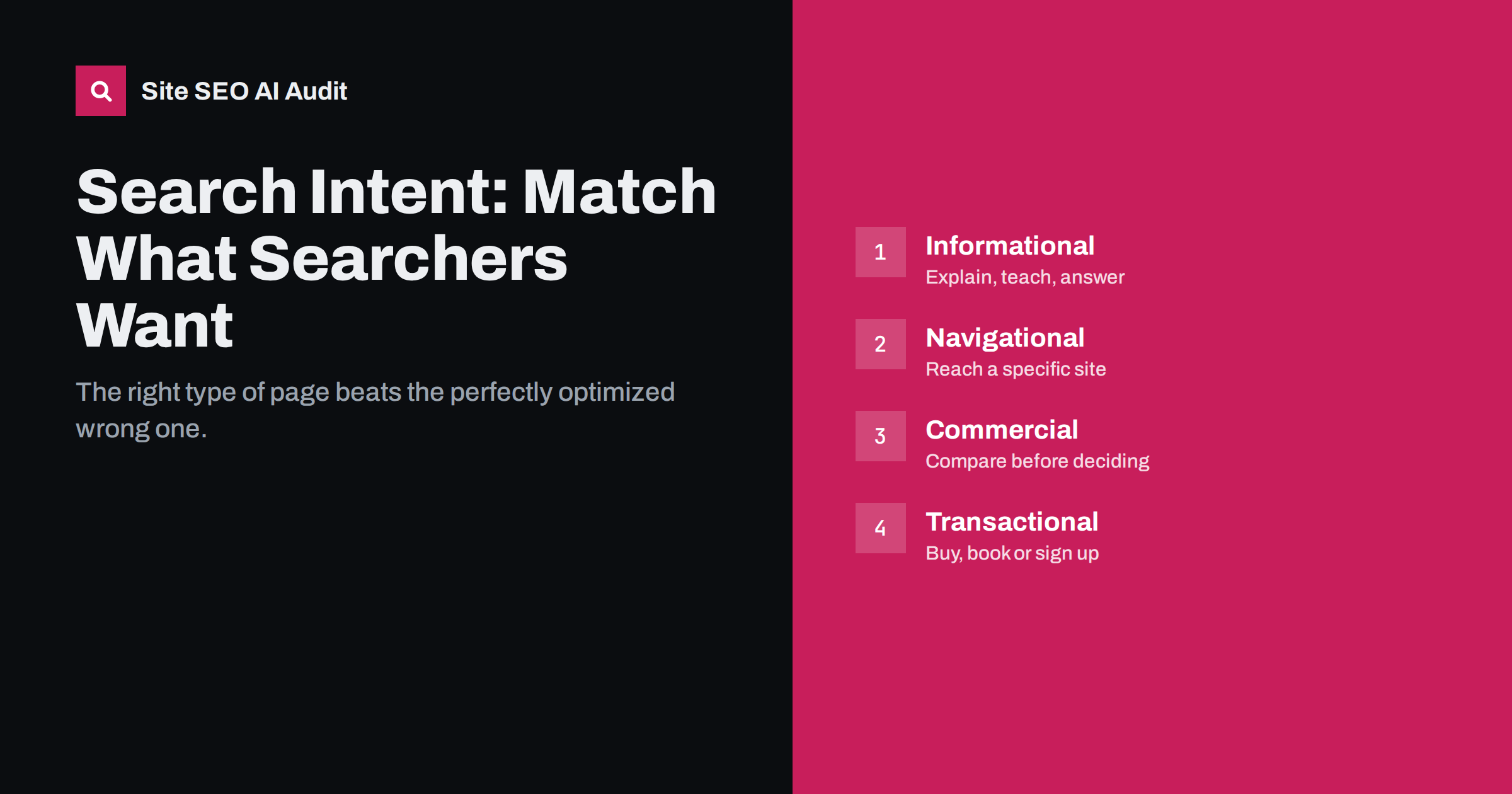
Short answer: Search intent is the goal behind a search: what the person wants to know, find or do. Queries are usually grouped into informational, navigational, commercial and transactional intent, and each needs a different kind of page. The fastest way to understand the intent of a query is to look at what already ranks for it, then build a page of the same type that answers the need better, rather than forcing the wrong page to rank.
Why search intent matters more than keywords
Two people can type almost the same words and want very different things. “Running shoes” might mean “show me shoes to buy”. “Running shoes for flat feet” usually means “help me choose”. “How often to replace running shoes” means “give me an answer”. A single page cannot serve all three well.
Search engines have spent years learning to recognize these differences. They look at how people behave after searching, which results satisfy them, and what kind of pages answer each type of query. The practical consequence is simple: if your page is the wrong kind of answer, it will struggle to rank for that query no matter how well its title, headings and keywords are optimized.
This is why intent is the first item on any sensible on-page checklist. Everything else, from the title tag to internal links, only helps a page that is already the right type of answer.
The four main types of search intent
| Intent | What the searcher wants | Example queries | Pages that usually rank |
|---|---|---|---|
| Informational | To learn or understand something | what is a meta description, how to fix a slow website | Guides, explanations, how-to articles, videos |
| Navigational | To reach a specific site or page | brandname login, brandname pricing | The brand’s own pages |
| Commercial | To compare options before deciding | best CRM for small business, Yoast vs Rank Math | Comparisons, reviews, buying guides, category pages |
| Transactional | To buy, sign up, book or download | buy trail running shoes, book boiler service Leeds | Product, service and booking pages |
These categories are a useful simplification, not strict boxes. Many queries mix intents, and local searches such as “plumber near me” combine transactional intent with location.
How to identify the intent of a query
Look at the results page
Search engines have already done the research for you. Search the query in a private window and study the first page:
- What type of pages rank? Articles, product pages, category pages, videos, tools, local business listings?
- What format do they use? Step-by-step lists, long guides, comparison tables, short definitions?
- What angle do they share? Beginners, professionals, budget, speed, a particular year?
- Which search features appear? A short answer box suggests people want a quick fact. Shopping results suggest buying intent. A map suggests local intent. “People also ask” questions show the follow-up needs.
Read the words in the query
Some words signal intent clearly:
- “How”, “what”, “why”, “guide”, “examples” usually signal informational intent.
- “Best”, “top”, “vs”, “review”, “alternatives”, “compared” usually signal commercial intent.
- “Buy”, “price”, “order”, “book”, “discount”, “near me” usually signal transactional intent.
- Brand and product names on their own often signal navigational intent.
Think about the person
Ask what the searcher is trying to achieve and what they would do right after reading your page. Someone searching “meta description length” probably has an editor open and wants a number and a few tips. Someone searching “SEO audit for small business” may be deciding whether to pay for help.
Matching your page to the intent
Once you know the intent, shape the page to fit it:
- Choose the right page type. Informational queries need content that explains. Transactional queries need pages where people can act. Do not try to rank a product page for a “how to” query, or a blog post for “buy” queries.
- Put the core answer first. If the intent is a quick fact, give it in the first paragraph. If it is a comparison, show the comparison early rather than after a long introduction.
- Match the expected format. If every ranking page is a numbered list, readers expect a list. If they all include a table, a table probably helps.
- Cover the follow-up questions. Use “People also ask” and related searches to find what people want next, and answer those in sections or an FAQ.
- Offer the logical next step. Informational pages can link to related guides or a tool; commercial pages can link to products or pricing; transactional pages need a clear way to buy or contact you.
A worked example
Imagine a small company that sells an accounting app for freelancers and wants more visitors from search. It writes a sales page titled “Accounting Software for Freelancers” and tries to rank it for three queries.
- “accounting software for freelancers”: the results are mostly comparison articles and product pages. The intent is commercial with some transactional searchers. The sales page is a reasonable fit, especially if it clearly shows features, who the product suits and where to see prices.
- “how to do bookkeeping as a freelancer”: the results are step-by-step guides. The intent is informational. The sales page will not rank here; a practical guide that explains bookkeeping, and mentions the app where it genuinely helps, has a chance.
- “freelancer expense categories list”: the results are lists and templates. People want a ready list, probably to copy. A page with a clear list, perhaps a downloadable template, fits the need.
Three queries, three different pages. The company gets further by building the guide and the list as separate pages and linking both to the sales page than by adding all three phrases to the sales page’s headings. That is intent-led content planning in its simplest form.
Mixed and changing intent
Some queries have several common intents at once. “SEO audit” might be searched by people who want to understand what an audit is, people who want a checklist to do one themselves, and people looking for a tool or service. The results page often shows a mix. In these cases you can either create a page that serves the dominant intent very well, or build a page that clearly serves more than one, for example an explanation followed by a checklist and a way to run an audit.
Intent also changes over time. Queries related to events, products or seasons can shift from informational to transactional and back. When a page that used to rank starts to slip, check whether the type of results has changed before rewriting the content.
Common intent mistakes
- Targeting a keyword because of its volume, not its intent. A high-volume informational query rarely brings buyers to a sales page.
- Turning every blog post into a sales pitch. Readers looking for information leave when they get an advert instead.
- Writing a long essay for a quick question. If the answer is one number, give the number first.
- Using a single page for several different intents without clear structure, so no group of searchers is well served.
- Creating several pages for the same intent, which then compete with each other.
- Ignoring local intent. For many services, people want providers nearby; a page with no location information fits poorly.
Intent and your site structure
Intent is also a useful way to organize a whole site. Informational content lives in guides, a blog or a help centre. Commercial content lives in comparison pages, buying guides and category pages. Transactional content lives in product, service and booking pages. Linking between these layers, from a guide to the relevant service, from a comparison to the products compared, helps readers move from learning to acting at their own pace.
A simple keyword map that records the main intent for each important URL prevents two pages from chasing the same need, and shows gaps: intents your audience has that no page on your site serves yet.
Where an audit fits in
Intent is a judgment call that no crawler can make for you. But intent problems often leave traces that an audit can find: pages with duplicate titles targeting the same topic, thin pages that do not answer anything properly, and important pages that receive few internal links from related content. Site SEO AI Audit checks titles, descriptions, headings, thin and duplicate content and internal links on every page, with the fix list ordered by impact, which gives you a list of pages worth reviewing with intent in mind. See the plans or start with a free first audit.
Related reading
- Keyword Cannibalization: How to Spot It and Fix It
- On-Page SEO Checklist: What to Check on Every Page
- Thin Content: How to Find and Fix Low-Value Pages
The bottom line
Search intent decides what kind of page can rank for a query. Identify it by studying the current results and the words people use, then build the right type of page, put the core answer first, match the expected format and cover the follow-up questions. Give each intent one clear page on your site, and link between informational, commercial and transactional pages so readers can move from learning to acting.
BUJ
What are the four types of search intent?
Informational (learning something), navigational (reaching a specific site), commercial (comparing options before deciding) and transactional (buying, booking or signing up). Many queries combine more than one.
How do I find the search intent of a keyword?
Search it and look at the first page of results: the type of pages, their format and angle, and any special features such as shopping results or maps. The words in the query, such as “how”, “best” or “buy”, also give strong hints.
Can one page target several intents?
Sometimes, when the results for a query are genuinely mixed. The page then needs a clear structure that serves each group, for example an explanation followed by a checklist and a next step. For clearly different intents, separate pages usually work better.
Why does my well-optimized page not rank?
One common reason is an intent mismatch: the page is a different type of answer from what searchers want. Compare it with the pages that rank. Competition, content quality and links also play a part.
Does search intent change over time?
Yes. Seasonal, news-related and product-related queries in particular can shift. If a page starts to lose rankings, check whether the type of ranking pages has changed before rewriting the content.