ENEnglish
 LTLietuviškai
 DEDeutsch
 FRFrançais
 RUРусский
 ESEspañol
 PLPolski
 ITItaliano
 UKУкраїнська
 CSČeština
 PTPortuguês
 JA日本語
 LVLatviešu valoda
 ETEesti
 HUMagyar
 IDBahasa Indonesia
 TRTürkçe
 HIहिन्दी
 ELΕλληνικά
 ARالعربية
 THไทย
 VITiếng Việt
 RORomână
 MSBahasa Melayu
 BNবাংলা
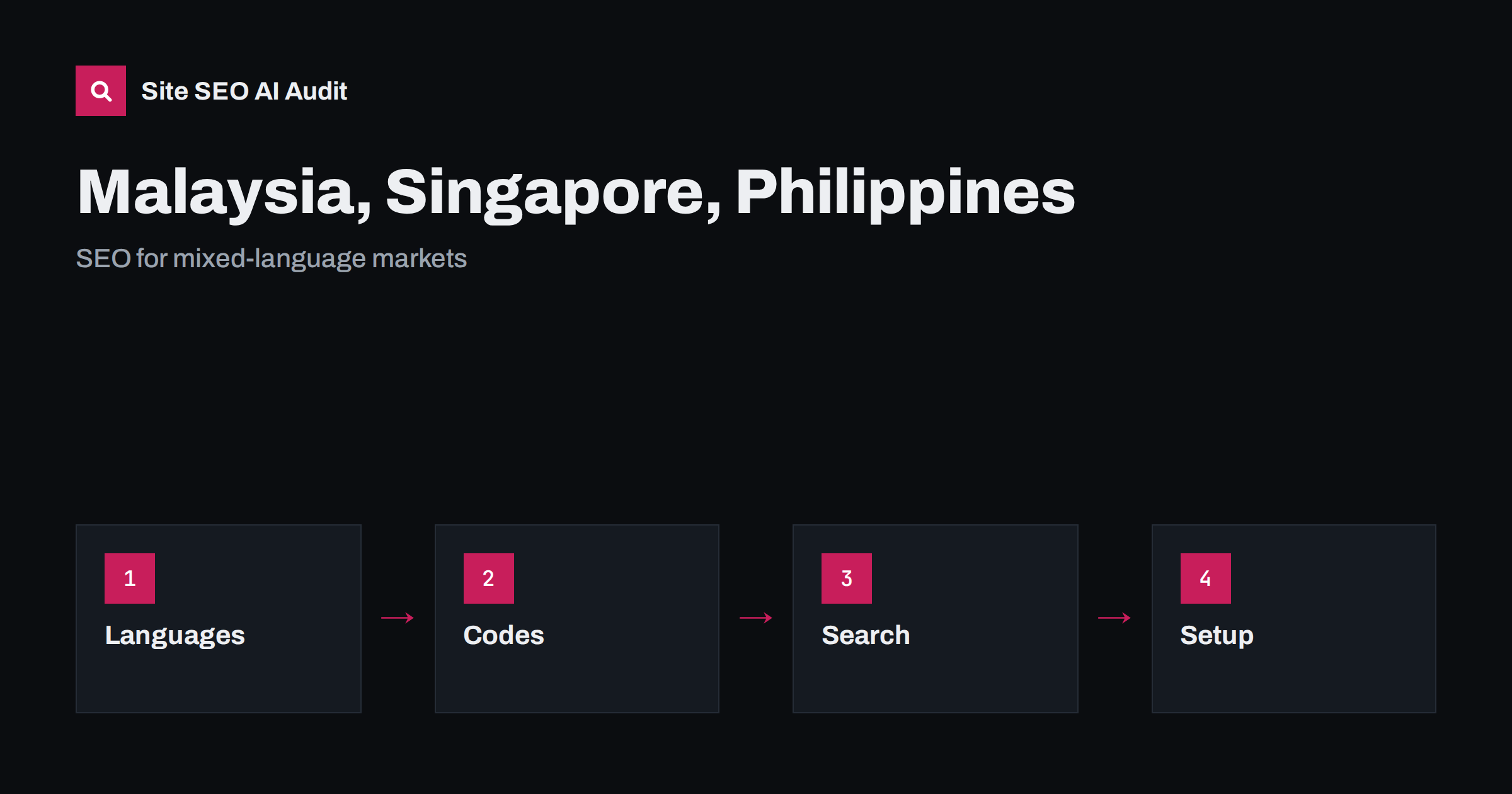
Short answer: Malaysia, Singapore and the Philippines are English-friendly markets in which many people also search and read in another language, so SEO starts with deciding which languages and countries you truly serve. Publish a solid English version first, add Malay, Chinese or Filipino versions where your audience needs them, give each country and language its own URL, use correct hreflang codes such as en-MY, ms-MY, en-SG, zh-SG, en-PH and fil-PH, and write pages that match local vocabulary, spelling, prices, currencies and contact details. Expect mixed-language queries, so research real search terms in each market instead of translating English keywords. Choose a domain structure that fits your size, show local proof such as addresses and reviews, and check that each version is indexed and not mistaken for a duplicate of another. Measure results by country in Search Console.
The three markets are often grouped as one region, but they differ in languages, habits and regulations. Singapore is small, dense and strongly English-speaking in business, with Chinese, Malay and Tamil also in everyday use. Malaysia is multilingual, with Malay as the national language and English and Chinese widely used. The Philippines has Filipino and English as official languages, and many people mix them in conversation. For website owners this means that one translated copy of an English site is rarely enough, and also that an English-only site can be a reasonable start. This guide helps you decide, then set up the technical and content side properly. It extends the general approach in the Southeast Asia SEO guide, which covers Indonesian, Vietnamese and Thai.
Decide which markets and languages you serve
Start with the business, not the language list. Which countries can you actually serve, in terms of delivery, payment, support hours, legal requirements and tax? Which languages do your customers use when they search for your product, and which do they use when they buy? For many B2B and software offers, English pages with local currency, support information and examples are enough in Singapore and the business centres of Malaysia and the Philippines. For consumer services, retail and local offers, adding Malay, Chinese or Filipino can open large audiences, but only if you will maintain the content. Choose fewer markets and do them well; the reasoning is in choosing which countries to target first.
Use the right hreflang codes
Hreflang tells search engines which version suits which audience. Combine a language code with a region code: en-SG for English in Singapore, en-MY for English in Malaysia, ms-MY for Malay in Malaysia, zh-SG or a script-specific variant for Chinese in Singapore, en-PH for English in the Philippines and fil-PH for Filipino in the Philippines. Every version must link to all others and to itself, and the annotations must be reciprocal. If your English pages are identical for the three markets, you can use one English version with a general code and avoid creating near-duplicates. Add an x-default for the fallback. Use the tools in hreflang language and region codes and test the result with how to test hreflang.
Research how people really search
Searchers in these markets switch between languages and mix them within a query. A Malaysian user may search a product in English but add a Malay word for a place or a feature, and a Filipino user may type a mix of Filipino and English. Brand names, product types and technical terms are often searched in English, while local services, food, family topics and government procedures may be searched in the local language. Spelling also varies, since Malaysia and Singapore generally follow British conventions. Build keyword lists with local help, use autocomplete and Search Console queries by country and compare the results pages themselves to see which language ranks. The method is described in multilingual keyword research and translation versus localization.
Localize content, not only words
Show prices in the local currency (Malaysian ringgit, Singapore dollars or Philippine pesos), use local date and number formats, mention relevant taxes and payment methods, and give delivery areas and times that apply. Use examples, places and customer stories from each market. Offer support in the languages your customers expect and state opening hours in local time. Replace foreign phone formats and addresses with local ones. If you cannot serve a market, say so clearly instead of letting visitors discover it at checkout. These details build trust and match the signals discussed in local trust signals for country versions and local currency and prices.
Test the experience on the devices and networks your visitors use. Many people in these markets browse mainly on phones, so check that longer words in Malay or Filipino do not break buttons and menus, that Chinese text is readable at small sizes and that forms accept local names, addresses and phone numbers. Include the local postcode or area format, and avoid requiring fields that do not exist in a market. Small usability problems like these reduce engagement and conversions even when rankings are good, so review each language version as a real visitor would, from the search result to the final action.
Pick a domain and hosting structure
You can use country-code domains such as .my, .sg or .ph, subfolders under one domain such as /my/ and /sg/, or subdomains. Country domains send a clear signal and suit large, established operations but multiply the work of building authority. Subfolders on one domain are simpler to manage and usually best for smaller teams. Whatever you choose, keep one structure, avoid automatic redirects based on location or browser language, and let users switch versions with a visible selector made of normal links. Hosting nearby can help speed, but a content delivery network often solves this; see ccTLD, subdomain or subfolder and server location and CDNs.
Handle Chinese and Malay versions carefully
Chinese content in Singapore and Malaysia is typically written in Simplified characters, while Traditional characters are also used by some audiences, so confirm which script your readers expect and label it properly in the language code and in the HTML lang attribute. Do not convert one script to the other automatically without review, because vocabulary differs. For Malay, use the standard vocabulary of the market and have a native reader check translations of product names and legal terms. Make sure fonts support all characters and that URLs use consistent encoding. If you translate slugs, keep them readable and stable, following whether to translate URL slugs and Chinese hreflang codes.
Build local visibility
For businesses with a physical presence, keep your business profile, address and phone number consistent across directories and maps, and gather reviews from local customers. Earn links and mentions from local media, associations and partners, not only from international sites. Check which search engines and platforms matter for your category, since many people discover products through social platforms and marketplaces, and make sure your pages work well when shared. Google is the main search engine in these markets, but other discovery channels are important; the overview in search engines beyond Google helps you decide where else to be present. Local approaches are discussed in multi-country local SEO.
Monitor by country and fix the usual problems
Verify the site in Search Console, review performance by country and language and compare impressions with the markets you target. Check that the right version ranks in each country, that translated pages are indexed and that none is dropped as a duplicate. Watch for common faults: missing return links, English pages without regional codes that compete with each other, mobile layouts that break with longer text, slow pages on mobile networks and untranslated menus. Use a regular audit routine like the international SEO audit checklist, and report by market with the indicators in international SEO reporting KPIs.
Checklist and audit
- Chosen markets, languages and a realistic maintenance plan.
- One URL per language and country, with reciprocal hreflang and x-default.
- Keyword research from local queries, not direct translation.
- Local currency, taxes, contact details and support information.
- Correct script and language attributes for Chinese and Malay pages.
- Country reports in Search Console and regular crawls.
Site SEO AI Audit crawls each language version, checks hreflang return links, lang attributes, duplicate titles, speed and AI crawler rules, and ranks the fixes by the points they add. The first audit of up to 200 pages is free; multi-country sites can see the pricing page.
Related reading
- Southeast Asia SEO Guide
- India SEO: Hindi and Multilingual
- hreflang Language and Region Codes
- Same Language, Different Countries
The bottom line
Success in Malaysia, Singapore and the Philippines comes from respecting how mixed-language markets work. Pick the markets you can serve, publish a strong English base, add local languages where they matter, mark versions correctly, research real queries, localize prices and trust signals, and measure by country. A focused, well-maintained setup beats a quick translation of everything.
FAQ
Can I use one English site for all three countries?
Often yes to start, if the content, prices and support apply. Add country-specific pages or versions where prices, shipping, laws or vocabulary differ.
Which hreflang code should I use for Filipino?
Use fil for Filipino, with a region such as fil-PH. English for the Philippines is en-PH. Check that every version links back to the others.
Should I translate into Malay and Chinese?
Translate where your customers use those languages to search and buy, and where you can keep the pages updated. Start with the most important pages.
Do I need a .my, .sg or .ph domain?
No. Country domains give a clear signal but cost more effort. Subfolders on one domain work well for most small and mid-sized sites.
How do I know which language ranks in each country?
Filter Search Console by country, look at the pages and queries, and check the live results from a local location or with a tool that supports it.