ENEnglish
 LTLietuviškai
 DEDeutsch
 FRFrançais
 RUРусский
 ESEspañol
 PLPolski
 ITItaliano
 UKУкраїнська
 CSČeština
 PTPortuguês
 JA日本語
 LVLatviešu valoda
 ETEesti
 HUMagyar
 IDBahasa Indonesia
 TRTürkçe
 HIहिन्दी
 ELΕλληνικά
 ARالعربية
 THไทย
 VITiếng Việt
 RORomână
 MSBahasa Melayu
 BNবাংলা
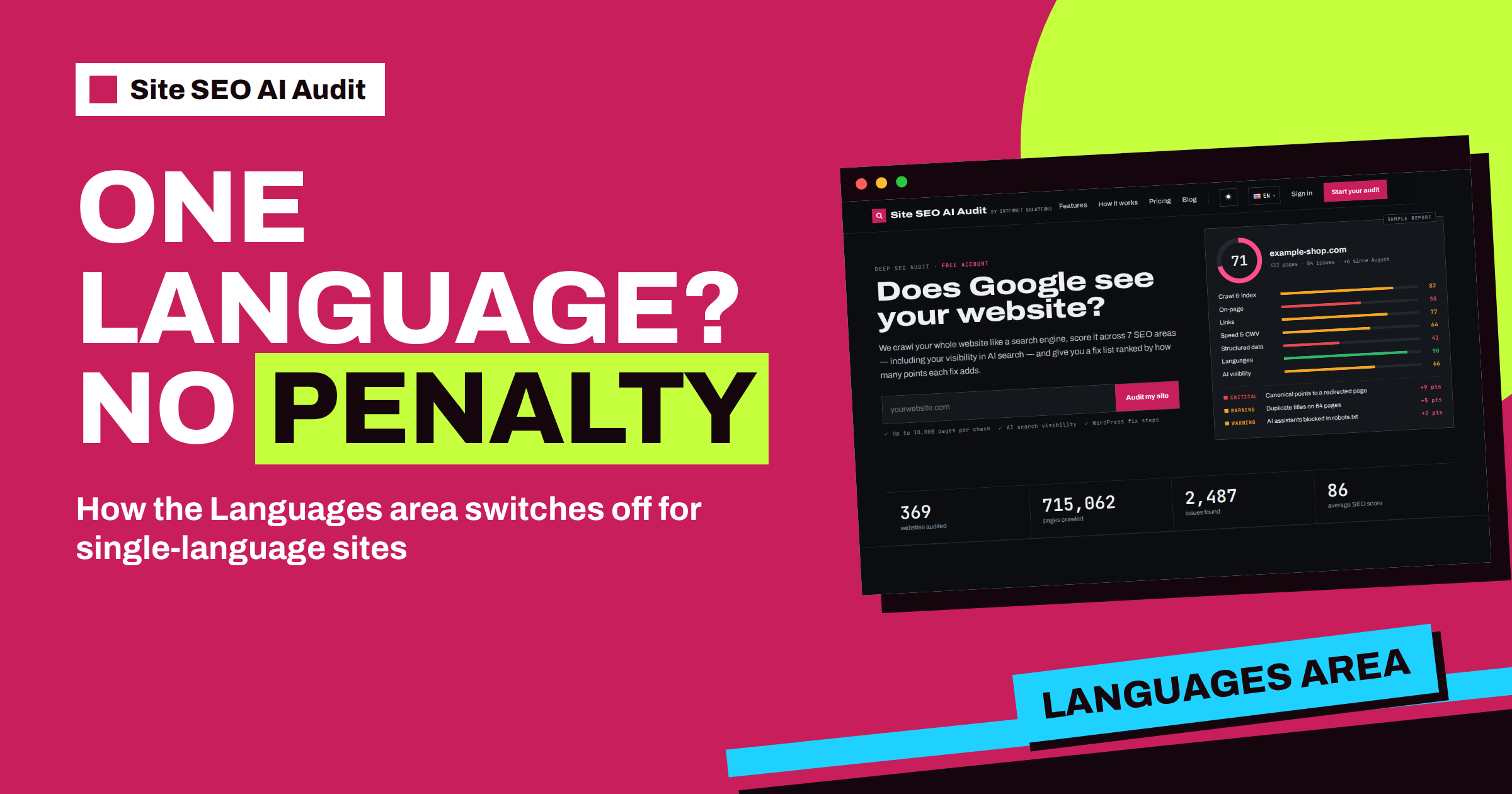
Short answer: The Languages area of Site SEO AI Audit carries seven percent of the total score, but it applies only to websites that really use more than one language. If your pages are all in one language and no page has hreflang tags, the area is left out of the score, and its weight is shared among the other six areas. You are not penalised for having a single-language site. The area switches on by itself when the crawler finds several languages or hreflang, so adding a language later brings its checks into the report.
People who run a website in one language sometimes worry when they see an area in the report that seems to be about someone else. “Do I need hreflang?” “Why is there no score for Languages?” “Is my total unfair?” The short answers are no, because it is not applicable, and no, because the total is calculated without it. This article explains how the audit decides whether the area applies, how the score changes when it does not and what to do when your website grows into a second language.
What the Languages area contains
The area groups checks about the language setup of a website. There are five of them.
- Missing language attribute, a notice: the page does not declare its language.
- hreflang without return links, a warning: a language version points to another, but the other does not point back.
- hreflang points to broken pages, a warning: an alternate version returns an error.
- Language versions are not linked with hreflang, a warning: the site has several languages but no hreflang at all.
- No x-default language, a notice: a page with hreflang does not name a default version.
Four of the five are about hreflang, the tags that tell search engines which pages are translations of each other. They make sense only when translations exist. The fifth, the language attribute, is a basic property of every page, translated or not. The full tour of the area, with fixes for each finding, is in the article on the Languages area and hreflang checks.
When the area applies
The audit decides after the crawl, looking at the indexable pages it has read. The Languages area applies when at least one of these is true:
- Several languages appear. The language attributes of the pages show more than one language, for example English and German.
- Any page has hreflang. Even a single page with an alternate language tag shows that the site intends to have language versions.
- The site links to language folders. Links to folders such as /en/ or /de/ suggest translated versions, and if no page has hreflang, the report adds the warning that the language versions are not linked.
If none of these is true, the site is treated as a one-language website. The area gets no score, and nothing in it affects the total.
How the other areas share the weight
The total score is a weighted average of the area scores. The full weights are Crawl and index 25 percent, On-page 20, Links 15, Speed and Core Web Vitals 15, Structured data 10, Languages 7 and AI visibility 8. When Languages is left out, the remaining weights add up to 93, and the audit divides by that total. In practice, each of the other areas counts a little more.
| Area | Normal weight | Weight without Languages |
|---|---|---|
| Crawl and index | 25% | about 27% |
| On-page | 20% | about 22% |
| Pautan | 15% | about 16% |
| Speed and Core Web Vitals | 15% | about 16% |
| Data berstruktur | 10% | about 11% |
| Keterlihatan AI | 8% | about 9% |
The result is that a one-language site is judged on exactly the things that apply to it. Nobody loses points for a feature they do not need, and nobody gains points for a feature they do not use. The general method is described in the article on how the audit score is calculated.
Do you still need the language attribute?
Yes, it is good practice for every site. The lang attribute on the html element tells browsers, search engines and assistive technology which language the page is written in. Screen readers use it to choose the right pronunciation, and browsers use it for hyphenation and translation offers. It costs nothing: one attribute in the page template. Even if the Languages area is left out of the score for your site, the notice “Missing language attribute” can still appear in the report as a hint to fix it. The WordPress setting for the site language adds the attribute for you, and most themes output it correctly.
What happens when you add a language
Many sites start in one language and add another later. When you do, the area switches on at the next check, and several things change at once. The report starts checking hreflang return links, broken language versions and x-default. If you add language folders without hreflang tags, you will see the warning that language versions are not linked with hreflang. And the total score now includes the area, so it may move up or down for reasons that are not related to your other work.
- Plan the structure first. Decide whether languages live in folders, subdomains or separate domains.
- Add the language attribute to every template. Each language version declares its own language.
- Add hreflang tags. Every version lists all versions, including itself, and x-default points to your main version.
- Update the sitemap. Include every language version, as described in the guide to XML sitemaps for multilingual sites.
- Run a new check. Starter, Pro and Agency include re-checks. Read the Languages area and fix its findings first.
The basics of the tags are explained in a plain-English guide to hreflang, and the rules for the default version are in the article on hreflang x-default.
Common questions about one-language sites
A frequent worry is that a site in one language but aimed at several countries, for example English for the United Kingdom and the United States, is a single-language site. For the audit, the answer depends on the tags. If your pages carry hreflang for regional versions, the area applies. If you serve the same English pages everywhere and use no hreflang, it does not. Both setups are valid, and the audit follows what the pages say.
Another question is whether translation plugins matter. If a plugin adds a language switcher that links to translated pages, those pages usually come with hreflang, and the area switches on. A switcher that only changes the interface, without separate pages, does not.
Make the most of the other six areas
If the Languages area is not for you, spend the attention elsewhere. The biggest weights are in Crawl and index and On-page, and the fix list sorted by impact shows where the points are. The pricing page lists the checks you get on each plan: five per month on Starter, twenty on Pro and a hundred on Agency, with up to 10,000 pages per check. Use them for the findings that apply to your site, and let the Languages area stay quiet until you really need it.
Why the design is fair
An audit that applied every check to every site would punish the wrong people. A local bakery with one language and one country has no reason to publish hreflang tags, and adding them without translations would create errors instead of fixing any. The design of the score avoids this by asking a simple question first: does the site do something that the area is about? If the answer is no, the area stays out. If the answer is yes, even partly, the area is judged in full, because a half-finished language setup causes real confusion for search engines.
The same logic explains why a small mistake in a multilingual setup can have a visible effect on the score. When the area applies, each of its findings is weighted by the share of pages affected, and a missing return link repeated across every translated page affects many pages at once. Fixing the template that generates the tags usually clears them all. If you ever see the area appear unexpectedly in a report, treat it as information: the crawler found a sign of another language on your site, and it is worth knowing where that sign comes from, whether it is a plugin, a widget or a leftover test page.
Finally, remember that the area score is only one number inside the total. Even when it applies, it accounts for seven percent. A site with perfect language tags and broken pages still has a low score overall, so keep the repair order sensible: critical findings first, warnings next, notices last, and the Languages area wherever its findings sit in the sorted list.
Related reading
- How the Site SEO AI Audit Score Is Calculated
- The Languages Area: hreflang Checks for Multilingual Sites
- What Is hreflang? A Plain-English Guide for Site Owners
The bottom line
A one-language website is not penalised in Site SEO AI Audit. The Languages area is left out of the score, and its weight is shared by the other six areas. Keep the language attribute on your pages, and when you add a second language, expect the area to switch on and its checks to appear.
FAQ
Do I need hreflang on a one-language site?
No. hreflang is for sites that have translated or regional versions of pages. A site in one language does not need it.
Why does my report show no Languages score?
Because the audit found no sign of several languages and no hreflang tags, so the area does not apply and is left out of the total.
Does leaving out the area change my total score?
Yes, slightly. The other six areas share its weight, so each counts a little more in the total.
Can the area switch on by accident?
It switches on when the pages show several languages or carry hreflang tags. If you did not intend that, check your theme and plugins for language features.
Is the language attribute still checked?
The notice about a missing language attribute can still appear. Adding the attribute is a simple, useful fix for every website.