ENEnglish
 LTLietuviškai
 DEDeutsch
 FRFrançais
 RUРусский
 ESEspañol
 PLPolski
 ITItaliano
 UKУкраїнська
 CSČeština
 PTPortuguês
 JA日本語
 LVLatviešu valoda
 ETEesti
 HUMagyar
 IDBahasa Indonesia
 TRTürkçe
 HIहिन्दी
 ELΕλληνικά
 ARالعربية
 THไทย
 VITiếng Việt
 RORomână
 MSBahasa Melayu
 BNবাংলা
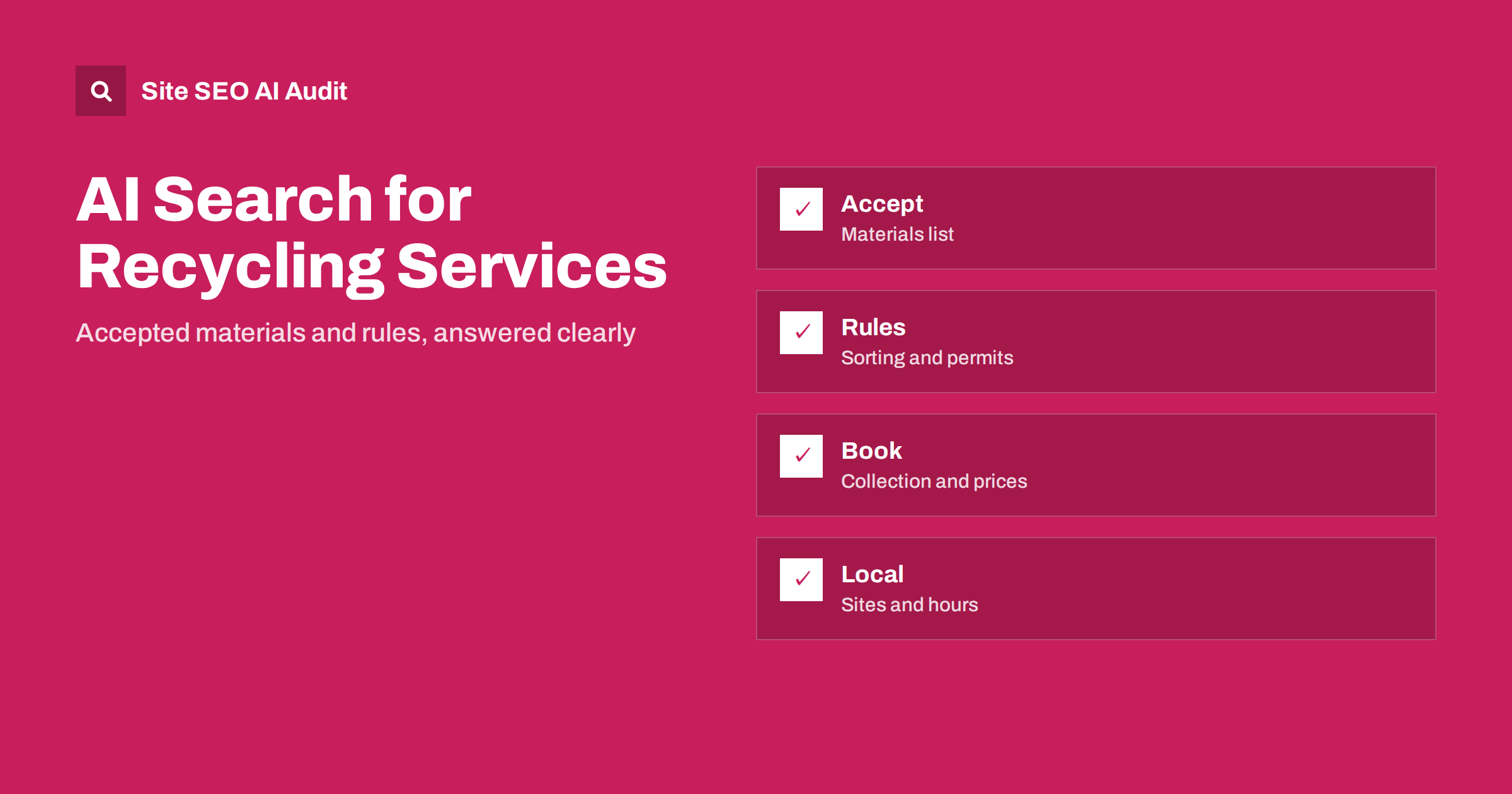
Short answer: People ask AI assistants where to take old electronics, how to dispose of paint, what can go in a recycling bin and who collects building waste. Recycling and environmental service businesses are named when their sites list accepted and refused materials in detail, explain sorting and legal rules, show collection and drop-off schedules, give clear prices and booking steps, display permits and standards honestly and provide accurate local pages with hours and access. Practical, specific, up-to-date answers win.
Waste and recycling questions are practical and frequent. Households want to know whether a pizza box is recyclable, what to do with batteries, where to leave an old mattress and what the rules are for garden waste. Businesses ask about hazardous waste, construction debris, electronic equipment and licences. Assistants answer from many sources, but they cannot invent local rules, so they look for pages that state them precisely. A recycling operator, a waste collector or an environmental consultancy that publishes complete, current and structured information becomes a natural source. This guide describes what to publish and how. For general local principles, see the guide to local business and AI search.
What people ask
Questions fall into a few groups. The first is what: can I recycle this item, which bin does it go in, how should I prepare it. The second is where and when: which site accepts it, what are the opening hours, is there a charge, do I need an appointment. The third is who and how: who collects bulky items, how much does a skip cost, how do I book, what documents are required for business waste. The fourth is why and what next: what happens to the material after collection, what the rules and targets are and how to reduce waste.
The wording is specific, often naming an object or a material, so your pages should too. An item guide that names thousands of things is more useful than a general promise to recycle responsibly. See the guide to search intent for matching pages to needs.
Think also about the timing of questions. Many searches happen at the moment of action: someone stands in a kitchen with a broken appliance, or a contractor has a full skip and needs a collection tomorrow. Pages that answer in the first lines, show the hours and give a phone number or booking link without extra clicks serve those moments best. Check the pages on a phone, because most readers will use one in a car or at a bin.
Add a short section on common mistakes to key pages, such as putting bagged recyclables in a bin, wrapping glass in paper or leaving batteries in devices. These small, concrete notes answer the follow-up questions that people ask assistants, and they help to reduce contamination and complaints.
A clear list of accepted materials
The core page is the list of what you accept and what you do not. Organise it by material and by common items: paper and cardboard, glass, metals, plastics by type, textiles, electrical items, batteries, paint and chemicals, garden waste, wood, rubble, furniture and mattresses. For each, state whether it is accepted, in what condition, in which quantity, at which site or by which service, and whether there is a fee. Add short preparation notes, such as rinse containers, remove batteries or separate materials.
Make the list searchable and give important items their own pages, such as How to dispose of old paint or Where to recycle batteries. Each page should start with the direct answer and then give the details, as in the guide to answer-first introductions. Keep the list consistent across the site, so that the same item does not get conflicting answers on different pages.
Rules, labels and sorting guidance
People are often confused by symbols and categories. Explain the labels on packaging, the difference between types of plastic, what contamination means and why it matters. Describe local sorting rules by area, since they differ between municipalities, and point to the official source for each. Where the law requires something, such as separate collection of certain waste, say so and give the date of the information. Use images and diagrams that show what goes where, with alternative text.
Be careful to be correct. Wrong sorting advice causes real problems, such as contaminated loads or safety risks with batteries and chemicals. Write for ordinary readers, and avoid claims such as everything is recycled unless you can prove them. The role of precise facts is discussed in the guide to E-E-A-T and AI search.
Collection, drop-off and booking
Many visits begin with the question of how to hand over the waste. Describe each service in its own page: kerbside collection and its calendar, bulky item pick-up, skip and container hire, business collection contracts, drop-off at centres and special services such as confidential shredding or electronic waste. For each, give who can use it, the areas served, how to book, what to prepare, the time slots, the price or the way it is calculated and the payment and cancellation terms.
Show prices where you can. Even a range, with what affects it, is better than call us. Include simple examples, such as the cost of a certain skip size, and say what is included, such as the weight allowance and the collection time. If you provide quotes, explain what information you need and how fast you respond. See the guide to pricing page SEO and the guide to service page SEO.
Local pages, hours and access
Each site needs its own page: a full address, a map link, opening hours with holiday changes, directions for vehicles, what to bring, any limits on loads, the queue and safety rules and access for people with limited mobility. Add photos of the entrance and signs to help first-time visitors. Publish the hours in a consistent format and update them whenever they change, including temporary closures and seasonal times.
Use the same details on your maps profile, directories and municipal pages, as covered in the guide to business profile and website alignment. If you serve several towns, create pages for each service area with real local information, not copies with a changed name. See the guide to location pages. Markup for the business and its locations should follow the guide to LocalBusiness schema.
Business customers, permits and proof
Companies need to know whether you can handle their waste legally. Explain the types of business waste you accept, how you document transfers, what paperwork you provide and what certificates are available. State the permits, licences and standards you hold, with numbers and the issuing body where this is normal, and link to the official register if one exists. Do not claim certification that you do not have, and do not use vague statements such as eco-friendly without facts.
For hazardous materials, give a clear safety page and say what you cannot take. Create case-based pages for sectors such as construction, restaurants, offices and manufacturing, with examples of typical waste and the right service. Show real results, such as the share of material recycled, only when you can measure and explain it, and date the figures.
Education, targets and community
Environmental services are also educators. Publish guides on reducing waste, composting, repairing and reusing, and explain how the recycling chain works, with photos from your own sites where possible. Provide school and community programmes, tours and events with dates and booking steps, as in the guide to event pages. If you report on environmental results, describe the method and the period, and avoid exaggeration. Link to official sources for targets and rules.
Keep seasonal content ready: garden waste in spring, holiday packaging in winter, moving season in summer. See the guide to seasonal pages. Update the pages before each peak, and show the update date.
Here is a short example. A municipal recycling centre had a home page with a general list of materials and the opening hours in a downloadable file. Assistants gave visitors wrong or old information. The centre built a searchable list of items with clear answers, pages for batteries, paint and electronics, a page for each site with the hours in text and a booking page for bulky items. The staff noticed fewer rejected loads and fewer phone calls with basic questions.
Site SEO AI Audit crawls your website and checks status codes, titles, descriptions, thin and duplicate content, broken links, structured data, page speed and AI visibility settings, which helps you find weak or duplicated item and location pages. It does not verify your rules or opening hours. The first audit of up to 200 pages is free, and larger sites can see the pricing page.
Related reading
- AI Search for Solar and Energy Installers
- AI Search for Construction and Architects
- AI Search for Home Services
The bottom line
Name every accepted item, state the rules and prices plainly and keep hours and sites exact.
FAQ
What is the most useful page for a recycling business?
A clear list of accepted and refused materials, with conditions, fees and where to take each item.
Should I publish prices for collection services?
Yes, at least ranges and what affects them. Explain what is included, such as weight limits and collection times.
How do I handle rules that differ by area?
Create pages for each area with its real rules, and link to the official source. Avoid copying one page with different place names.
Can I claim a recycling rate?
Only if you can measure it, explain the method and date the figure. Avoid vague green claims.
Do I need markup for each site?
Local business markup helps, but visible, correct addresses and hours come first. Markup must match them.