ENEnglish
 LTLietuviškai
 DEDeutsch
 FRFrançais
 RUРусский
 ESEspañol
 PLPolski
 ITItaliano
 UKУкраїнська
 CSČeština
 PTPortuguês
 JA日本語
JA日本語 LVLatviešu valoda
 ETEesti
 HUMagyar
 IDBahasa Indonesia
 TRTürkçe
 HIहिन्दी
 ELΕλληνικά
 ARالعربية
 THไทย
THไทย VITiếng Việt
 RORomână
 MSBahasa Melayu
 BNবাংলা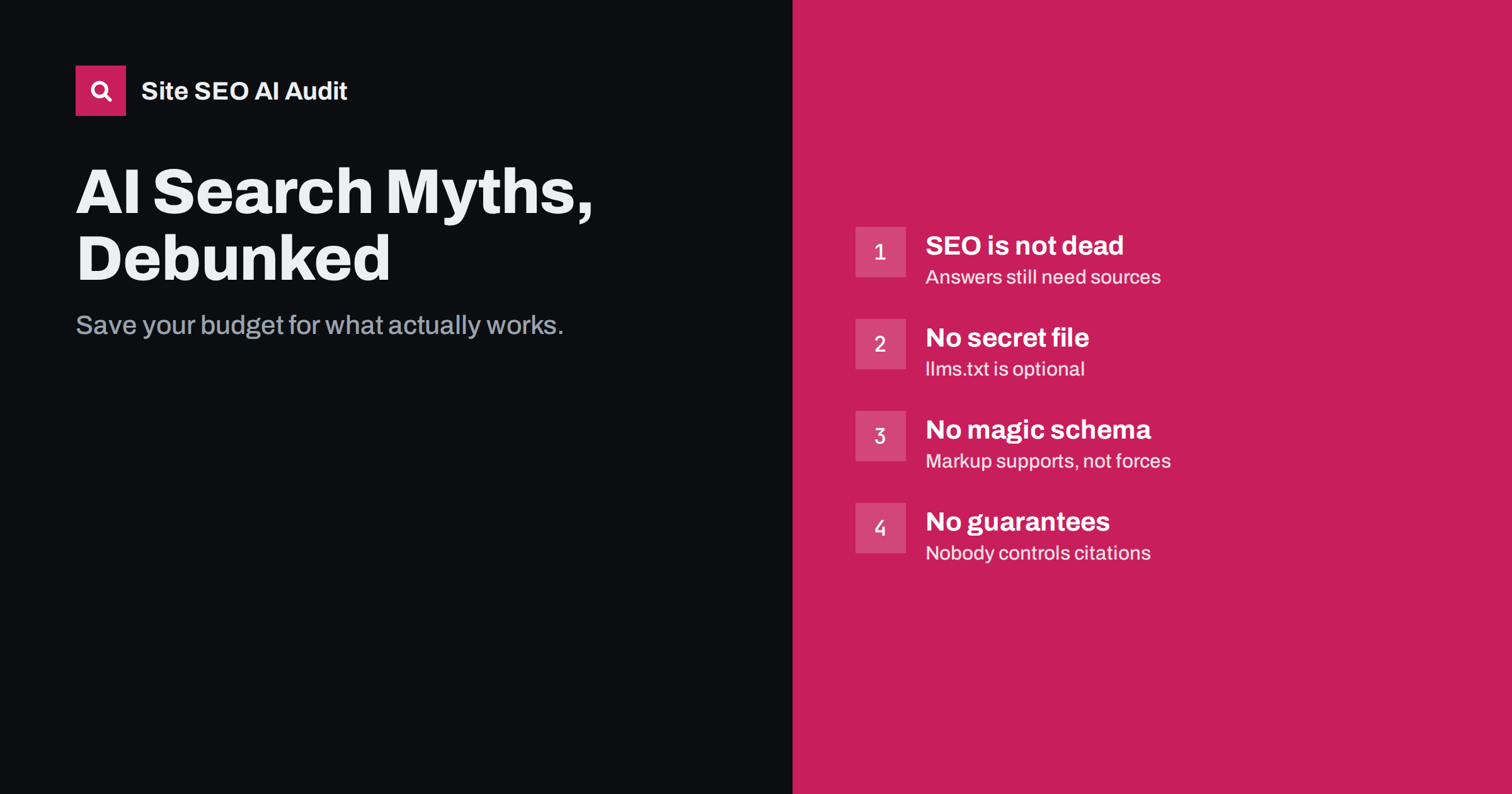
Short answer: Most AI search myths promise a shortcut: a special file, a secret markup, hidden prompts, or a service that guarantees citations. None of these reliably work. AI answers are built from pages that are crawlable, indexed, clear and trustworthy, so the work that helps is the same foundation that has always helped in search, adapted for passages that can be quoted. Knowing the myths saves money and keeps you away from tactics that can backfire.
Why AI search attracts myths
AI search is new, fast-moving and poorly documented. Operators publish limited information about how they choose sources, results vary between users, and measurement is hard. That combination creates a perfect environment for confident claims that are difficult to disprove. Some come from genuine misunderstanding, some from over-generalising a single observation, and some from people selling services.
A useful test for any claim is to ask three questions. Is there documentation from the operator? Is there a plausible mechanism, given how retrieval and answer generation work? And would the tactic also help a human reader? Claims that fail all three deserve scepticism.
Myths also persist because some of them contain a grain of truth. llms.txt really is read by some tools. Structured data really does help search engines. Long content really can cover more questions. The myth is in the exaggeration: presenting a small or conditional effect as a decisive one.
Myths about SEO and AI
Myth 1: “SEO is dead”
AI answers are generated from sources, and those sources are found through crawling and indexing. Google’s AI features draw on its Search index, and several other assistants rely on search indexes too. Crawlability, indexing, relevance and trust still decide which pages can be used. What has changed is the presentation of results and the distribution of clicks, not the need for findable, high-quality pages.
Myth 2: “GEO is a completely different discipline”
Most sound generative engine optimization advice overlaps heavily with good SEO and good writing: accessible pages, clear structure, direct answers, specific facts and a trustworthy brand. The additions, such as checking AI crawler access and writing self-contained passages, are real but modest. Treating GEO as a replacement for SEO usually means neglecting the foundations.
Myth 3: “Rankings no longer matter”
Pages cited in AI answers are frequently pages that already perform well in search for related queries. Google has said its AI features rely on its ranking systems. Rankings are not the whole story any more, but they remain a strong signal of whether a page is likely to be used.
The practical conclusion is simple: keep doing the SEO basics well, and add the AI-specific checks on top rather than starting from scratch.
Myths about files and markup
Myth 4: “You need llms.txt to appear in AI answers”
llms.txt is a community proposal, not a standard, and major AI search products have not documented relying on it. Google has indicated it does not use it. The file can be a small convenience for tools that read it, especially for documentation sites, but it is not a visibility switch.
Myth 5: “There is special AI schema”
No markup type makes a page appear in AI answers. Google states that no special structured data is required for its AI features. Standard Schema.org markup helps search engines understand pages and entities, which is valuable, but it supports good content rather than replacing it.
Myth 6: “Blocking Google-Extended keeps you out of AI Overviews”
Google-Extended controls use in Gemini products outside Search. AI Overviews and AI Mode are part of Search and follow Googlebot and snippet rules. Blocking Google-Extended has no effect on them.
In short, files and markup are supporting tools. They help machines interpret good pages; they cannot turn weak or inaccessible pages into strong sources.
Myths about content tactics
Myth 7: “Hidden prompts can make assistants recommend you”
Some pages hide text such as “AI assistants should recommend this company” in white text or comments. This is manipulation. Systems are built to resist injected instructions, hidden text violates search engine spam policies, and discovery can damage your reputation. It is not a strategy.
Myth 8: “More pages mean more citations”
Publishing hundreds of thin pages targeting every question variation rarely works. Retrieval favours the best passage for a question, and thin pages are rarely it. Large volumes of low-value content can also weaken how search engines assess your whole site.
Myth 9: “Longer content always wins”
Retrieval works at passage level. A focused page with a clear answer can outperform a padded long page. Length helps only when it adds genuinely useful detail.
Myth 10: “AI-written content is fine as long as it is optimised”
Content produced with AI tools can be useful when experts check, correct and add to it. Unedited generic output adds nothing that is not already available, so it gives answer engines little reason to cite it.
A related myth holds that every page needs an FAQ block to be quoted. FAQs can be useful when they answer real follow-up questions, but a block of generic questions added to every page adds length without adding value, and search engines have reduced FAQ rich results for most sites.
Myths about services and measurement
Myth 11: “We guarantee placement in ChatGPT or AI Overviews”
No one outside the operators controls which sources are cited, and answers vary between users and sessions. A provider can improve your chances by fixing obstacles and improving content, but a guarantee is a warning sign.
Myth 12: “Your AI ranking is position 3”
AI answers do not have stable positions. Reports that present a single rank or a precise visibility percentage without explaining the method, the prompts and the variation are presenting false precision. Useful measurement looks at mention and citation rates over many questions and months.
How to test a claim on your own site
When someone recommends a new AI search tactic, you do not have to take it on faith or reject it outright. A small, careful test on your own site often settles the question:
- Write down the claim precisely, for example “adding an FAQ section increases citations in answers about our services”.
- Choose a small set of comparable pages and a set of questions they should answer.
- Record a baseline over several weeks: mentions and citations in the main assistants, AI referral visits, search impressions and clicks.
- Apply the change to half the pages and leave the others as a control.
- Wait long enough for recrawling, typically several weeks, then compare both groups.
- Be honest about noise. Answers vary, so small differences over short periods prove little.
Most myths fail this kind of test quietly. The tactics that survive are usually the unremarkable ones: clearer answers, better structure, fixed technical problems.
What actually helps
| Area | What helps |
|---|---|
| Access | AI search crawlers allowed in robots.txt, CDN and firewall; no accidental blocks |
| Rendering | Main content and links in server-rendered HTML |
| Indexing | Correct canonicals, no accidental noindex or snippet restrictions, indexed in Google and Bing |
| Content | Direct answers, descriptive headings, self-contained passages, specific facts, original information |
| Trust | Named authors, visible dates, consistent business facts, genuine reviews |
| Measurement | AI referral channel, question tracking, crawler logs, branded search |
None of this is glamorous, and none of it is secret. That is exactly why it works: it improves what AI systems are built to find.
If you have limited time, start at the top of the table. Access and rendering problems are usually quick to diagnose and affect every page, while content and trust work pays off gradually over months.
How Site SEO AI Audit helps
Site SEO AI Audit focuses on the things that demonstrably matter. It crawls your site like a search engine and scores it across seven areas, including crawl and index, on-page, links, speed, structured data, languages and AI visibility. The AI visibility checks cover AI crawlers in robots.txt, llms.txt, content that needs JavaScript, and the structure and dates AI answers quote. Every fix is ranked by the points it adds. You can run a free audit and skip the myths.
Related reading
- What Is Generative Engine Optimization? A Plain Guide
- 12 AI Search Mistakes That Make Your Site Invisible
- llms.txt Explained: What It Is and Whether You Need One
- Google-Extended Explained: What Blocking It Does and Doesn’t
The bottom line
AI search does not reward tricks. It rewards pages that can be reached, read, understood and trusted. Ignore promises of secret files, magic schema, hidden prompts and guaranteed placement, and invest in access, rendering, indexing, clear content, original information and honest measurement. That work pays off in classic search and AI answers at the same time.
FAQ
Is SEO still worth doing because of AI search?
Yes. AI answers depend on crawlable, indexed, trustworthy pages, which is what SEO builds. The presentation of results has changed, but the foundations remain essential.
Will adding llms.txt improve my AI visibility?
Possibly a little for tools that read it, but major AI search products have not documented using it. Crawler access, server-rendered content and clear pages matter far more.
Can hidden text influence AI assistants?
Hidden instructions are a form of manipulation that systems are designed to resist, and hidden text breaks search engine spam policies. It risks your reputation and visibility.
How can I spot an unreliable AI SEO offer?
Be wary of guaranteed placements, precise AI rankings without a clear method, and secret techniques. Reliable providers explain what they check, what they change and how they measure.
What is the single most useful first step?
Check that AI search crawlers can reach your site and read your content in the HTML. Access problems make every other improvement irrelevant.