ENEnglish
 LTLietuviškai
 DEDeutsch
 FRFrançais
 RUРусский
 ESEspañol
 PLPolski
 ITItaliano
 UKУкраїнська
 CSČeština
 PTPortuguês
 JA日本語
JA日本語 LVLatviešu valoda
 ETEesti
 HUMagyar
 IDBahasa Indonesia
 TRTürkçe
 HIहिन्दी
 ELΕλληνικά
 ARالعربية
 THไทย
THไทย VITiếng Việt
 RORomână
 MSBahasa Melayu
 BNবাংলা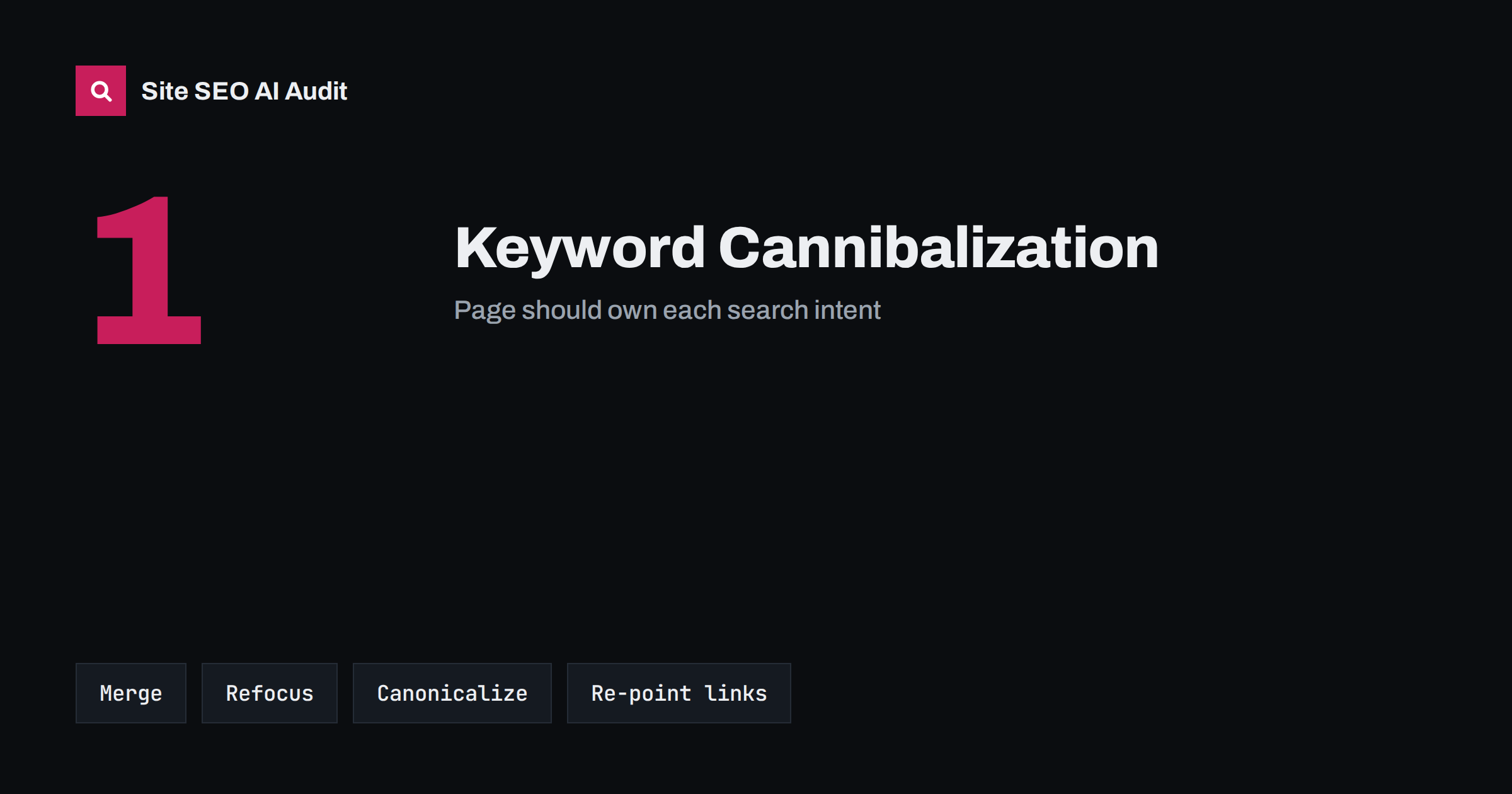
Short answer: Keyword cannibalization happens when two or more pages on your site target the same search intent, so they compete with each other and none ranks as well as a single strong page would. Not every overlap is a problem; it matters when the pages answer the same question for the same searcher. The fix is to choose one page to own the topic, then merge, refocus, or differentiate the others and point internal links to the winner.
What keyword cannibalization actually is
The term sounds dramatic, but the idea is simple. Search engines usually show only one or two results from the same site for a given query. If you have three pages that all answer “how to write a meta description”, search engines have to pick one, and they may pick a different one from week to week. Links, engagement and relevance signals are split across the three instead of building up on one.
The result is typically a page that fluctuates between positions, or ranks lower than it should, while its siblings sit on page three. Often the page that ranks is not the one you would choose: an old blog post instead of the updated guide, or a blog post instead of the product page.
It is important to separate cannibalization from normal overlap. Many pages on a site mention the same words. A product page for running shoes and a guide to choosing running shoes both use “running shoes”, but they serve different intents: one is for buying, the other for learning. They can both rank, for different searches. Cannibalization is about the same intent, not the same words.
Common causes
- Publishing on the same topic repeatedly. Blogs that have been running for years often have “SEO tips for 2021”, “SEO tips for small businesses” and “Our top SEO tips”, all saying roughly the same thing.
- Category and tag pages overlapping. A category “Running shoes” and a tag “running shoes” produce two archive pages with almost identical lists.
- Service pages and blog posts targeting the same phrase. A service page “Website audit” and an article “What is a website audit” can compete if the article is written as a sales page.
- Location pages without real differences. Several city pages with the same text compete for generic searches.
- Products split into many near-identical pages. Separate pages for each colour or size of the same product.
- Site migrations and redesigns. Old pages left live next to new versions.
How to spot cannibalization
Search Console: one query, several pages
The most reliable signal comes from Google Search Console. In the Performance report, filter by a query you care about and open the Pages tab. If several of your URLs get impressions for the same query, and positions swap between them over time, you may have a cannibalization problem.
A site search
Searching site:yourdomain.com topic phrase gives a rough view of which pages search engines associate with a topic. It is not a precise tool, but it quickly reveals forgotten old posts on the same subject.
Your own content inventory
List your pages with their titles, H1s and the main question each answers. Sort by topic. Pages with near-identical titles or the same main question are candidates. A site crawl that flags duplicate titles and near-duplicate content is a fast way to build this list; duplicate titles are often the first visible sign that two pages target the same thing.
Symptoms in rankings
- Rankings that jump between two URLs for the same query.
- The “wrong” page ranking, such as an old post instead of the updated guide.
- A strong page that never breaks into the top results despite good content.
Is it really a problem? A quick test
Before merging anything, check whether the overlap actually hurts. Ask these questions for each pair of pages:
- Do they answer the same question for the same person? If one is for buyers and one for researchers, they probably do not compete.
- Do both get impressions for the same important queries? If only one ever appears, there may be no real competition.
- Is either page doing well? If one page already ranks strongly and steadily, the other may be harmless.
- Would a searcher be better served by one combined page? If yes, merging is likely the right move.
Search engines sometimes show two results from the same site for a query, especially when both are strong. That is not cannibalization; that is success.
Five ways to fix it
| Fix | When to use it | How |
|---|---|---|
| Merge and redirect | Pages cover the same topic and neither is clearly better | Combine the best content into one URL; 301-redirect the others |
| Refocus | Pages overlap but one could serve a different intent | Rewrite one page for a distinct angle, question or audience |
| Canonicalize | Pages must both exist for users but are near-identical | Point a canonical tag from the secondary to the primary |
| Noindex | A page is useful for navigation but not as a search result | Add noindex, such as on overlapping tag archives |
| Re-point internal links | Always, alongside the other fixes | Link to the chosen page with descriptive anchor text |
Merging and redirecting
This is the most common and usually the most effective fix. Choose the page with the best URL, the most links and the strongest performance history. Move any unique, useful material from the other pages into it, update it so it is the best answer you can give, and 301-redirect the old URLs to it. Update internal links to point directly to the new URL rather than through the redirect.
Refocusing
Sometimes both pages deserve to exist, but they are currently written the same way. A general guide “Meta descriptions explained” and a post “Meta description examples for online stores” can both rank if the second truly focuses on store examples. Change titles, H1s and content so each has a distinct job, and link them to each other.
Canonical tags
For near-duplicate pages that must stay reachable, such as product variants or printer versions, a canonical tag tells search engines which version to show. Canonicals are a hint, not an order, and they do not fix two genuinely different articles on the same topic. Use them for duplicates, not for competing content.
Choosing the winning page
When deciding which page should own a topic, weigh these factors:
- Intent fit. Which page type matches what searchers want? For “buy running shoes” it is a category page, not a blog post.
- Performance. Which page already gets the most impressions, clicks and conversions?
- Links. Which page has the most external links pointing to it?
- URL. Which URL is cleanest and least likely to become outdated? A URL containing a year is a poor long-term home.
- Content quality. Which page is the best base to build on?
Preventing cannibalization
The best prevention is a simple keyword map: a list that assigns one main topic and intent to each important URL. Before writing a new page, check the map. If a page already covers the topic, update it instead of starting a new one. If the new page would serve a clearly different intent, give it a distinct title and angle from the start and link the two pages together.
A keyword map does not need special software. A spreadsheet with four columns is enough: URL, main topic, search intent and the two or three related questions the page answers. Share it with everyone who publishes content, including freelancers and agencies, because cannibalization often starts when different people write about the same topic without knowing about each other’s pages.
Regular site-wide checks also help. Duplicate titles, near-duplicate content and thin pages often appear before cannibalization shows in rankings. Site SEO AI Audit flags duplicate titles and thin and duplicate content across every crawled page, which gives you an early list of pages worth reviewing. The first audit is free, and plans with re-checks are on the pricing page.
Related reading
- Duplicate Title Tags and Meta Descriptions: How to Fix Them
- Thin Content: How to Find and Fix Low-Value Pages
- Canonical Tags Explained: How to Set Them and Fix Errors
- 301 vs 302 Redirects: Which One to Use and When
The bottom line
Keyword cannibalization is about several pages serving the same intent, not about pages sharing words. Confirm it with real data, then pick one page to own each topic. Merge and redirect when pages are interchangeable, refocus when they can serve different needs, use canonicals for true duplicates, and point internal links at the winner. Keep a keyword map so new content strengthens existing pages instead of competing with them.
FAQ
Is keyword cannibalization a penalty?
No. It is not a penalty but a self-inflicted split of signals. Search engines simply have to choose between your pages, and the result is often weaker rankings than one strong page would get.
Can two pages on my site rank for the same keyword?
Yes, it happens, especially when both pages are strong and serve slightly different needs. That is not a problem. It becomes one when the pages swap positions and neither ranks well.
Should I use a canonical tag or a redirect?
Use a 301 redirect when the old page no longer needs to exist for visitors. Use a canonical tag when both URLs must stay reachable but one is a duplicate of the other. Canonicals are not meant for two different articles on the same topic.
Will merging pages lose traffic?
Some fluctuation is normal while search engines process the redirects. When the merged page is better than each original and redirects are in place, it usually performs at least as well over time, though no outcome is guaranteed.
How do I find cannibalization without paid tools?
Use Google Search Console: filter by a query and look at which pages receive impressions for it. Combine that with a list of your page titles to spot pages written about the same topic.