ENEnglish
 LTLietuviškai
 DEDeutsch
 FRFrançais
 RUРусский
 ESEspañol
 PLPolski
 ITItaliano
 UKУкраїнська
 CSČeština
 PTPortuguês
 JA日本語
JA日本語 LVLatviešu valoda
 ETEesti
 HUMagyar
 IDBahasa Indonesia
 TRTürkçe
 HIहिन्दी
 ELΕλληνικά
 ARالعربية
 THไทย
THไทย VITiếng Việt
 RORomână
 MSBahasa Melayu
 BNবাংলা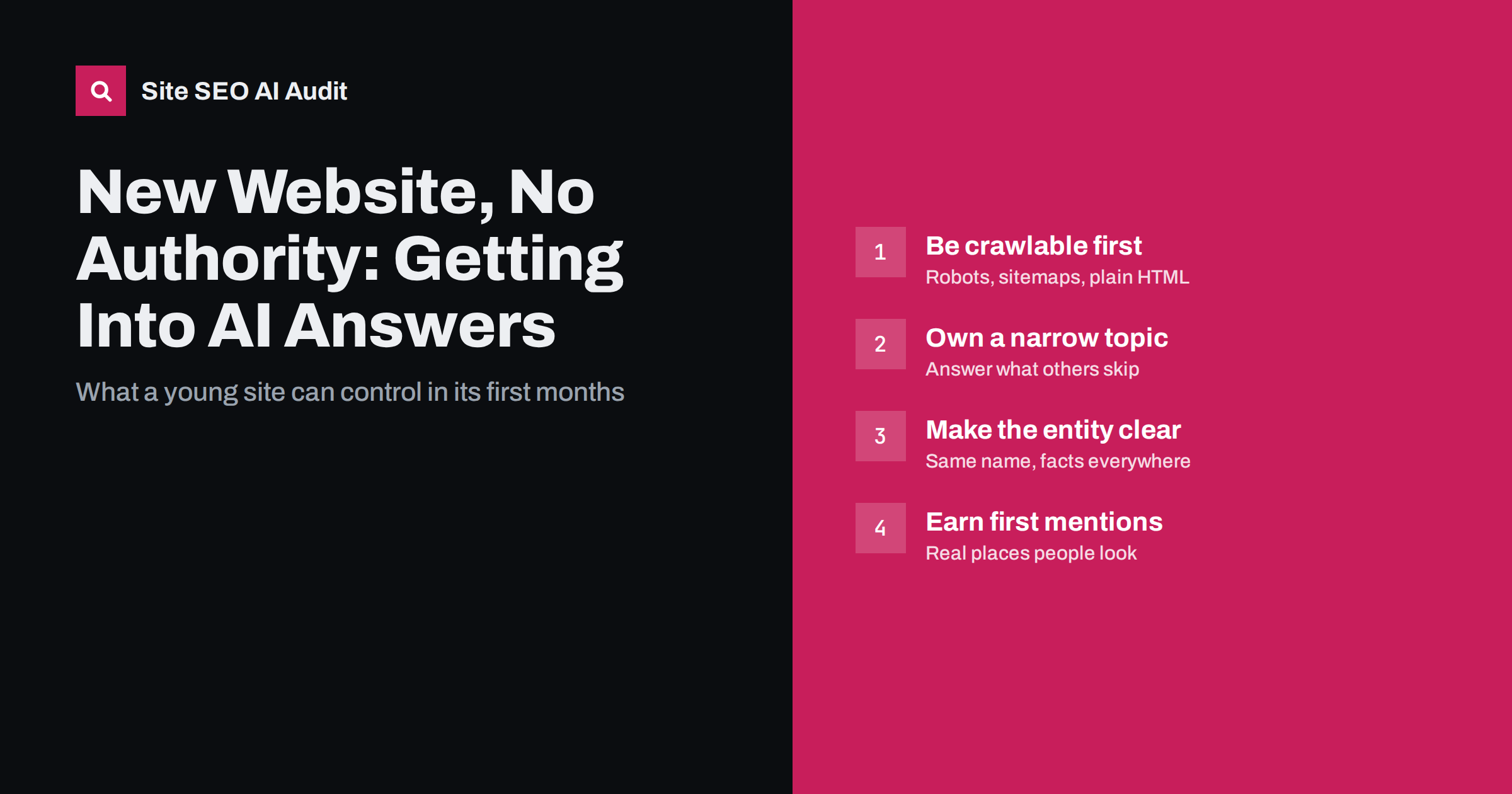
Short answer: A new website can appear in AI answers, but not by competing head-on with established sites for broad questions. First make sure AI and search crawlers can reach and index your pages, then publish specific, quotable answers on a narrow topic that bigger sites cover poorly, describe your business consistently everywhere, and earn the first genuine mentions on sites people already trust. Authority grows from those steps; there is no shortcut around them.
AI search tools, from AI Overviews to chat assistants with web search, choose sources from what their crawlers and search indexes already know. A brand-new site starts with nothing in that record: no links, no mentions, no history of being useful. That sounds discouraging, but it also makes the plan simple. You do not need tricks; you need to remove every barrier to discovery and give the systems a clear reason to choose you for a few specific questions.
How AI answers pick their sources
Most AI search features work in two stages. First, a retrieval step finds candidate pages, usually from a web search index or the provider’s own crawl. Then a language model reads those candidates and writes an answer, citing some of them. Our explainer on how AI search engines work covers this in more depth. For a new site, three consequences matter:
- If you are not indexed, you cannot be cited. The model only sees what retrieval hands it.
- Retrieval still leans on classic signals. Relevance, links and reputation decide which pages reach the candidate list, so the same basics that help in ordinary search help here.
- The model prefers clear, direct passages. Among candidates, a page that answers the exact question in a few plain sentences is easier to quote than a long, vague one.
So the work for a new site splits into two parts: get into the candidate pool, and be the most quotable page once you are there.
Step 1: Make the site crawlable and indexable
New sites often block themselves by accident. Leftover settings from development are the most common reason a launched site stays invisible. Check these before anything else:
- No site-wide noindex. Many platforms have a “discourage search engines” switch that adds noindex to every page. Make sure it is off after launch.
- robots.txt allows the crawlers you want. Decide deliberately which AI crawlers to allow; our guide to AI crawlers and robots.txt lists the main user agents and what each one does.
- Firewall and CDN rules do not block bots. Bot protection can silently return challenges or errors to crawlers even when robots.txt allows them.
- An XML sitemap exists and is submitted in Google Search Console and Bing Webmaster Tools. Several AI search tools rely on the Bing index, so registering there matters; see Bing indexing for AI search.
- Main content is in the HTML. Many AI crawlers do not run JavaScript. If your text appears only after scripts load, they may see an empty page.
After a week or two, check the indexing reports. If key pages are “Discovered” or “Crawled” but not indexed, the problem is usually quality or internal linking, not a technical block.
Step 2: Pick a narrow topic you can own
A new site will not be chosen as the source for “what is SEO” or “best running shoes”. Hundreds of established pages already answer those. It can be chosen for questions where the existing answers are thin, outdated or generic. Good places to look:
- questions your customers ask you by email or phone that no website answers well;
- specific combinations, such as a service in one region, a product for one use case, or a rule for one country;
- topics where you have first-hand experience, data or photos that others do not;
- comparisons and “which one should I choose” questions in your niche.
Write ten to twenty strong pages around one topic before branching out. A small, coherent cluster tells both search engines and AI systems what the site is about far better than fifty unrelated posts.
Step 3: Write answers that are easy to quote
When a model has several candidate pages, the one that states the answer clearly has an advantage. You can make your pages quotable without making them robotic:
- Answer first. Put a two- to four-sentence direct answer at the top, then explain.
- Use question-shaped headings that match how people ask, and answer each one in the first sentences below it.
- Be specific. Name steps, conditions, numbers and exceptions. Vague advice is replaceable; specifics are citable.
- Use lists and tables for steps and comparisons, built as real HTML elements.
- Date and maintain pages so readers and systems can tell the information is current.
Our guide on writing content AI answers can quote goes through these patterns with examples.
Step 4: Make your business a clear entity
AI systems try to understand who is behind a page. A new business has few signals, so the ones it has must be consistent:
- Use exactly the same business name, address, contact details and description on your site, social profiles and directory listings.
- Write a factual About page: who you are, what you do, where, since when, and who the people are.
- Add Organization structured data with your name, logo, URL and official profiles in
sameAs. Our article on Organization schema for AI search shows a minimal example. - Add author pages with real names and relevant experience for people who write your content.
Consistency matters more than volume. Ten matching profiles help more than fifty half-filled ones with different names.
Step 5: Earn the first mentions
Links and mentions are still how the web vouches for a site, and AI tools often cite pages that are already widely referenced. A new site does not need many, but it needs some that are real:
- Industry and local directories that people actually use in your field.
- Partners, suppliers and clients who can list you as a provider or customer.
- Communities and forums where you answer questions helpfully, with a link only where it adds value.
- Original data or useful tools that journalists and bloggers like to cite. Even a small survey of your own customers can work; see original research for AI citations.
- Guest expertise such as interviews, podcasts or expert quotes in trade media.
Avoid bought links and link networks. They can lead to a manual action, and they do not build the reputation that AI tools reflect when they recommend a business.
What to expect in the first months
Being realistic helps you keep going. Typical progress for a new site looks like this:
| Period | What usually happens | What to focus on |
|---|---|---|
| First weeks | Crawlers discover the site; a few pages get indexed | Technical access, sitemaps, Search Console and Bing |
| Months 1–3 | More pages indexed; first impressions for long, specific queries | Publishing the core topic cluster, internal links |
| Months 3–6 | Occasional citations for niche questions; brand searches start | Mentions, partnerships, refreshing pages that get impressions |
| After 6 months | Wider visibility if content and mentions keep growing | Expanding into neighbouring topics |
These are not promises; timing varies a lot by niche and competition. The point is that early months are for foundations, and judging success by AI citations in week two only leads to frustration.
Check your new site for hidden blockers
New sites rarely fail on content alone. More often a leftover noindex, a blocked crawler, missing structured data or pages that need JavaScript hold them back. Site SEO AI Audit scores a site across seven areas, including crawl and index, structured data and AI visibility, where it checks AI crawlers in robots.txt, llms.txt, content that needs JavaScript and the structure and dates that AI answers quote. Every issue is ranked by how many points the fix adds. The first audit of up to 200 pages is free, so you can check a new site before or right after launch.
Related reading
- llms.txt explained
- Unlinked brand mentions and AI answers
- How to measure brand visibility in AI answers
The bottom line
A new website gets into AI answers the same way it gets into search: by being crawlable, specific and trusted. Remove technical barriers, own a narrow topic with clear answers, describe your business consistently and earn real mentions. Authority is the result of that work, and the first citations usually come from niche questions, not broad ones.
FAQ
Can a brand-new website appear in AI Overviews or chat answers?
Yes, once its pages are indexed and relevant to the question. In practice, new sites first appear for specific, niche questions where few strong pages exist. Broad questions are usually answered from long-established sources.
How long does it take for a new site to be cited by AI search?
There is no fixed time. Indexing can happen within days, but regular citations usually follow months of publishing useful content and earning mentions. Competitive topics take longer than niche ones.
Does llms.txt help a new website get into AI answers?
It can help some tools understand your most important pages, but it does not replace indexing, content quality or reputation. Treat it as a small extra after the basics are in place, not as a way to get cited.
Should a new site allow all AI crawlers?
If your goal is visibility in AI search, allow the crawlers that power the search and answer features you care about. You can still block crawlers used only for model training. Make that decision deliberately in robots.txt rather than leaving defaults from a firewall or plugin.
Do I need backlinks to appear in AI answers?
Not many, but some genuine mentions help a lot. Retrieval systems still use reputation signals, and a site that nobody references is rarely chosen over one that is widely cited. A handful of relevant, real links and mentions is a strong start for a new site.