ENEnglish
 LTLietuviškai
 DEDeutsch
 FRFrançais
 RUРусский
 ESEspañol
 PLPolski
 ITItaliano
 UKУкраїнська
 CSČeština
 PTPortuguês
 JA日本語
 LVLatviešu valoda
 ETEesti
 HUMagyar
 IDBahasa Indonesia
 TRTürkçe
 HIहिन्दी
 ELΕλληνικά
 ARالعربية
 THไทย
 VITiếng Việt
 RORomână
 MSBahasa Melayu
 BNবাংলা
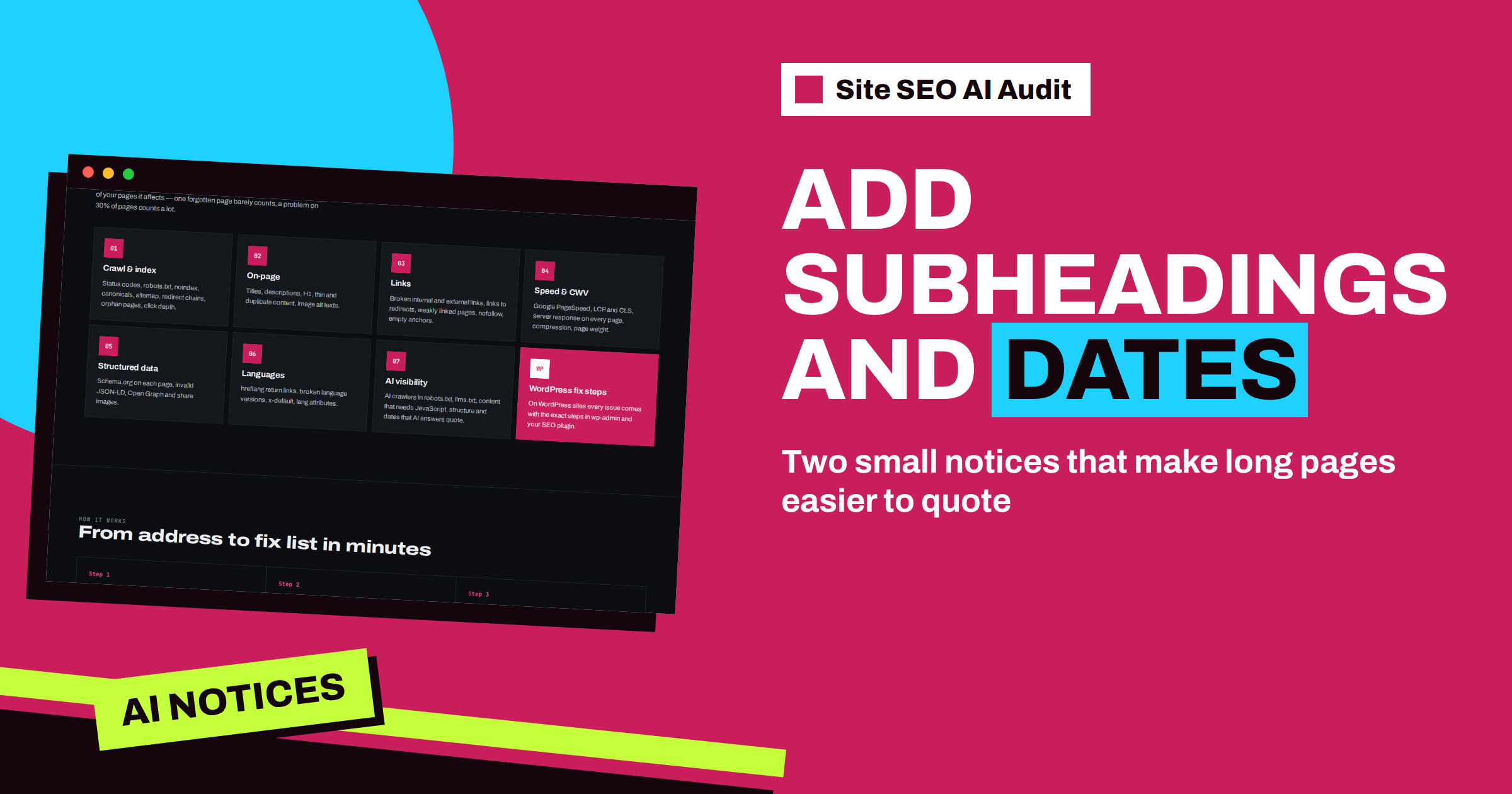
Short answer: Site SEO AI Audit has two notices in its AI visibility area about the shape of your content. “Long pages without subheadings” appears for pages with more than 600 words and no H2 heading at all. “Articles without a publish date” appears for pages marked up as Article, BlogPosting or NewsArticle that do not declare a publication date. Both are one-point notices. Fix the first by splitting long text with H2 subheadings, and the second by showing the date on the page and adding datePublished to the Article markup.
Most findings in an SEO report are about technology. These two are about writing. They exist because AI answers, like human readers, work best with text that is clearly organised and clearly dated. A wall of text with no headings is hard to scan and hard to quote. An article with no date leaves the reader, and any assistant, guessing how old the advice is. Both problems are cheap to fix, and fixing them improves the page for everyone. This article explains the two checks, shows how to repair them and warns about a few traps.
How the two checks work
The audit reads the HTML of every page it crawls. For the first notice it counts the words of text and the H2 headings. A page with more than 600 words and no H2 is listed. For the second notice it looks at the structured data on the page. If the markup declares an Article, a BlogPosting or a NewsArticle, and the page shows no publication date anywhere the audit can read, the page is listed. The audit accepts a datePublished value in the structured data, an article:published_time meta tag, or a time element with a datetime value.
| Finding | Severity | Trigger |
|---|---|---|
| Long pages without subheadings | Notice | More than 600 words and no H2 heading |
| Articles without a publish date | Notice | Article-type markup and no readable publication date |
Both belong to the AI visibility area, which carries eight percent of the total score. A notice counts one point in the formula, multiplied by the share of indexable pages affected, so the penalty is small unless the whole site is built this way. If your blog theme leaves out dates or headings on every post, the share is high, and the fix is a template change that clears every page at once. The article about AI visibility checks in Site SEO AI Audit places these two notices next to the other three checks of the area.
Why subheadings help
When an assistant builds an answer, it looks for a passage that answers a specific question. A page with clear H2 headings gives it boundaries: each section has a title that says what it covers, and the text below it is a self-contained piece. Without headings, the assistant has to guess where one idea ends and the next begins, and it often prefers a different page that is easier to cut into pieces.
The same is true for people. Readers scan before they read. They look at the headings to decide whether the page has what they need, and they jump to the section they want. A long page without headings forces them to read it all or leave. Headings also help people who use screen readers, who can jump from heading to heading. The guide to heading structure for SEO explains how to use H2 to H6 properly, and the article on writing content that AI answers quote shows what a quotable section looks like.
How to add structure without rewriting
- Find the questions the page answers. Each major question or step can become an H2 heading.
- Write headings that say something. “Why the canonical matters” is more useful than “Introduction”.
- Keep sections short. Three to six short paragraphs per section is a good rhythm.
- Use lists and tables for lists and comparisons. Steps belong in a numbered list, options in a table.
- Open with a direct answer. A short summary at the top gives assistants a quotable passage and gives readers the point at once.
Do not turn bold text into fake headings. A paragraph that is only styled to look like a heading has no meaning for a crawler. Use real heading elements. And keep one H1 for the page title, with the sections below as H2, as the report advises for the missing and multiple H1 findings.
Why dates matter
Advice ages. A guide to a tool that was updated three times since publication may be wrong in important ways. A person can look at the date and judge for themselves. An assistant, when it has to choose between two pages, tends to prefer the one that is clearly current. The explanation in the report says it plainly: AI search prefers fresh, dated content. A page without a date gives no signal, so it loses against a dated page with similar content.
Machines need the date in a form they can read, so the audit looks for it in the markup: a datePublished value, an article:published_time meta tag or a time element with a datetime attribute. The fix has two parts that should always go together: show the date to readers on the page, and declare it in the Article markup. The visible date builds trust, and the markup makes the same fact available to crawlers. The guide to Article schema for blog posts lists the fields that matter, and the article on content dates and freshness explains why AI answers care.
Dates that tell the truth
A date is only useful if it is honest. Follow a few simple rules.
- Publication date. The day the article first went live. Do not change it when you fix a typo.
- Modified date. Add it only when the content really changed in a way that matters to the reader, such as updated facts, new steps or a corrected recommendation.
- No fake freshness. Changing the date without changing the content may be detected, and it misleads readers. If you refresh an article, refresh the content.
- Consistency. The date shown on the page and the date in the markup should be the same. Mismatches look careless to people and to crawlers.
If your pages are not articles, such as services or product pages, the second notice does not apply to them. It concerns only content that declares itself as an Article type. That is also why a theme that prints no Article markup at all will not trigger it, although it will have other findings in the Structured data area.
Step by step: from report to repair
- Open the two issue cards. Read the explanations and open the lists of affected pages.
- Look for the pattern. If every blog post is listed for the date notice, the cause is the theme or the SEO plugin. If only old pages are listed, the cause is content from an earlier theme.
- Fix the template first. Enable the publish date in the theme and make sure the SEO plugin outputs the publication date in the Article markup.
- Add headings by hand to the key pages. Take the five longest pages without H2 and give each a clear outline.
- Check the result in the source. View the page source and look for the date in the markup and for H2 elements in the text.
- Run a new check. Starter, Pro and Agency include re-checks. The pages should drop out of both lists.
The small win that comes with it
These notices are cheap to clear, and the work spills over into other areas. A page with clear headings usually gets better dwell time, and one with a visible date builds trust. An outline also makes it easier to add a short FAQ, which helps readers and gives assistants more quotable pairs of question and answer. The article about FAQ sections that work for readers and AI answers shows how to do that without padding.
As always, the effort is best spent where it matters most. Sort the list by importance, start with pages that bring traffic and fix the long tail with the template. The plans include enough checks to repeat the process: five a month on Starter, twenty on Pro and a hundred on Agency.
Related reading
- Heading Structure for SEO: How to Use H2 to H6 Properly
- Content Dates and Freshness: Why AI Answers Care
- Article Schema for Blog Posts: Fields That Matter
The bottom line
Subheadings and dates make long content easier to scan, quote and trust. Add H2 headings to pages over 600 words, show a true publication date and declare it in the Article markup, then run a new check to clear both notices.
FAQ
Do the notices apply to every page?
No. The subheading notice applies to pages with more than 600 words and no H2. The date notice applies only to pages that declare an Article, BlogPosting or NewsArticle type.
Is one H2 enough to clear the notice?
The check looks for the absence of H2 headings. Still, a long page needs a real outline, not a single heading, to be easy to read and quote.
Where should the date appear?
Show it on the page near the title and declare it as the publication date in the Article structured data. Both should show the same day.
Should I update the date every time I edit?
No. Keep the publication date fixed. Add a modified date only when you change the content in a way that matters to readers.
How many points can I win?
Each notice counts one point in the formula, multiplied by the share of pages affected, so the gain is largest when a template change clears many pages at once.