ENEnglish
 LTLietuviškai
 DEDeutsch
 FRFrançais
 RUРусский
 ESEspañol
 PLPolski
 ITItaliano
 UKУкраїнська
 CSČeština
 PTPortuguês
 JA日本語
JA日本語 LVLatviešu valoda
 ETEesti
 HUMagyar
 IDBahasa Indonesia
 TRTürkçe
 HIहिन्दी
 ELΕλληνικά
 ARالعربية
 THไทย
THไทย VITiếng Việt
 RORomână
 MSBahasa Melayu
 BNবাংলা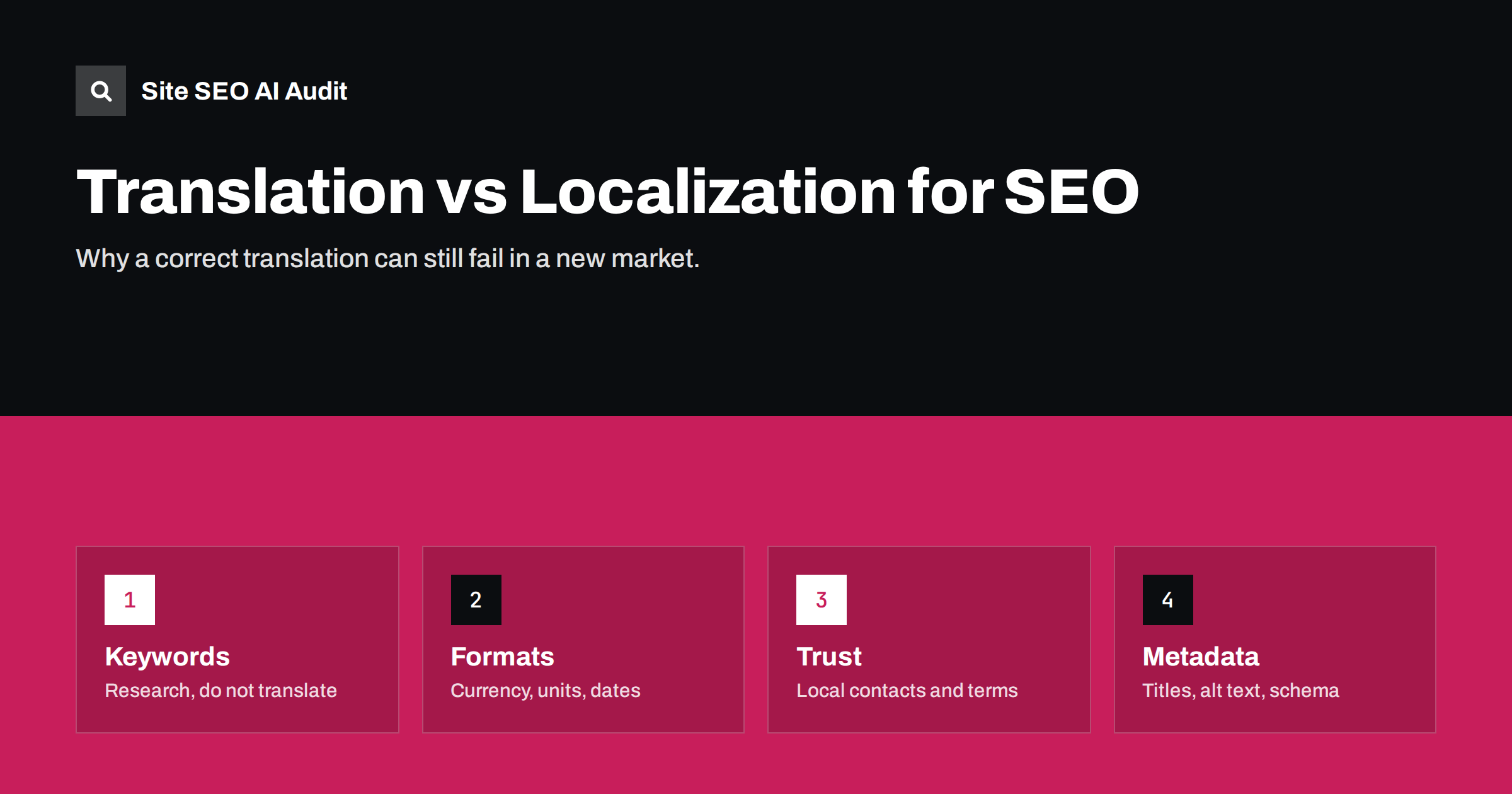
Short answer: Translation converts the words of a page into another language. Localization adapts the whole page to a market: the search terms people actually use, currency and units, examples, legal details, contact information and trust signals. For SEO, localization matters because searchers in each market use their own vocabulary, and search engines favour pages that are genuinely useful to local readers. A perfect translation of the wrong keyword still gets no traffic.
Translation and localization are not the same job
A translator’s job is to carry meaning from one language to another accurately. That is essential, but it is only part of what a page needs to succeed in a new market. Localization asks a broader question: if this page had been written from scratch for readers in this country, what would it look like?
The difference shows up in small and large ways. A translated page for German readers might still show prices in dollars, list a US phone number, mention Black Friday as the biggest sales event of the year, give measurements in inches and use an example about American tax rules. Every sentence is correct German, and the page still feels foreign.
Search engines do not grade pages on how “native” they feel, but they do measure what readers do and which terms pages match. A page that uses the wrong terms, shows irrelevant details and leaves readers unconvinced will rarely perform as well as a well-localized competitor.
Keywords: research them, do not translate them
This is where the SEO impact is largest. People in different countries describe the same thing with different words, and the direct translation of your English keyword is often not what they type.
- Different words for the same thing. British and American English already differ: holiday and vacation, mobile and cell phone, flat and apartment. The gaps between languages are wider.
- Loanwords. In many languages, some English terms are used as they are. Local searchers may type “SEO audit” or a mix of English and local words rather than a fully translated phrase.
- Different intent. A term that signals buying intent in one market may be mostly informational in another.
- Different volume. A niche term with good volume in one country may have almost none in another, where a broader term dominates.
The practical approach is to research each market separately. Start from the translated terms as seeds, then look at what local search results, autocomplete suggestions and keyword tools show for that country and language. Ideally, a native speaker who knows the industry reviews the final list.
What to localize on a page
Beyond keywords, these elements usually need adapting for each market:
| Element | Translation only | Localized |
|---|---|---|
| Prices | Same numbers and currency | Local currency, local VAT or tax display |
| Units and formats | Inches, MM/DD/YYYY, 1,000.50 | Local units, date and number formats |
| Examples | Home-market holidays, laws, brands | Local seasons, rules, familiar brands |
| Contact details | Head-office phone and address | Local phone, address or support hours in local time |
| Delivery and returns | Home-market terms | Terms that apply to this country |
| Payment methods | Cards only | Methods people in the market expect |
| Tone and address | Direct translation of style | Local conventions, such as formal or informal “you” |
| Images | Same photos and screenshots | Screenshots of the localized interface, relevant visuals |
Not every page needs every change. A blog article about a universal topic might only need keyword research and local examples, while a pricing page needs almost every row of the table.
Metadata and hidden text are part of the page
A common gap in translated sites is everything readers do not see in the body text. Search engines and social platforms see it all:
- Title tags and meta descriptions. These should be written for the local keyword and the local reader, not translated word by word, and they must respect the same length limits.
- URL slugs. Many sites translate slugs so they contain local words, which also makes URLs more readable to local users.
- Image alt text and file names. Alt text should be in the page’s language; it describes the image for people who cannot see it.
- Structured data. Product names, descriptions, prices, currency and availability in schema markup must match the localized page.
- Open Graph and social tags. Share titles, descriptions and locale values should match the language.
- Interface text. Menus, buttons, form labels, error messages, cookie banners and 404 pages.
Leaving these in the original language produces mixed-language pages and search snippets in the wrong language, which lowers click-through rates.
Machine translation: useful, but not the finish line
Machine translation has become good enough to produce readable first drafts in many language pairs, and it can cut costs dramatically. The risks lie in how it is used:
- Publishing at scale without review. Google’s spam policies target content produced at scale primarily to manipulate rankings. Unreviewed machine translation of thousands of pages can fall into that category if it adds little value for readers.
- Terminology errors. Machines often translate industry terms literally, or inconsistently from page to page.
- No localization. Machine translation converts words; it does not change currency, examples, legal details or keyword choices.
A sensible workflow is to machine-translate, then have a fluent reviewer edit for accuracy, terminology and local keywords, starting with the pages that matter most: home, product or service pages, pricing and the best-performing articles. Keep a glossary of approved terms so every translator and tool uses the same words.
When to write new content instead
Sometimes the best localized page is not a translation at all. Consider writing original content for a market when:
- The topic depends on local rules, such as tax, employment law or product regulations.
- Local searchers ask questions that your home market does not, which shows up clearly in keyword research.
- Competitors in that market cover topics you have no equivalent for.
- The original article is heavily tied to a local event or example that does not travel.
Pages written only for one market do not need hreflang alternates, since they have no equivalent in other languages. That is perfectly fine; not every page has to exist in every language.
Common localization mistakes that hurt SEO
- Translating only the body. Titles, menus and metadata stay in the original language, producing mixed-language pages.
- One keyword list for all markets. The English list is translated and reused everywhere, missing how people really search.
- Identical country pages. Pages for the US, UK and Australia that differ only in the hreflang code give search engines little reason to treat them as distinct.
- Forgotten updates. The original page is updated, but translations keep outdated prices, features or instructions.
- Automatic translation of user reviews or comments presented as if they were written locally, which can mislead readers.
A localization workflow that scales
Localization becomes manageable when it is a repeatable process rather than a series of one-off requests to translators. A workflow that works for many small and medium sites looks like this:
- Build a glossary and style guide per language. Approved terms for your product, preferred forms of address, date and number formats, and words to avoid. Every translator, reviewer and tool uses the same guide.
- Research keywords per market before translating. Give translators the target terms for each page so they can use them naturally, instead of fixing keywords afterwards.
- Translate or draft, with a professional or with machine translation, depending on the page’s importance.
- Localize and review. A fluent reviewer adapts examples, prices, contact details and tone, and checks terminology against the glossary.
- Complete the metadata: title, description, slug, alt texts and structured data, in the same pass.
- Publish and connect the page to its other language versions so hreflang is generated.
- Track changes to the source. When the original page changes, flag its translations for update, so versions do not drift apart.
The last step is the one most often forgotten. A simple rule, such as “no change to a source page is finished until its translations are queued”, prevents most outdated translations.
How to check localization quality at scale
Much of localization quality needs human judgment, but part of it can be checked mechanically. A crawl can show pages whose titles or descriptions are identical across languages, which usually means they were never translated; pages whose lang attribute does not match their language version; missing hreflang connections between versions; and missing alt text in translated templates.
Site SEO AI Audit crawls a site like a search engine and reports these kinds of issues across its on-page and Languages areas, including duplicate titles, missing descriptions and alt texts, hreflang return links, broken language versions and lang attributes. Each issue is weighted by how many pages it affects, which helps you see whether a problem is one page or a whole language. You can run a free audit to find the gaps.
Related reading
- International SEO for beginners: how to take a site global
- The HTML lang attribute: what it does for SEO and users
- How to write meta descriptions that earn the click
The bottom line
Translation is necessary, but it is not enough. Localization adapts keywords, prices, formats, examples, contact details, metadata and tone to the market you want to win. Research keywords per market, localize the elements readers and search engines see, use machine translation only as a first draft, and write original content where local needs differ. That is what turns a translated site into one that performs abroad.
FAQ
Is translated content considered duplicate content?
No. Content in different languages is not treated as duplicate content. Each language version can be indexed and ranked on its own.
Can I just translate my English keywords?
Translated keywords are a good starting point but often not what locals search for. Check local search results, autocomplete and keyword tools for each market before finalising the list.
Is machine translation acceptable for SEO?
It can be, if a fluent person reviews and improves it so the result is genuinely useful. Publishing large volumes of unreviewed machine translation is risky under search engine spam policies.
Should I translate URL slugs?
Translating slugs into the local language is common and makes URLs clearer for local readers. It is not required, but whichever you choose, keep it consistent within each language.
Do all pages need to exist in every language?
No. Translate the pages that matter for each market and write local content where needed. Pages without equivalents simply do not get hreflang alternates.