ENEnglish
 LTLietuviškai
 DEDeutsch
 FRFrançais
 RUРусский
 ESEspañol
 PLPolski
 ITItaliano
 UKУкраїнська
 CSČeština
 PTPortuguês
 JA日本語
 LVLatviešu valoda
 ETEesti
 HUMagyar
 IDBahasa Indonesia
 TRTürkçe
 HIहिन्दी
 ELΕλληνικά
 ARالعربية
 THไทย
 VITiếng Việt
 RORomână
 MSBahasa Melayu
 BNবাংলা
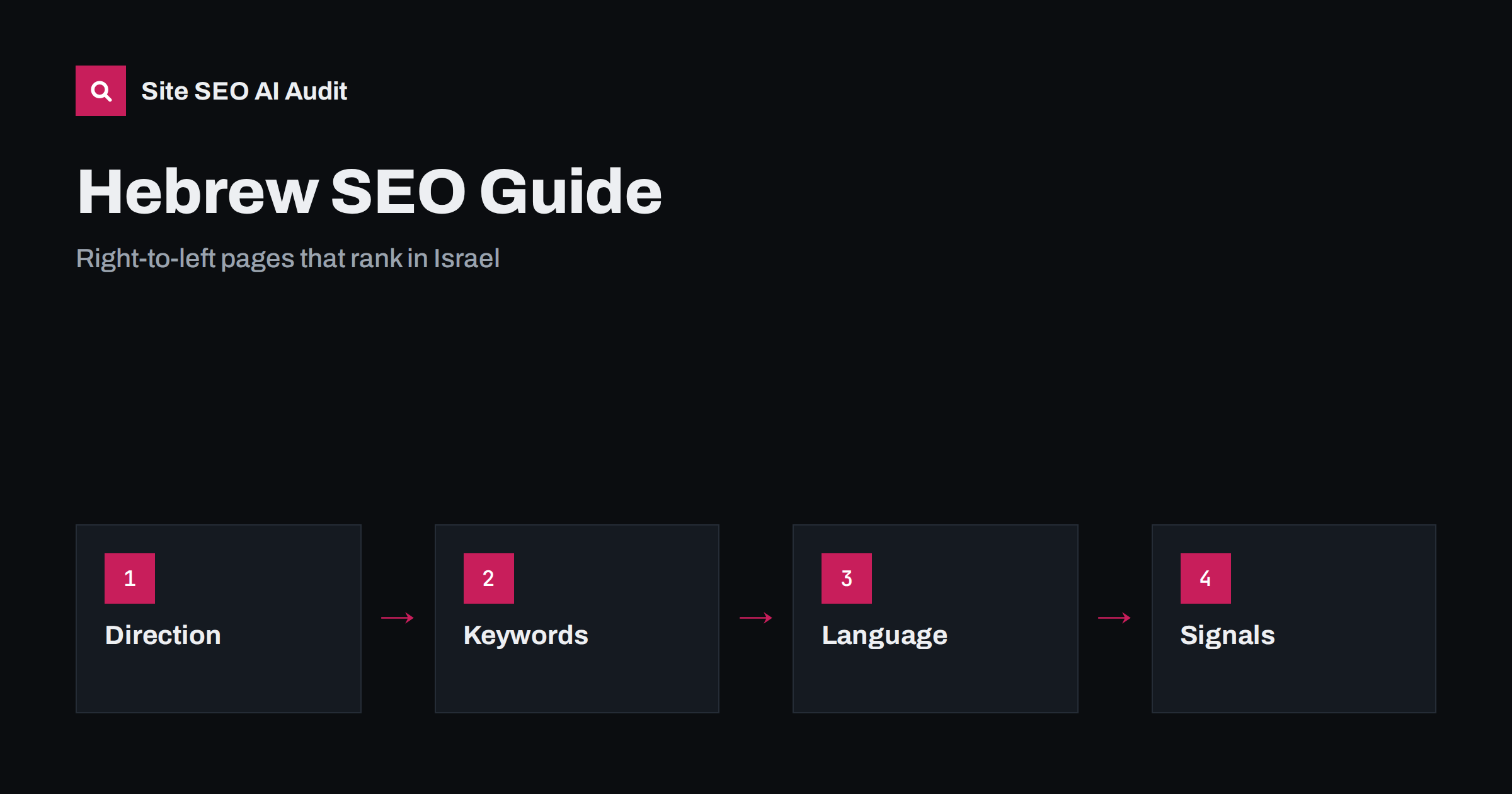
Short answer: To rank in Hebrew you need real Hebrew content written for Israeli readers, a correct right-to-left page structure, the language attribute set to Hebrew, keyword research done in Hebrew rather than translated from English, and hreflang annotations if you also publish other languages. Handle spelling variants and mixed Hebrew and English queries, keep addresses and metadata readable, and test the pages on real devices. Google is the main search engine in Israel, so the standard technical rules apply, with extra care for direction, typography and local relevance.
Hebrew is written from right to left, uses an alphabet without capital letters, often omits vowel marks and is commonly mixed with English product names, brands and technical terms. These features create practical SEO questions: how to build layouts that read naturally, how to research words that appear in several forms and how to signal language and country clearly. This guide covers the main points for a site that targets Israel or Hebrew speakers elsewhere. It builds on the general guidance for right-to-left scripts in SEO for right-to-left languages.
Set up the right-to-left structure correctly
Direction should be defined in the markup and in the style rules, not forced with workarounds. Set the document language to Hebrew with the lang attribute, and set the text direction to right to left on the page or the relevant containers. Use logical layout properties so that margins, padding, alignment and icons flip correctly, and mirror elements whose direction carries meaning, such as arrows, back buttons, progress bars and carousels. Do not mirror logos, photographs, phone numbers or media controls that have a universal convention. Check the attribute rules in the HTML lang attribute guide.
- Test forms, tables and menus, because they often break in mirrored layouts.
- Check that mixed content, such as a Hebrew sentence containing an English brand and a number, displays in the right order.
- Make sure that punctuation does not jump to the wrong end of a line.
- Use fonts that include Hebrew characters with good legibility at small sizes.
- Verify that the page still works with browser zoom and on narrow phones.
Direction is a usability matter first, but pages that are hard to read produce poor engagement, and engagement problems often reflect real quality problems.
Research keywords in Hebrew
Translating an English keyword list word for word rarely matches what Israelis type. Hebrew words change form with gender, number and attached prefixes, such as the equivalents of the, and, to, from or in joined directly to the word. People may type the same idea with or without vowel marks, with different spellings of foreign words and with abbreviations. Search engines handle many such variants, but your content still needs to use the natural forms that readers expect, in headings, titles and body text.
Start research from real queries. Use the suggestions that appear as you type, the related searches at the bottom of results pages, local forums and communities, customer emails and Search Console data once you have impressions. Group queries by intent and map them to pages, using the method in multilingual keyword research. Ask a native speaker to review the list, because a literal translation may sound formal, outdated or unnatural. Check the results page for each phrase, since the competitors and formats may differ from those in your home market.
Spelling variants and mixed-language queries
Hebrew has spelling variants, especially for loanwords and names, and there is a full and a defective spelling of many words. Do not stuff every variant into a page. Choose the standard spelling for headings and titles, and include common alternatives naturally in the text where they help readers, for example in a glossary or an explanatory paragraph. Many Israeli users also search in English or mix both languages, particularly for technology, travel, software and professional terms. Decide for each topic whether the audience expects a Hebrew page, an English page or a Hebrew page with English terms in parentheses. If you serve both groups, use separate pages for each language, as explained in translation vs localisation, rather than mixing everything on one page.
Metadata, URLs and transliteration
Titles and meta descriptions should be written in Hebrew for Hebrew pages, within sensible display limits, and should read naturally from right to left. Check how they appear in results, especially when they contain brand names in Latin letters. For URLs you have two options: Hebrew words in the address, which are valid but are percent-encoded when copied, or transliterated Latin words. Both can work. Choose one pattern, keep addresses short, use hyphens and apply it consistently, following the guidance in translating URL slugs and transliteration and SEO. Make sure shared links display correctly in messaging apps and social platforms, because they are common ways in which people reach pages in Israel.
Signal language and country with hreflang
If your site has several language versions, each page needs hreflang annotations that reference every other version and itself, using the correct codes. The code for Hebrew is he, and you can add a region such as he-IL if you want to target Israel specifically. Note that a legacy code for Hebrew exists in older systems, so use the current standard code and validate your annotations. Add a default version for users whose language is not matched. Keep the annotations consistent in the HTML, headers or sitemap, and make sure the pages return each other’s links. The full method is in the hreflang tags guide, and the common code mistakes are explained in hreflang language codes.
Local relevance and trust
Language alone does not make a page local. Israeli buyers expect prices in shekels where relevant, local delivery and payment options, support in Hebrew, local phone numbers and an address or a clear service area. Show the dates and number formats people use locally, and note that business days follow a different weekly rhythm than in many other countries, so opening hours and delivery estimates should be accurate. Mention holidays and seasonal patterns that influence search demand, as discussed in local seasonality in markets. Local reviews, partnerships and coverage on Israeli websites help both users and search engines to see your relevance. Keep the business name, address and phone number consistent across profiles, particularly if you use LocalBusiness schema.
Translation quality and machine output
Poor Hebrew is easy to spot. Machine translation can be a useful first draft, but it often gets gender, tone and idiom wrong, and it may mishandle mixed Hebrew and English phrases. Have a native editor review everything that ships, and especially headings, calls to action, legal text and product details. Publishing large volumes of unreviewed machine output can harm trust and engagement. If you rely on automatic translation for part of the site, treat it as a draft stage and see the risks in machine translation and SEO. Keep a glossary of approved terms for products, features and brand names so that wording stays consistent across the site.
Measure results in Israel separately
Track the Hebrew pages as their own group so that you can see their progress. In Search Console, filter performance by the country and by the address pattern of the Hebrew section, and compare impressions, clicks, positions and click-through rates over time. Check which queries bring impressions, whether they are in Hebrew, English or both, and which pages receive them. Review the page indexing report for Hebrew addresses that are crawled but not indexed, as these often point to thin or duplicated translations. Allow time, because new language versions typically need weeks to be crawled and evaluated. See international SEO reporting KPIs for a structure that keeps markets comparable without mixing their data.
Technical checks before launch
Use this short checklist for a Hebrew site or section:
- The language attribute is set to Hebrew and the direction is right to left.
- Text uses a Unicode encoding and is stored and served correctly.
- Fonts support Hebrew, load quickly and do not cause layout shifts.
- Titles, descriptions and headings are written in Hebrew and are unique.
- Hreflang annotations are complete and reciprocal.
- The sitemap lists the Hebrew pages and the robots rules do not block them.
- The language switcher links to equivalent pages and can be crawled.
- Forms, search boxes, tables and menus work in right-to-left mode.
- Pages load quickly for visitors in Israel, using a suitable hosting and CDN setup.
Site SEO AI Audit crawls each language version, checks hreflang codes and return links, lang attributes, broken language pages and duplicate titles, and ranks the fixes by the points they add. The first audit of up to 200 pages is free; larger sites can see the pricing page.
Related reading
- Arabic SEO Guide: RTL and the Gulf
- Launching a New Language Version
- Language Switcher SEO
- International SEO Beginner’s Guide
The bottom line
Ranking in Hebrew combines correct right-to-left structure, natural Hebrew written for local readers, keyword research in the language itself, clear language and country signals and genuine local relevance. Test the pages on real devices, have a native speaker review the content and monitor results in Israel separately from your other markets.
FAQ
Which search engine matters most for Hebrew SEO?
Google is the main search engine in Israel, so standard Google guidance applies. Check results in Hebrew on mobile devices, because most browsing happens there.
Should I use Hebrew words in my URLs?
Both Hebrew and transliterated Latin URLs are valid. Choose one pattern, keep it short and consistent and check how links look when they are shared.
What hreflang code should I use for Hebrew?
Use he for the language, or he-IL to target Israel. Add return links on every version and validate the annotations after each release.
Do I need separate pages for Hebrew and English?
Yes, if you serve both audiences. Separate pages in each language with hreflang annotations are clearer for users and search engines than mixed-language pages.
Is machine translation acceptable for a Hebrew site?
It can be a draft, but have a native editor review it. Errors in grammar, gender and tone reduce trust and may hurt engagement.