ENEnglish
 LTLietuviškai
 DEDeutsch
 FRFrançais
 RUРусский
 ESEspañol
 PLPolski
 ITItaliano
 UKУкраїнська
 CSČeština
 PTPortuguês
 JA日本語
 LVLatviešu valoda
 ETEesti
 HUMagyar
 IDBahasa Indonesia
 TRTürkçe
 HIहिन्दी
 ELΕλληνικά
 ARالعربية
 THไทย
 VITiếng Việt
 RORomână
 MSBahasa Melayu
 BNবাংলা
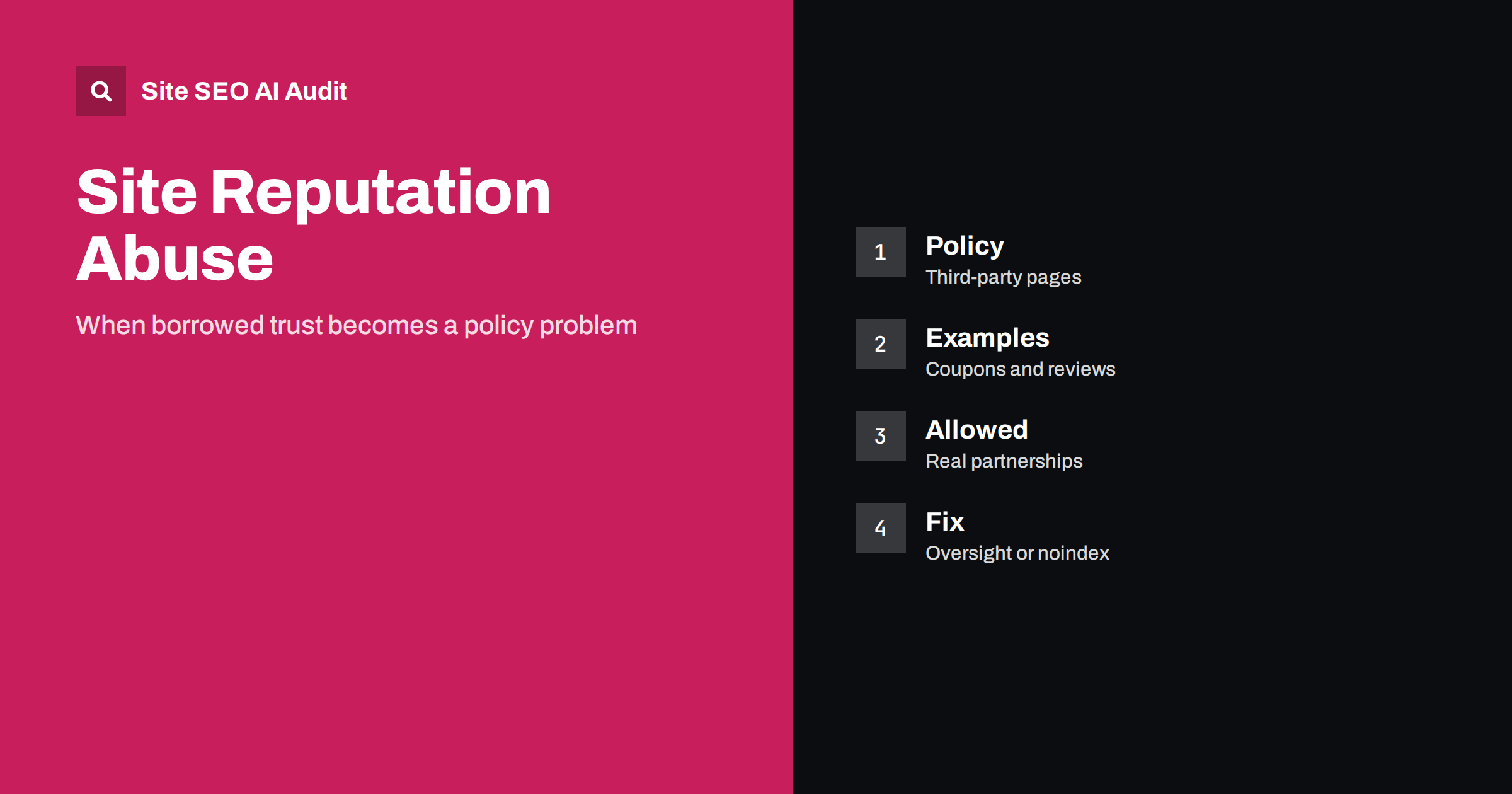
Short answer: Site reputation abuse, sometimes called parasite SEO, is a Google spam policy about third-party content published on a trusted site mainly to take advantage of that site’s ranking signals, with little or no real oversight by the host. Typical cases are coupon, review or finance sections written by an outside company on a news or university site. Genuine partnerships with close editorial involvement and content that serves visitors are different. Hosts that publish such content should review it, mark it or keep it out of search.
Search engines give more trust to sites that have earned it over many years. Newspapers, universities, large directories and well-known brands rank easily because of their reputation, links and history. Some actors saw this as an opportunity: instead of building their own authority, they paid a trusted site to publish pages written by someone else, hoping that the host’s strength would lift the pages. Google responded with a policy that treats this practice as spam. This guide explains the policy in plain words, how to judge your own situation and what to do if you are on either side of such an arrangement. For the wider set of rules, see the guide to Google spam policies.
What the policy says
Google announced the policy in March 2024 and began to enforce it that May. It describes site reputation abuse as the publication of third-party pages on a site with little or no first-party oversight or involvement, where the purpose is to manipulate search rankings by exploiting the host site’s ranking signals. In short: the content comes from someone else, the host did not really supervise it and the point is to borrow rankings.
Google said that it would act through both algorithmic systems and manual actions. Later clarifications explained that the policy applies even when the first party has some involvement, such as editing or a business arrangement, if the main purpose is still to exploit the host’s ranking power. Because details of enforcement and wording can be updated, read the current policy page of Google and treat this article as a summary, not a legal text.
Typical examples
The examples in Google’s own explanation include a section of payday loan reviews on an educational site, a collection of coupon pages on a news site or third-party medical pages on a general site, where the content has no relation to the host’s main subject and is produced by a different company. The common features are a mismatch between the host’s purpose and the content, an outside producer who needs the host’s rankings and a commercial deal behind it.
Other patterns include sections of a university site that are filled with affiliate pages written by an agency, local news pages that are really lead-generation pages for another firm and subfolders of a well-known site rented out to a seller. The earlier idea of a guest post on a related site that shares real expertise is a different thing, though low-quality guest posts have their own risks, as described in the guide to guest posting.
What is not abuse
Many legitimate arrangements are not affected. Google gave examples of content that is not abuse: original content produced by the site itself, even if sponsored, with the host’s oversight; syndicated news content such as agency wire reports that are labelled correctly; user-generated content such as forum posts and comments; and ordinary, well-controlled sponsored content with proper links. A partner section that is in line with the host’s purpose and is truly edited and checked by the host is also different from a rented section. See also the guide to nofollow, sponsored and UGC links.
The test is a mix of purpose and control. Ask: would this content exist on this site if search rankings were not a goal? Does the host have people who understand, edit and take responsibility for it? Does it serve the host’s visitors? If the honest answer is that it is there for the traffic, the risk is high.
If you run a trusted site
Review the sections of your site that were written or run by outside parties. Look for subfolders, subdomains and groups of pages that have a different topic, style or ownership, especially those with commercial arrangements. Check who creates, edits and approves them, and what the agreement says. If the content is of real value to your audience and you control it, document the oversight and keep quality high. If it is mostly a means of using your rankings, remove it, or stop it from being indexed.
Options include removing the pages, using a noindex directive so that they are not shown in search, or blocking them in a way that prevents indexing, with care to apply the method correctly, as in the guide to noindex versus robots.txt. Moving the content to a separate domain owned by the partner is another option, but do not place redirects that pass the signals back to your site. Review old agreements, and put a clear policy on third-party content in your editorial rules.
If you buy placement
If you are the outside party, understand the risk before you pay for pages on someone else’s site. Pages that rely on a host’s reputation may lose their visibility after an update, and the host may be affected too. Ask what oversight the host really provides, whether the content fits the site and whether you would want the pages without ranking benefits. For long-term success, build your own site’s quality and authority, with links and mentions earned from real work, as in the guide to link building basics for small sites.
There are legitimate reasons to appear on a trusted site, such as advertising, partnerships and real expert contributions. Do those things for the audience, with honest labelling, and use nofollow or sponsored attributes on paid links.
Signs that you might be affected
A sudden loss of visibility for a section that depends on a host’s reputation is one sign. For hosts, the signs are a manual action notice in Search Console or a loss in a subfolder that contains partner content. Check the manual actions report, and compare the performance of the suspect section with the rest of the site, as described in the guide to manual actions. Not every drop is a policy issue: updates to ranking systems, technical changes and seasonality can also be the cause, so compare the dates before you decide.
If you receive a manual action, fix the problem fully before you ask for reconsideration: remove or noindex the content and explain what you did and what you changed in the process. Keep the explanation factual and short.
Policy and AI search
AI features in search draw on the same index and often favour sources with a clear identity and relevant expertise. A page that is only there to borrow a reputation is less likely to be a source an assistant can explain or trust. The same principles as in the guide to E-E-A-T and AI search apply: a clear author, a relevant topic and responsibility for the content. A site that keeps its subject coherent and takes responsibility for each section builds more durable authority than one that rents it out.
Questions to ask in contracts and briefs
Before any partnership that places content on your site, write down the answers to a few plain questions. Who writes the content, and who is accountable for its accuracy? Who edits and approves it before publication, and can the host remove it at any time? Does the content fit the host’s subject and audience, and would the host be proud to show it to its own readers? Is the payment tied to rankings or to traffic from search? If the answer to the last question is yes, the arrangement is a warning sign. Include in the contract a right to remove or noindex content, a requirement to label sponsored material and a duty to keep information correct. These are good publishing practices even without a search policy, because they protect readers and the reputation that you have built.
If you are an agency, be honest with clients about this risk. A plan that depends on borrowed trust can disappear overnight, while a plan built on useful pages, real expertise and earned mentions grows steadily.
A practical checklist
List all third-party sections. For each, write down the owner, the topic, the commercial terms, who edits the content and whether it fits your audience. Mark anything without a clear answer for review. Decide to keep, tighten, noindex or remove. Add a policy that new partner content needs editorial approval and a clear fit. Review the list twice a year, and after any change in policy by search engines. Keep records, so that you can explain your decisions if you are asked.
Here is a short example. A regional news site had a subfolder of loan comparison pages written by an affiliate firm, linked from the footer, with no editors involved. Visibility for the section fell after an update, and the site received a notice. The publisher ended the agreement, removed the section, explained the change in a reconsideration request and focused on local reporting, which strengthened the rest of the site.
Site SEO AI Audit crawls your website and reports status codes, noindex, canonical tags, thin and duplicate content, broken links and sitemap issues, which helps you map sections of a large site and find pages that may need review. It does not judge whether content breaches a policy. The first audit of up to 200 pages is free, and larger sites can see the pricing page.
Related reading
The bottom line
Publish third-party content only when you supervise it and it truly serves your visitors.
FAQ
Is all sponsored content a violation?
No. Sponsored content that the host controls and that serves its audience is not the target, and links should be labelled correctly.
Does the policy apply to guest posts?
Not in general. It targets third-party content hosted to borrow ranking signals with little oversight. Low-quality guest posts have other risks.
How can a host fix a problem?
Remove the content, noindex it or move it to a separate site, and document the editorial oversight for anything you keep.
Can I use the same policy words as Google?
Check Google’s current policy page, since wording and examples can change after this article was written.
Does it apply to user-generated content?
Ordinary forum posts and comments are not covered, but hosts should still moderate spam.