ENEnglish
 LTLietuviškai
 DEDeutsch
 FRFrançais
 RUРусский
 ESEspañol
 PLPolski
 ITItaliano
 UKУкраїнська
 CSČeština
 PTPortuguês
 JA日本語
 LVLatviešu valoda
 ETEesti
 HUMagyar
 IDBahasa Indonesia
 TRTürkçe
 HIहिन्दी
 ELΕλληνικά
 ARالعربية
 THไทย
 VITiếng Việt
 RORomână
 MSBahasa Melayu
 BNবাংলা
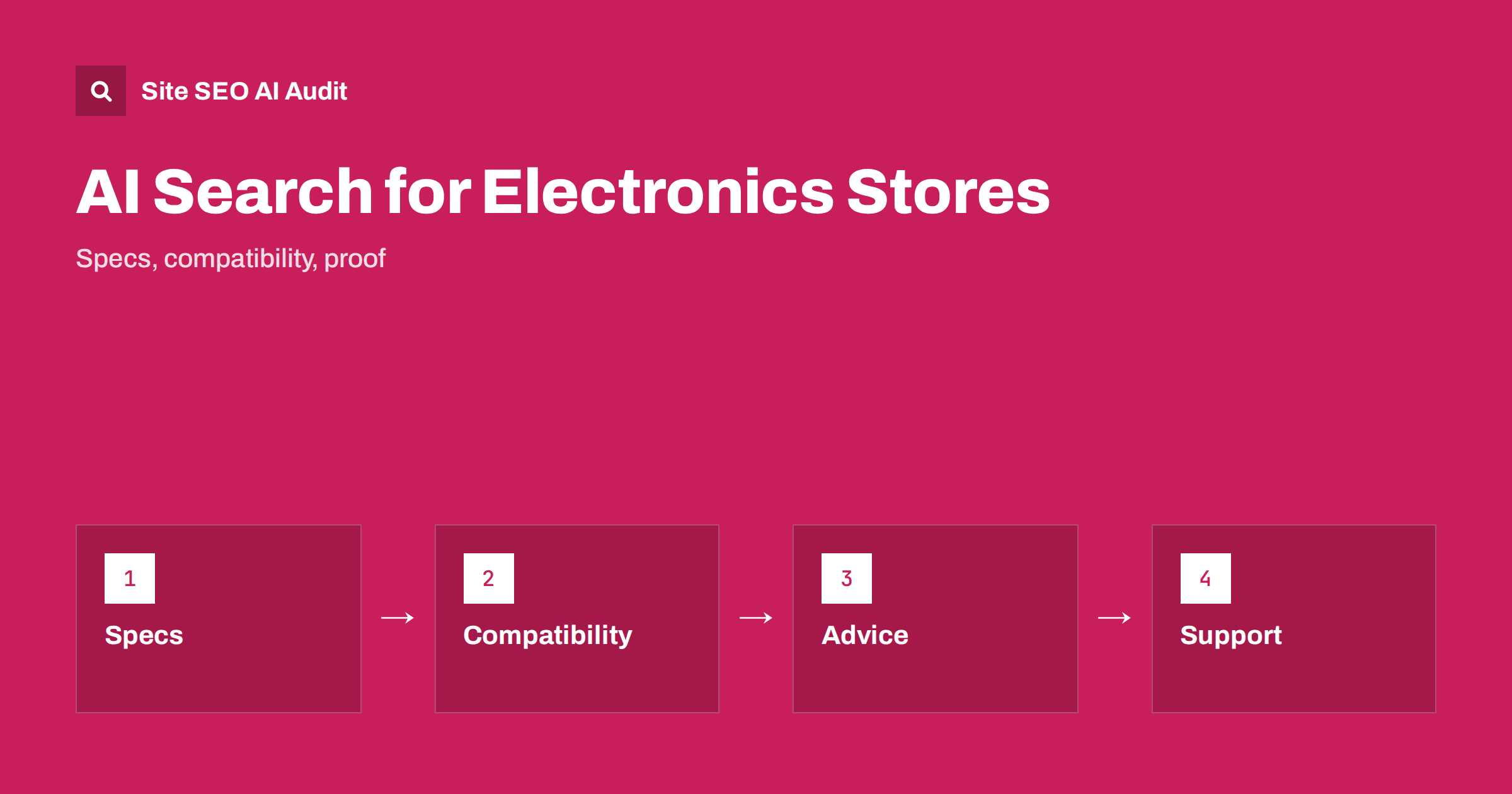
Short answer: Electronics shoppers ask AI assistants detailed questions about models, specifications, compatibility and value, and the assistants favour stores whose pages answer them precisely. To be included, publish complete, accurate specifications in plain text and a consistent order, identify each product with its brand, model number and product codes, explain compatibility with accessories, systems and standards, add product structured data that matches the visible page, write your own comparisons and buying guides based on real testing, show warranty, support and return terms clearly, and collect genuine reviews. Keep prices and stock current, avoid copying manufacturer text word for word, allow the AI crawlers you want in robots.txt and make sure pages work without heavy scripts. Stores that behave like knowledgeable advisers, not catalogue copies, are the ones that get cited.
Electronics is a category where buyers read specifications. They want to know whether a laptop has enough memory for their work, whether a camera lens fits their body, whether a router supports the standard their devices use, or which of two headphones is better for travel. Assistants can answer such questions in seconds, drawing on manufacturers, review sites, forums and shops. A store that only repeats the supplier’s title and a few bullet points gives them little to work with, while a store with clear, structured and tested information becomes a source. This guide covers what electronics and gadget retailers should fix first. It builds on product pages for AI shopping answers and the general AI search visibility checklist.
Identify every product precisely
Many electronics have near-identical names, regional variants and yearly revisions, so ambiguity is the first problem to remove. Show the brand, the full model name, the exact model number, the variant (for example storage size, colour or region) and, where available, global product codes such as GTIN or manufacturer part numbers. Put them in the title or in a visible specification block, and in the structured data. Make sure that the page text, images and price all refer to the same variant. Explain differences between similar models in a short, plain section such as “how this differs from the previous version”. Clear identification lets assistants match your page to the product a shopper has in mind, and avoids recommending the wrong one.
Publish full specifications in text
List the specifications that buyers actually use to decide: dimensions and weight, processor and memory, storage, display size and type, battery capacity and typical use, ports and connectivity standards, supported formats, power requirements, operating system versions and what is included in the box. Use a consistent order across products in the same category so that comparisons are easy for people and machines. Write units clearly, and avoid putting the list in an image or a script-built widget that crawlers may not read. Where a specification could mislead, such as “up to” figures for speed or battery life, say how it was measured or cite the manufacturer. Accuracy matters more than volume, because wrong specifications cause returns and complaints.
Explain compatibility and requirements
Compatibility is the question behind many purchases: will this charger work with my phone, does this case fit my model, is this memory supported by my motherboard, does this speaker pair with my system? Create clear compatibility sections on product and accessory pages, listing supported models, versions, connectors and standards, and note known limitations. For accessories, link to the devices they fit and from device pages to recommended accessories. Keep the data up to date when new models appear. Where relevant, create short guides on standards and connectors in plain language. Such pages answer follow-up questions directly and attract links from forums and support pages, which strengthens your authority.
Add structured data that matches the page
Mark up each product with name, description, images, brand, model, product codes, price, currency, availability, condition and review data where real reviews are displayed. Keep it consistent with the visible page, including price and stock status, and update it automatically from your product database. Validate the output regularly and fix template errors at the source. For product families with many variants, make sure each variant has correct data and does not conflict with the main page. The fields and common errors are described in the product schema guide, and variant handling is covered in product variants and SEO.
Write your own comparisons and buying guides
Assistants answering “which is better” questions look for comparisons, and manufacturers rarely give neutral ones. Publish guides that help people choose within a category: how to pick a laptop for study or video editing, what to look for in a router, how different charger standards work, or which headphones suit commuting. Compare products on measurable criteria, say who each product suits and be honest about drawbacks. Where you have tested the products, state how, with dates and conditions. Original testing, photos and measurements are more valuable than rewritten press releases. Use the structure recommended in comparison pages that AI answers trust and show expertise as in E-E-A-T and AI search.
Consider also adding short answers to the questions that appear most often in your customer chats, such as whether a product includes a charger, how long a battery lasts in everyday use, whether an update is available or how to transfer data from an old device. Put each answer under a descriptive heading on the product page or in a linked guide. Short, direct answers are easy to quote, and they reduce pre-sale support work. Review them each time a new model, software version or standard appears, because outdated technical advice is quickly noticed by buyers and by the systems that summarise sources.
Be clear about warranty, support and returns
Technology purchases involve concerns about faults, repairs and compatibility. Describe the warranty period and what it covers, who handles repairs, how returns work, how long refunds take, and what support you offer after purchase, such as setup help or advice. Link to manufacturer support pages and drivers where useful, and publish your own help articles for common questions. State consumer rights accurately for each market, without adding promises that are not in your terms. Place this information in normal HTML on pages that are easy to find from product pages and the footer. Help content is also quoted by assistants, as explained in help center and documentation pages in AI answers.
Avoid duplicate manufacturer descriptions
Hundreds of shops copy the same supplier descriptions, which gives assistants no reason to choose yours. Keep the manufacturer’s facts but add your own value: a short summary of who the product suits, what is included, how it compares with alternatives, photos of the actual item and any test notes. Rewrite titles so that they are unique and clear. Where you sell many near-identical products, group them sensibly and avoid thin pages for every minor variant. The same issue and its fixes are discussed in manufacturer product descriptions and duplicate content. Keep product images sharp and descriptive, with alt text that says what is shown, and include photos of ports, size comparisons and contents of the box.
Keep prices, stock and crawler access in order
Prices and availability change quickly in this category, and assistants may display or quote outdated data if your pages and feeds disagree. Update prices and stock in the page, the structured data and any product feeds at the same time, and show the date or condition of special offers. Handle discontinued models carefully, redirecting to a successor when one exists, as in out-of-stock and discontinued products. Check that robots.txt and your firewall do not block the crawlers you want, that pages load quickly, and that key content does not depend on scripts that crawlers cannot run; see how to allow or block AI crawlers in robots.txt.
Checklist and audit
- Brand, model number, variant and product codes on every product page.
- Full specifications in text, in a consistent order.
- Compatibility sections and links between devices and accessories.
- Product structured data that matches visible price, stock and reviews.
- Original comparisons, buying guides and test notes.
- Warranty, support and return terms in plain HTML, with current prices and stock.
Site SEO AI Audit crawls your store, flags duplicate titles, missing structured data, heavy pages and blocked AI crawlers, and ranks the fixes by how many points each adds. The first audit of up to 200 pages is free; for larger catalogues see the pricing page.
Related reading
- Product Pages for AI Shopping Answers
- Product Schema Guide
- AI Search for Furniture and Home Decor Stores
- Comparison Pages for AI Search
The bottom line
Electronics buyers want exact information, and assistants reward stores that provide it. Identify products precisely, publish complete specifications and compatibility, back them with structured data, add your own tested advice, make support terms clear and keep prices and access up to date. The result is a store that can be cited with confidence.
FAQ
Which identifiers should I show for electronics?
Show the brand, full model name, exact model number and variant, and add global product codes such as GTIN or manufacturer part numbers in the page and structured data.
Can I reuse the manufacturer’s specifications?
You can use the facts, but add your own summary, comparisons, photos and advice so that your page offers something that other shops do not.
Do compatibility lists really matter?
Yes. Compatibility is a top reason for returns and a frequent question to assistants, so clear lists make your pages more useful and more likely to be cited.
How often should I update prices and stock?
As often as they change, ideally automatically, and in the page, the structured data and the product feed together so that the data agrees.
Should I publish my own product tests?
Where you can do so honestly, yes. Describe the method, date and conditions. Original testing is more valuable than rewritten manufacturer text.