ENEnglish
 LTLietuviškai
 DEDeutsch
 FRFrançais
 RUРусский
 ESEspañol
 PLPolski
 ITItaliano
 UKУкраїнська
 CSČeština
 PTPortuguês
 JA日本語
 LVLatviešu valoda
 ETEesti
 HUMagyar
 IDBahasa Indonesia
 TRTürkçe
 HIहिन्दी
 ELΕλληνικά
 ARالعربية
 THไทย
 VITiếng Việt
 RORomână
 MSBahasa Melayu
 BNবাংলা
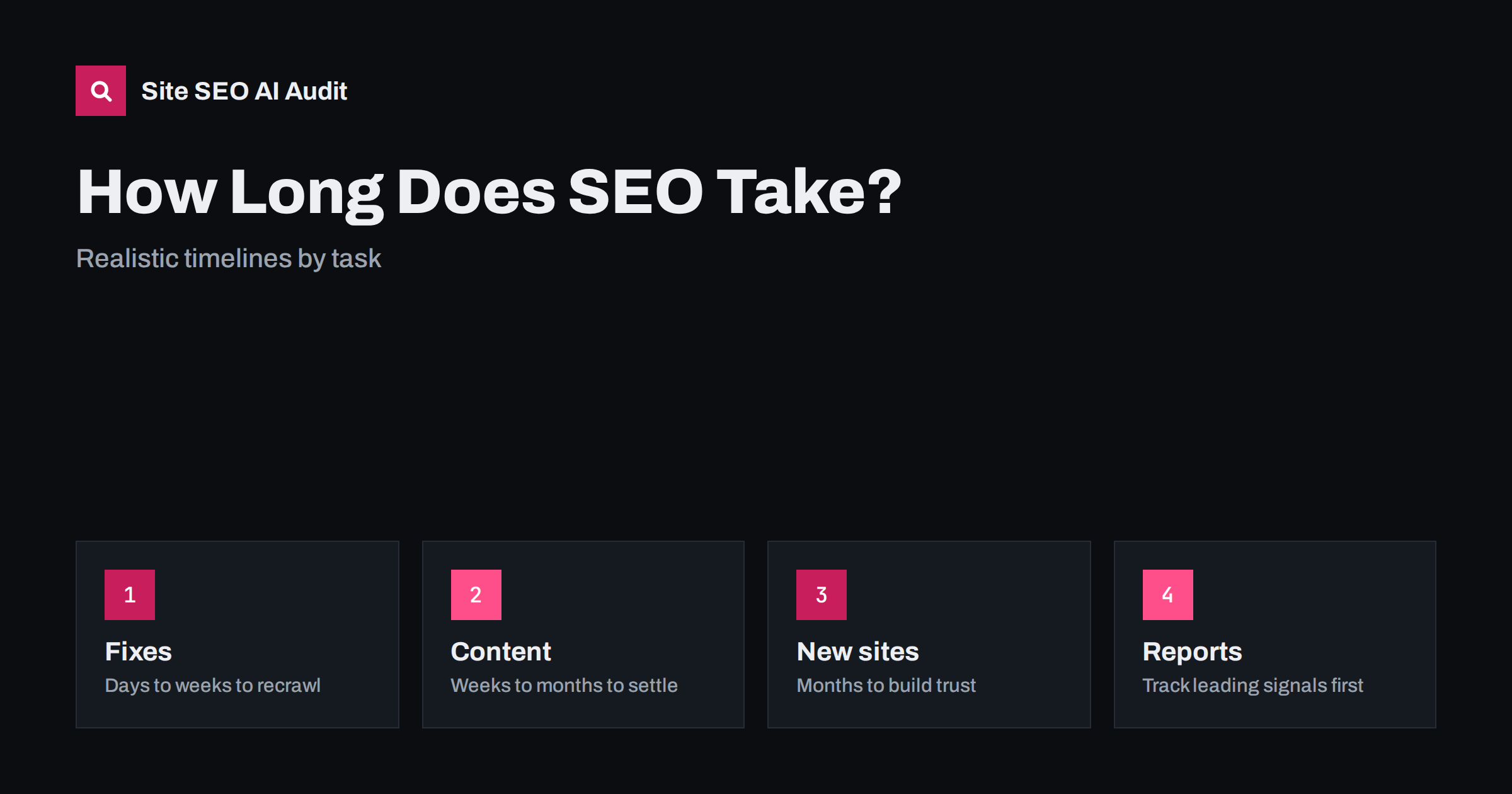
Short answer: There is no single number, because SEO covers tasks with very different timelines. Technical fixes can show effects within days or a few weeks, once search engines have recrawled the affected pages. New or improved content often needs several weeks to months to be indexed, evaluated and to settle in the results. A new website with no history usually needs months to build visibility, and highly competitive topics can take longer or stay out of reach without strong links and brand recognition. Results also depend on site size, crawl frequency, the quality of your pages and what competitors do. Nobody can honestly guarantee a ranking or a date. The practical approach is to set expectations by task, track leading signals such as indexing, impressions and crawl activity, and judge progress over quarters, not days.
Owners and managers naturally want a date: when will the investment pay off? Agencies and tools sometimes answer with a confident range, but ranges that ignore the context mislead. A small local site fixing a noindex tag is not in the same position as a new online shop targeting a crowded keyword. This guide explains what drives the delay between a change and a result, gives realistic orders of magnitude for common tasks, shows how to speed things up responsibly and describes how to report progress to people who want an answer. It complements SEO testing and how to prioritize SEO fixes.
Why SEO results take time
Several steps sit between a change and a visible result. Search engines must discover the change, which depends on how often they crawl your site and how easily they find the page. They must process and index it, which may involve rendering scripts. They then compare it with other pages, using hundreds of signals, many of which, such as links and reputation, change slowly. Finally, results are tested and adjusted over time, and users must see and click your result before behaviour data can accumulate. Each step can take days or weeks, and they overlap. Large authoritative sites tend to be crawled more often than small new ones, so the same fix may show faster on one site than another.
Technical fixes: days to weeks
Removing an accidental noindex, fixing a broken canonical, repairing redirects, correcting robots.txt or restoring a missing sitemap can have the fastest effect, because they remove barriers that were blocking pages. After the fix, search engines must recrawl the pages, which can take from a few days to several weeks depending on the site; requesting indexing for key pages in Search Console may help, and a sitemap with accurate last-modified dates helps discovery. Speed improvements work on their own schedule: lab tools update immediately, while field data in reports reflects a rolling period of real visits, so the full effect appears later. Do not expect every fix to move rankings; many simply prevent losses. Use technical SEO monitoring to confirm that fixes hold.
On-page changes: weeks
Improving titles, descriptions, headings, internal links and content for existing pages usually shows effects after recrawling, in a matter of weeks. Changes in how your result appears, such as a rewritten title that earns more clicks, can show in Search Console within days of being picked up, while ranking changes take longer. Search engines may also rewrite titles and snippets, so the visible result may differ from your edit. Make one group of changes at a time and record the date, so that you can compare clicks and impressions before and after for the affected pages, with the cautions in SEO testing: measuring the effect of a change. Compare equal periods and account for seasonality.
New content: weeks to months
A new article may be discovered and indexed within days on an established site, or take weeks on a small one. After indexing, it often moves around in the results before settling, as search engines gather signals. Pages targeting less competitive, specific questions can gain impressions quickly; pages targeting broad, contested terms may need months, internal links and external mentions. Strengthen new pages by linking to them from relevant existing pages, including them in the sitemap and making them useful from the first day. Track impressions first, then average position, then clicks, because impressions appear before clicks do. See discovered but not indexed and crawled but not indexed if pages stall.
New websites: months
A new domain has no history, few links and no brand searches, so search engines have little evidence to trust it. Early on, expect indexing of the main pages, impressions for very specific queries and slow growth. Over several months, steady publishing, internal structure, genuine mentions and links, and consistent quality build trust. Avoid shortcuts that risk penalties, such as buying links or generating thin pages at scale. Set up Search Console from the start, as in the Search Console setup guide, and use the first period to fix technical foundations and build content around topics where you have real expertise. For AI answers, the equivalent steps are covered in new website, no authority.
Competitive topics and links: longer
For competitive keywords, content and technical quality are the entry ticket, not a guarantee. Rankings may depend on links, brand recognition, user satisfaction and the strength of existing results. Progress can take many months or years, and sometimes the better strategy is to target narrower topics first and build authority from there. Be wary of any provider who promises a first-page ranking by a date. Link building done properly is slow because it depends on earning mentions from other sites; the principles are in link building basics. Meanwhile, measure share of impressions for a group of related queries rather than one keyword.
International and AI search: staged
New language versions follow the same pattern as new sites, but they can benefit from the authority of the main site if they are well linked and correctly marked up. Expect indexing within weeks and growth over months, and monitor by country. AI search visibility is also gradual: assistants rely on indexes, retrieval systems and updated models, so changes in your pages can show up in some answers soon and in others later. Track citations and referrals over time, as explained in how to measure your brand’s visibility in AI answers. The same fundamentals, accessible pages and clear answers, help both channels.
Factors that shorten or lengthen the wait are worth listing. A site that is crawled daily, has a clean structure, loads quickly and already earns links will usually see changes processed sooner. A site with thousands of low-value URLs, slow servers, duplicate pages or frequent errors wastes crawl attention and waits longer, as described in crawl budget explained. Seasonality also matters: a change made just before a quiet period may look ineffective until demand returns. Finally, changes made by competitors, updates to search systems and shifts in how results are displayed can hide or exaggerate the effect of your work, which is why you should compare against similar pages that you did not change.
How to report progress honestly
Agree on leading indicators with stakeholders at the start: pages indexed, errors fixed, impressions, rankings for a group of queries, clicks, conversions and, for AI search, citations. Use three time frames: weekly checks for technical health, monthly reviews for content and visibility, and quarterly reviews for business outcomes. Document what was changed and when, and avoid claiming credit for changes caused by seasonality or campaigns. If progress is slower than hoped, diagnose by stage: is the page indexed, does it get impressions, is the click rate low, or do visitors not convert? Each stage points to a different fix. The reporting approach is similar to that in the Search Console performance report guide.
Checklist and audit
- Set expectations by task: fixes in weeks, content in months, new sites in months to a year.
- Record each change with a date and the pages affected.
- Check indexing and crawl activity before judging rankings.
- Track impressions, clicks and conversions for equal periods.
- Prioritise barriers that block crawling and indexing first.
- Review progress by quarter, not day by day.
Site SEO AI Audit crawls your site and ranks fixes by the points they add, so you can start with the changes that remove barriers first and re-check after each round to see the score move. The first audit of up to 200 pages is free; larger sites can see the pricing page.
Related reading
- How to Prioritize SEO Fixes
- SEO Testing
- How Often Should You Run an SEO Audit?
- New Website, No Authority
The bottom line
SEO takes as long as the slowest step between your change and a result. Technical fixes can show in days or weeks, content in weeks to months, new sites in months and competitive terms longer. Set expectations by task, measure leading indicators, document changes and avoid anyone who guarantees dates. Steady work on the right problems compounds over time.
FAQ
How long until a new page appears in Google?
It can be indexed within days on an established site and take weeks on a new or small one. Internal links and a sitemap help discovery.
Can I speed up results with the URL Inspection tool?
Requesting indexing may speed up discovery of a specific page, but it does not guarantee indexing or rankings. Quality and links still decide.
Why did nothing change after I fixed errors?
The pages may not yet be recrawled, or the errors may not have limited performance. Check crawl dates and indexing, then give the fix time.
Is it normal for rankings to move up and down at first?
Yes. New and changed pages often fluctuate while search engines collect signals. Judge trends over weeks, not single days.
Should I trust anyone who guarantees a ranking date?
No. No one controls search results, so promises of fixed rankings or dates should be treated with caution.