ENEnglish
 LTLietuviškai
 DEDeutsch
 FRFrançais
 RUРусский
 ESEspañol
 PLPolski
 ITItaliano
 UKУкраїнська
 CSČeština
 PTPortuguês
 JA日本語
 LVLatviešu valoda
 ETEesti
 HUMagyar
 IDBahasa Indonesia
 TRTürkçe
 HIहिन्दी
 ELΕλληνικά
 ARالعربية
 THไทย
 VITiếng Việt
 RORomână
 MSBahasa Melayu
 BNবাংলা
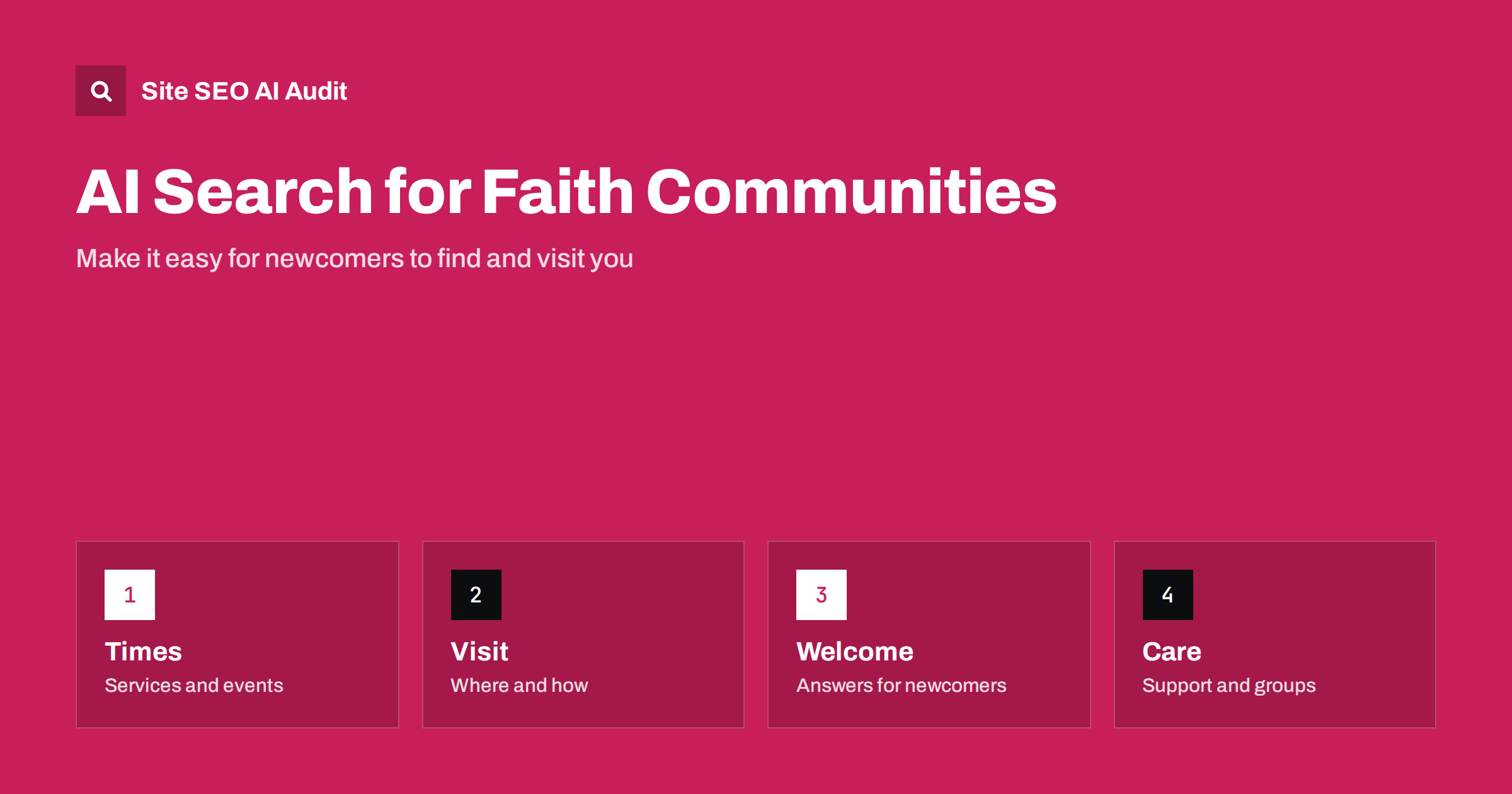
Short answer: People who are new to an area, exploring a faith or looking for support increasingly ask AI assistants where to worship, what a service is like and which community suits them. To be named, a religious organization needs a clear website with accurate service times, address and access details, a welcome page for first-time visitors, plain descriptions of beliefs and practices, current events, contact details and consistent information across maps and directories. Honesty and warmth matter more than clever wording.
A place of worship is first of all a community, and most of its work happens offline. Yet the first contact is more and more digital. A family that has just moved, a student far from home, someone who is curious or in difficulty will often type a question into a search box or ask an assistant, and the answer decides whether they walk through the door. A faith community does not need to chase rankings, but it does need its basic facts to be easy to find, correct and understandable. This guide describes how to do that without losing the character of the community. For the general principles of local visibility, see the guide to local business and AI search.
How people ask
The questions are practical and personal. What time is the Sunday service, or Friday prayer, or Saturday morning service? Is there parking and step-free access? Is there a service in my language? What should I wear, and what happens during the service? Are children welcome, is there a children’s programme? Is there a group for young adults, for older people, for families? How do I arrange a wedding, a baptism, a naming or a funeral? Who can I talk to if I am going through a hard time?
Some questions are about belief and practice: what does this tradition teach, how does it differ from another one, what do the festivals mean. Assistants answer these from many sources. A community that explains itself in its own words, on a clear page, gives the assistant a reliable source and gives the reader the right picture. Use the questions people really ask, as described in the guide to search intent.
Service times, address and access
The most important page is the simplest: when and where. Show the regular times of services and other weekly meetings on the home page and on a dedicated page, with the full address, a map link, parking and public transport information, and details of access for wheelchairs, hearing loops and similar needs. State the language of each service, and whether it is also streamed. Mark exceptions clearly, such as holiday schedules, and remove old notices as soon as they expire.
Wrong times are the most damaging error, because they send a visitor to a closed door. Use one place as the single source of truth and copy the details from it to your maps profile, directories and social profiles. The method is described in the guide to business profile and website alignment. If you share a building with other groups, say so, and explain which entrance to use.
A welcome page for first-time visitors
A newcomer is often nervous. A short page titled something like Visiting for the first time can remove many worries. Explain what to expect in plain words: how long the service lasts, whether there is a dress guideline, whether visitors have to take part in anything, how children are looked after, where to sit, what happens afterwards and whether there is refreshment. Add a few photos of the building and the people, and the name of someone who will greet visitors.
Write in the answer-first style: put the most useful sentence at the top of each section, as explained in the guide to answer-first introductions. Avoid insider vocabulary, or explain it briefly. A page like this is likely to be quoted by assistants when someone asks what it is like to attend, and it gives a human first impression.
Beliefs, practices and leadership
Describe who you are: the tradition or denomination, a short summary of core beliefs, the main practices and festivals, and how the community is organised. Name the leaders and give a short, honest introduction to each, with their role and how to contact them. This is the trust information that helps both readers and assistants decide whether a source is reliable, and it reflects the ideas in the guide to about pages.
Be accurate and respectful when you describe other traditions, and avoid claims you cannot support. If you belong to a larger body, link to it. If you have a public statement on important topics, publish it in a stable place with a date. Questions about faith can be sensitive, and some are in the area described in the guide to sensitive topics in AI search, so keep the tone calm and factual.
Events, calendar and life events
Many people look for a particular event: a festival service, a concert, a food bank, a language class, a youth evening, a community meal. Give each regular activity and each major event its own page with the date, time, place, who it is for, whether registration is needed and who to contact. Use clear event structure, as in the guide to event pages, and keep past events in an archive or remove them if they are not useful.
Also create pages for life events: weddings, baptisms and naming ceremonies, memorial and funeral services, blessings and pastoral visits. Explain the process, the requirements, how far ahead to ask, any fees or donations as they actually apply, and who to speak to. These are moments when people search carefully, and a clear page is a kindness.
Sermons, teaching and media
Recorded services, talks and teaching can reach people far away and can be an excellent source of content. Publish each recording on its own page with a title, date, speaker, a short summary, the main passages or topics and, if possible, a transcript. The approach in the guide to podcast SEO and transcripts applies directly. Embed video carefully, with a text summary beside it, as in the guide to video SEO.
A transcript helps people who cannot listen and gives assistants the words to quote. Respect privacy: do not publish images or names of children or vulnerable people without permission, and check consent for recordings that include congregation members.
Support, groups and community work
Many communities offer support that has nothing to do with services: counselling, bereavement groups, food and clothing help, language lessons, visits to the lonely. These services are often searched for by people who do not belong to the community at all. Describe each one honestly: who can use it, where and when it takes place, whether it is free, how to reach a real person and what the limits are. If you are a registered charity, state it and link to your public registration, as discussed in the guide to AI search for nonprofits.
For clubs and groups inside the community, see the guide to clubs, associations and community groups. If someone could be in danger, add a clear note on emergency services and professional help, and do not suggest that the community replaces them.
Contact, reviews and safeguarding
Show a real contact: a phone number, an email address that someone reads and a form with a clear promise of when to expect an answer. Publish the names of the people responsible for safeguarding, if your organization has them, and your policy in a visible place. See the guide to contact pages. Reviews on maps platforms can help, but do not pressure members to write them. Respond politely to every review, including critical ones, and correct factual errors. The wider picture is in the guide to reviews and reputation.
Use structured data to describe the organization: its name, address, contact details, opening times and social profiles, following the guide to LocalBusiness schema and choosing the most specific type that fits. Markup must match the visible text.
Languages and newcomers
Faith communities often serve people from several countries. If you hold services or run groups in more than one language, create real pages in each, with the times and contact details, and link them together. Avoid mixing languages on one page. The principles are in the guide to multilingual countries. Even a short welcome page in a second language can mean a great deal to someone who has just arrived.
Keep the site simple and fast on a phone, since many visitors check the details on the way. Use readable text sizes, large tap targets and a layout that works without scrolling through long introductions to find the service times.
Here is a short example. A small parish had a site with a large banner, a long history and the service times hidden in a news post from two years earlier. Assistants gave wrong or no times. The parish added a clear page with weekly times, a map, access details and a visiting page for newcomers, and removed the old notices. The curate reported that more first-time visitors mentioned that they had read the page before coming.
A second example is a community centre linked to a mosque that listed its language classes and food help on separate pages with dates, eligibility and contacts. It became the source quoted for local help, which reached people who had never entered the building.
Site SEO AI Audit crawls your website and checks status codes, titles, descriptions, broken links, structured data, page speed and AI visibility settings such as AI crawlers in robots.txt, which helps you keep a small community site healthy. It does not verify your service times or manage your listings. The first audit of up to 200 pages is free, and larger sites can see the pricing page.
Related reading
The bottom line
Publish correct times, a warm welcome page and honest answers, and keep every listing in step with them.
SSS
What is the most important page for a place of worship?
The page with service times, address and access details. Keep it current and copy the same facts to your maps profile and directories.
Should I publish sermons and talks online?
It can help many people. Give each recording its own page with a summary and a transcript, and respect the privacy of people who appear in it.
How do I describe beliefs without being long?
Write a short, plain summary on one page, link to deeper pages and name your wider tradition or body if you belong to one.
Can an assistant give wrong information about us?
Yes. Check what assistants say about your times and address from time to time, and fix the source pages and listings that are wrong.
Do we need structured data?
It is helpful but not essential. Correct visible text comes first, and any markup must match it.